


The Fosi Audio K7 was kindly provided free of charge in exchange for an honest review. I didn’t receive monetary or any other kind of compensation and I don’t use affiliate links. The retail price of the K7 is $199.99 and you can buy it from Fosi Audio online shop.
Fosi Audio
Fosi Audio is an emerging brand that makes various audio devices, from USB DAC dongles to phono stages and power amplifiers. The company aims to produce gear that combines innovative design and premium quality at affordable prices for everyone. Fosi Audio was established back in 2017 and since then they have earned global recognition by both audiophiles and the specialized press. You can read further Fosi Audio reviews here.
Fosi Audio K7
One of their latest products is the Fosi Audio K7, a desktop DAC and headphone amplifier that is made to meet the needs of both audiophiles and gamers alike. The K7 initially launched through Kickstarter and is now available to purchase from Fosi Audio website.
Technical highlights
The Fosi Audio K7 is equipped with the latest AK4493S DAC chip by AKM and a separate XMOS XU208 USB receiver, making it compatible with PC, PS5 Pro, PS5 and Switch, supporting sampling rates up to 384kHz/32bit PCM and DSD256.
The circuit follows a true balanced architecture that utilizes several OPA1612 op-amps to handle low-pass and buffer duties, plus a high performance NJU72315 IC for volume control. The headphone amplifier is made with two TPA6120A2 ICs, one per channel, and a NJW1119A IC is used for bass and treble tone control. Each stage utilizes its own low-noise LDO regulators for clean and stable power supply. The unit is powered by an external 12V DC switching power supply.
Bluetooth connectivity
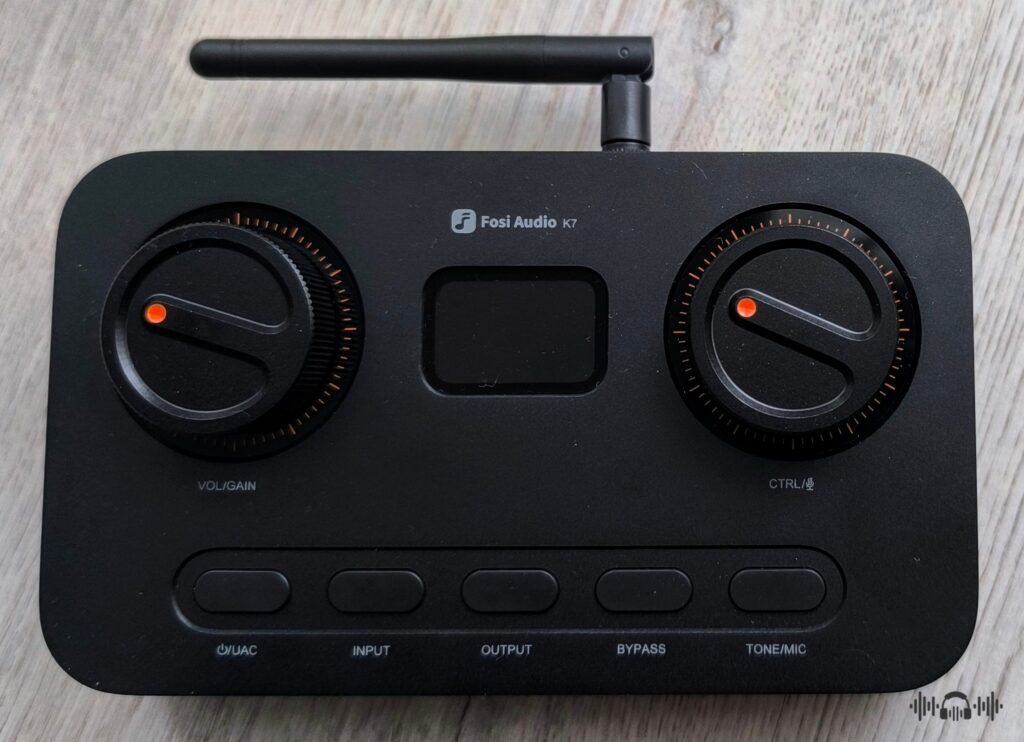
The K7 employs a wireless Qualcomm QCC3031 Bluetooth 5.0 receiver that supports the SBC, AAC, aptX, aptX HD and aptX LL codecs. Latency time is advertised as low as 40 ms but I have noticed some delay during movie watching that should be the same for gaming so you better use a cable connection for such applications.
The K7 will automatically establish a connection with the best available codec and remember the last connected device. The reception is stable and the audio performance good despite the lack of support for the LDAC codec. Wired is always better but the ease of use is sometimes enough to justify some differences in sound quality.
Design and build quality
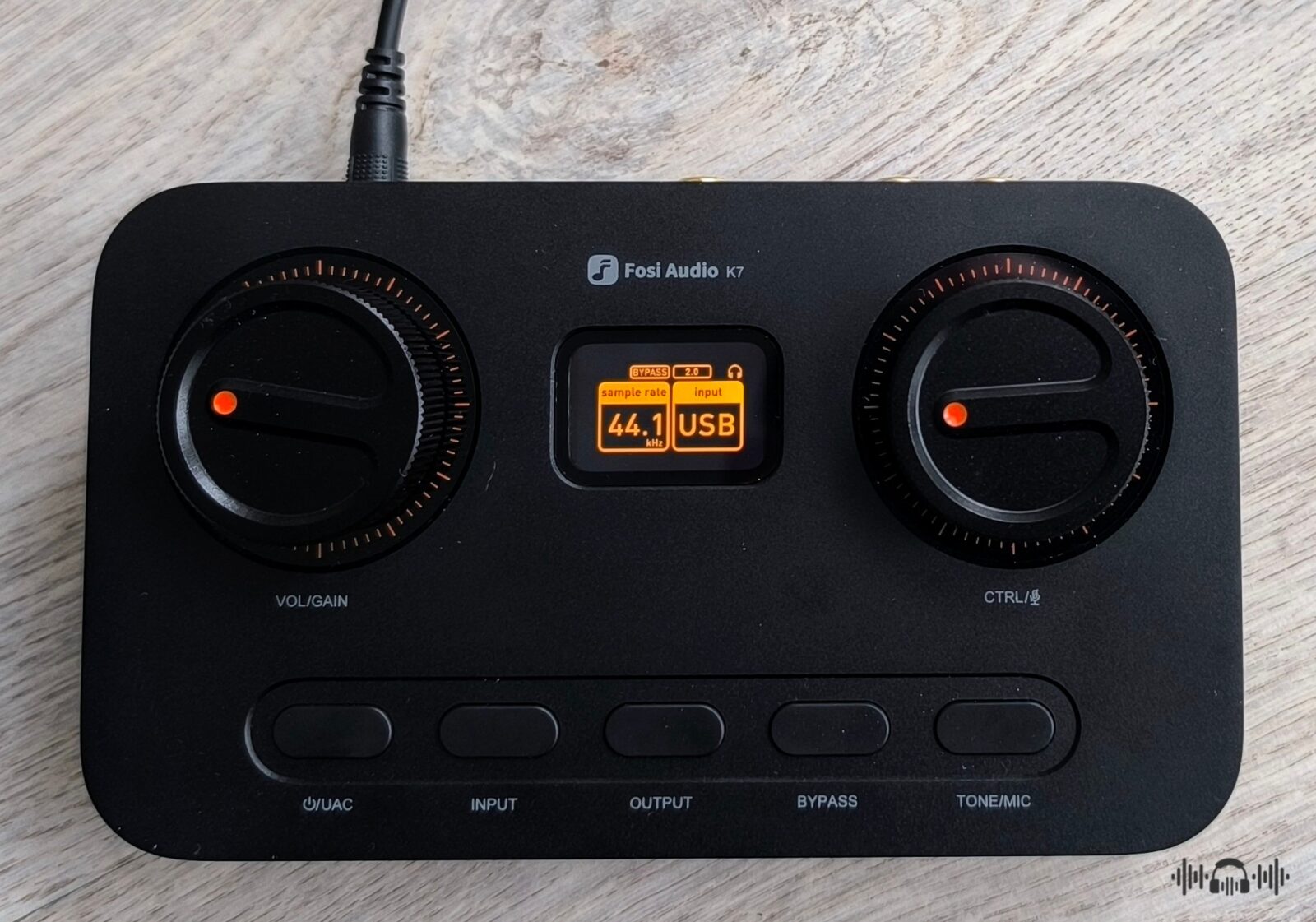
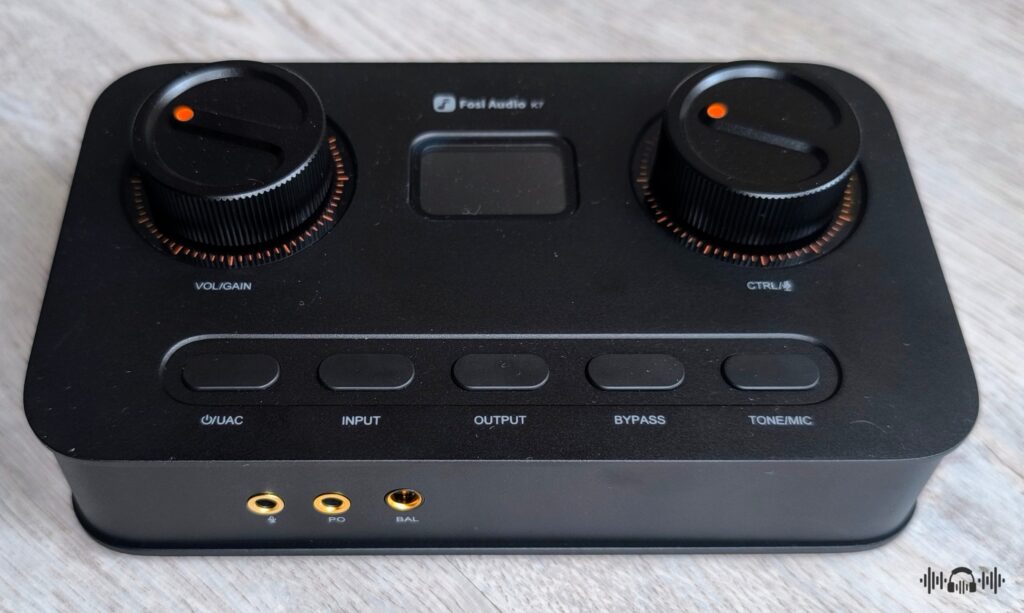
The K7 has a plain industrial design that reminds more of studio pro gear than a fancy gaming machine. The compact sized chassis has a slightly angled tilt that makes it ergonomic to use and is made from CNC machined aluminium alloy in a matte black finish.
The device has two rotary knobs and five buttons that are also made from aluminum. They have good feedback but they wobble a little and make clicking noises during use. Other than that, the K7 feels solid and exceptionally well made.
Connectivity and user interface
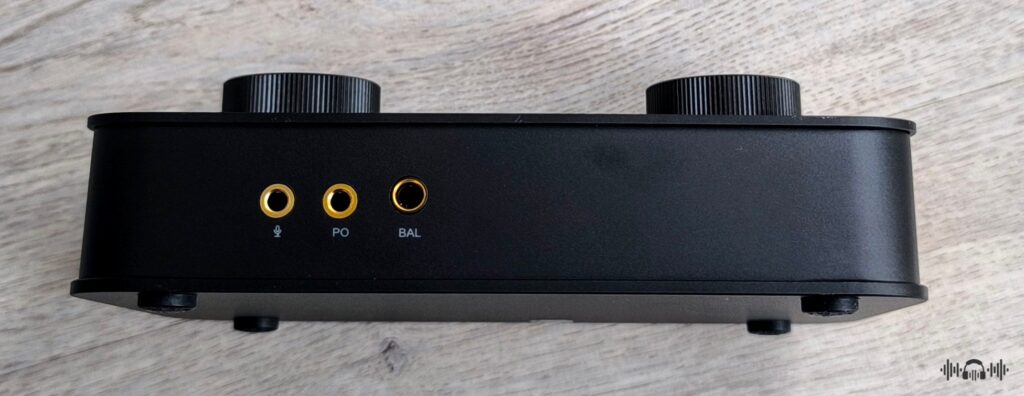
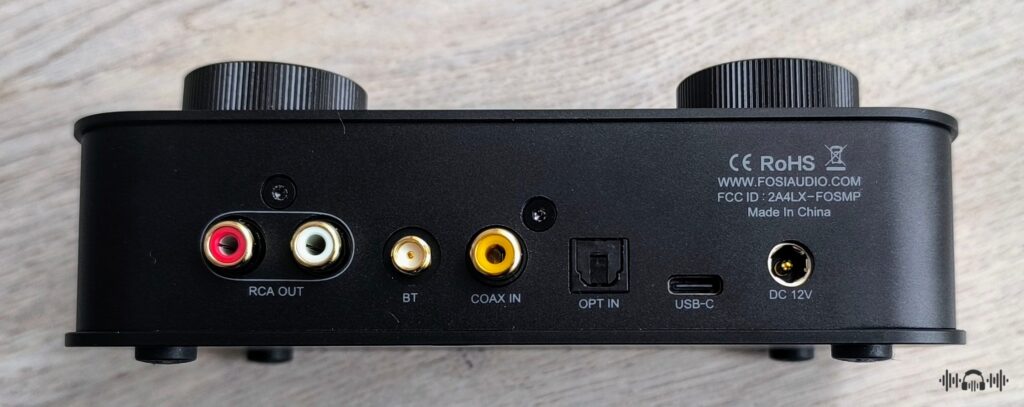
Except for the Bluetooth connection the K7 supports USB type-C, coaxial and optical digital inputs. It is also equipped with a 3.5mm microphone input that has intelligent noise reduction and adjustable level, a very useful feature for gamers and online meetings. The microphone can only be used in USB UAC1.0 mode.
The sound is delivered through two headphone outputs at the front (4.4mm balanced and 3.5mm single-ended) and an RCA stereo output at the back. The line level is adjustable and maxes out at 2V. The tone controls are effective for both the headphone and line outputs that are independently selectable but have a shared volume level. As an example, when the line output level is set to max, reverting back to headphone listening, the volume will remain maxed so there is the risk of blowing your headphones if you are not careful enough.
The K7 has two multifunction knobs, five buttons and is equipped with a 1.5” monochrome LCD screen that displays useful information at a glance. The left knob is used to adjust the volume and toggle between low and high gain with a single press. The right knob is for bass/treble and microphone volume adjustment while a single press mutes/unmutes the microphone. You can toggle the right knob’s functionality between tone control and microphone level adjustment by pressing the far right button. The selection is displayed on the LCD screen. Short or long press the first left button to power on/off the device and use the same button to switch between UAC1.0 and UAC2.0 modes. The next one is to select the input method (USB, coaxial, optical and Bluetooth) and the last one is for selecting between headphone or RCA output.
Accessories
The package includes a 12V external power supply, a Bluetooth antenna, a USB type-C to C cable with a type A adapter and a 3.5mm headphone splitter cable.
Power output and noise
The rated power of the Fosi Audio K7 is 2100mW*2/32Ω from the balanced output and 600mW*2/32Ω from the single ended. The output impedance is not specified. You can switch between high and low gain with a single press of the left knob. The selection is momentarily displayed on the screen but there is no permanent sign so you can’t know the gain at a glance.
The K7 has plenty of power to run most headphones on the market while it is very silent for use with sensitive earphones. The volume adjustment has some kind of glitch, I don’t know if it is accidental or intended. The volume level goes like this: 18-21-24-26-28-30-32-33-36-38-40 and not in defined increments as someone would have expected.
I have tested the Fosi Audio K7 with various headphones and earphones, like the HIFIMAN Sundara and the FiiO FH19.
Listening impressions
The K7 has a monitor-like studio tuning that aims for the best possible measured performance and transparency. The sound is crystal clear and precise with exceptionally low background noise and excellent fidelity. The frequency response is ruler flat without deviations from linearity. The sound of the K7 is characterized by outstanding precision and deep detail retrieval without sounding too analytical.
The technical performance is very strong, the bass is tight and controlled with class-leading definition and a layering that excels for the category. It is impactful and physically impressive with wide dynamic contrasts. The mid-range is resolving, crystal clean and articulated while the treble is extended, swift and energetic. The soundstage is mostly flat without too much depth layering but it is wide and spacious with excellent positioning accuracy and imaging for the category.
However, the music is presented in a flat and rather uninspiring way, the K7 is a little lifeless and clinical sounding. The textures are lean and dry throughout the whole frequency range and somewhat lacking in weight and flesh. The tonality is convincing but the timbre is without any significant harmonic saturation and not devoid of some digital artificiality.
The treble is close to brightness, the mid-range could use some more lushness and the bass needs elasticity. It seems that the voicing is strictly academic, the K7 is made to sound more correct and scientific rather than emotionally engaging or musically expressive. Of course you can always fine tune the frequency response of the bass and the treble but the tone controls are not going to alter the overall qualitative characteristics of the sound.
Gaming performance
The Fosi Audio K7 is advertised as suitable for gaming but the truth is that the only gaming extras are the tone controls and the adjustable microphone input. The K7, unlike other gaming DAC/amps like the Creative Sound Blaster G8, doesn’t support any special gaming software, user adjustable EQ or Dolby Audio surround sound. However the microphone input is an advantage that makes the K7 a better option for gaming than other similar devices like the FiiO K7.
Vs the competition
Fosi Audio has not reinvented the wheel with the K7. There are a lot of competitive devices in the same price range, each one with its own advantages and disadvantages. As an example, the Sound Blaster G8 ($149.99) has dedicated gaming software, dual USB inputs for mixing, HDMI ARC input and Dolby surround sound but on the other hand, it is not as powerful as the Fosi Audio K7 and is a bit noisy with sensitive earphones.
Another option is the FiiO K7 BT ($249). This one doesn’t have a microphone input, OLED display or tone controls, however it is as powerful as the Fosi Audio K7, it has an extra line input and a tuning that is a little more natural and engaging. There are numerous other examples by brands like SMSL or Topping that are too many to mention. There is no good or bad device but only the right one for you that suits your needs in the best possible way.
In the end
The Fosi Audio K7 is yet another all-in-one DAC/amp that tries to earn its place among the vast competition. And the truth is that it can stand its own ground because it has a couple of hidden aces under its sleeve. The K7 is highly recommended for anyone looking for crystalline clarity, maximum transparency and plenty of power with a very low noise floor. Additionally, the tone controls and the handy microphone input are two extra features that add greater versatility and can make the K7 more appealing than the competition.
Copyright – Petros Laskis 2025.
+ Neutral and uncolored sound signature
+ Excellent transparency and fidelity for the category
+ High definition and crystalline clarity
+ Wide soundstage with good imaging
+ Plenty of features and connectivity options
+ Powerful headphone amplifier
+ Exceptionally low noise floor
+ Microphone input with independent volume adjustment
+ Tone controls with bypass mode
+ Handy OLED screen and mute button
+ Ease of use with dedicated buttons
+ Good Bluetooth performance
+ Compact, sturdy and very well made

- Rather clinical and sterile timbre
- Slightly lifeless and uninspiring sound
- Not much gaming features like dedicated software
- The mic is only supported in UAC1.0 mode
- Volume adjustment glitch
- The buttons are a little loose
- The headphone and line outputs share the same volume level






Leave a comment