


The Questyle CMA18 Portable was kindly provided free of charge in exchange for an honest review. I didn’t receive monetary or any other kind of compensation and I don’t use affiliate links. The price of the Questyle CMA18 Portable is 799$ and you can buy it from the Questyle official store.
Questyle Audio
Questyle Audio specializes in the development of advanced lossless audio systems that offer impeccable sound quality and a seamless listening experience. They offer a wide range of products, system solutions, and key components tailored to meet the specific requirements of their customers. One of their notable achievements is the implementation of the Current Mode Amplification topology, which utilizes current rather than voltage to amplify audio signals. This innovative approach sets Questyle Audio apart and contributes to their reputation in the industry.
Questyle CMA18 Portable
Questyle Audio has a range of successful products such as the CMA15 and CMA18 desktop DAC/amps, as well as the portable M15i USB DAC. The recently launched CMA18 Portable aims to close the gap by delivering top-tier performance in a portable form factor.

Technical highlights
The XMOS XU316 USB receiver, in conjunction with the AK4493 DAC chip, enables D/A conversion up to 768kHz/32bit and DSD512. Incorporating four sets of patented PCT-class current-mode SiP modules, the Questyle CMA18 Portable delivers a peak power of up to 5W and peak current of 2A. With two gain settings and advanced current-mode amplifier technology, it guarantees exceptional performance and versatility.
As an MFi certified device, the CMA18 Portable embraces the era of mobile true-lossless audio with Apple. It offers compatibility with USB-A, USB-C, and Lightning interfaces, making it suitable for use with smartphones and PCs. Moreover, it supports various operating systems including Linux, iOS, macOS, HarmonyOS, Android, and Windows. With input sampling rates of up to 768kHz/32bit PCM and native DSD512 support, it ensures high-quality audio reproduction across different platforms.
Wireless Bluetooth reception mode
The CMA18 Portable’s Bluetooth mode is compatible with both aptX HD and LDAC, high-resolution codecs, guaranteeing top-notch wireless sound quality. Pairing is a breeze and quick once you opt for the Bluetooth input by holding down the source button. The connection remains steady without any interruptions, and the performance is as good as the LDAC codec allows. While USB decoding may offer superior audio quality, wireless audio remains a strong contender and convenient when a cable is not an option.
ADC Recording Function
The Questyle CMA18 Portable features a unique analog input recording function with two stereo line-in inputs (3.5mm AUX IN and 4.4mm BAL IN). These inputs can be connected to various audio equipment with line-out analog outputs such as turntable systems, pre-amps, and mixing consoles. Once connected, the CMA18 Portable can serve as an external, high-performance analog-to-digital (ADC) recording device for either input. Additionally, users can monitor the input in real-time through the 3.5mm or 4.4mm outputs. It is important to note that this monitoring function does not act as a true analog amplifier, as the audio signal heard through headphones is post-ADC conversion.
How to use the recording function
When the CMA18 Portable is switched to either AUX IN or BAL IN mode and linked through USB to a host device (such as a phone, tablet, or computer) that allows recording via USB, both the USB connection and REC indicator lights will illuminate, indicating that the recording feature is active. The process is straightforward and there are no specific prerequisites for recording software as long as it is compatible with recording through an external USB sound card or audio interface.
Appearance and build quality
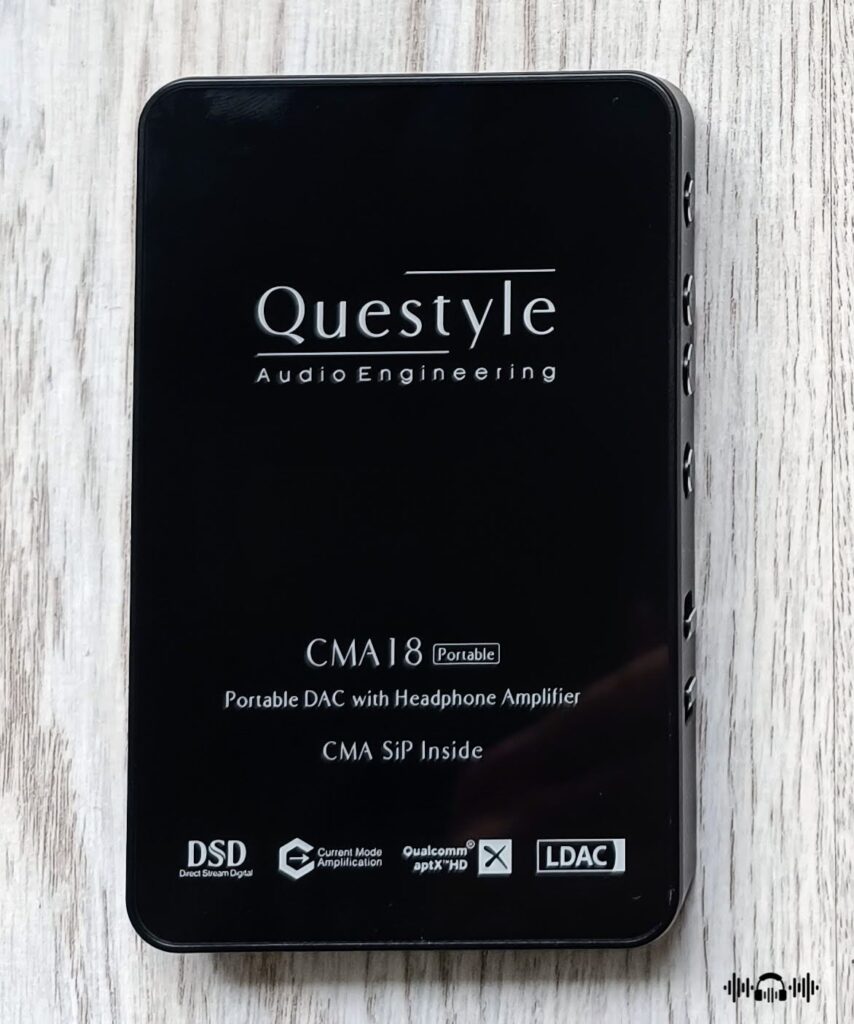
The CMA18 Portable features a chassis with a rectangular shape, elegantly rounded corners, and sleek edges. Measuring at 10.5 x 6.6 x 1.3cm and weighing 160g, this device is slim, compact, and pocket-friendly, allowing for easy one-handed operation. Unlike a dongle, it cannot hang out from your phone, but you can conveniently place it under the back of the phone or leave it on a desk.
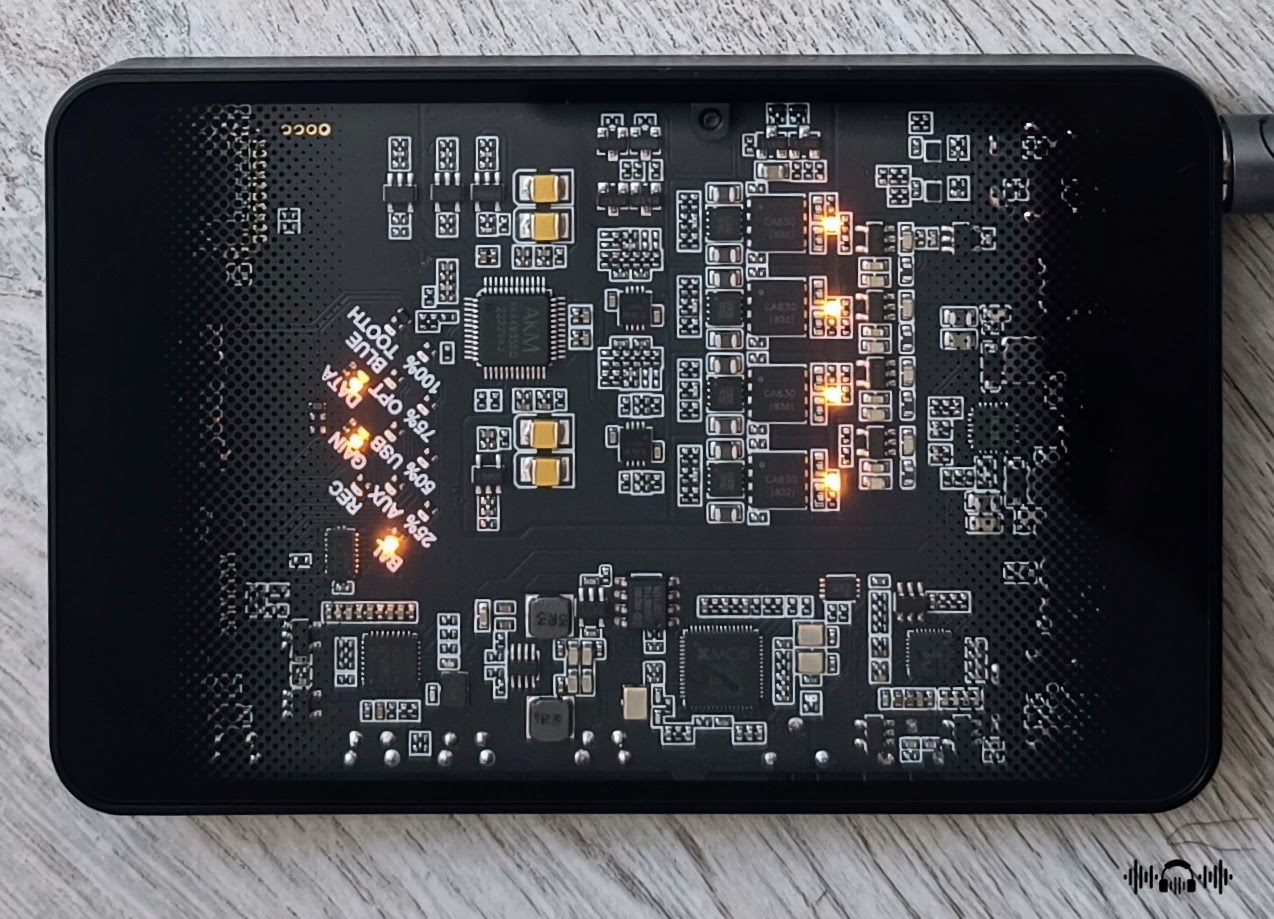
Crafted from sandblasted aviation-grade aluminum, the chassis of the device exudes elegance with its silver high-gloss buttons and side panels. The front face showcases a custom corning glass, offering a glimpse into the internal board and the amber-colored notification LEDs. Additionally, it boasts a gradient dot pattern and an extra RF signal suppressing coating. The back is further enhanced with corning glass, beautifully accentuating the Questyle logos.
The CMA18 Portable has a chic and unique design that effectively blends luxury with sleek simplicity. However the glass back may become slippery on specific surfaces, and the absence of a protective case necessitates cautious handling to prevent potential damage of the glass panels.
Operating the CMA18 Portable
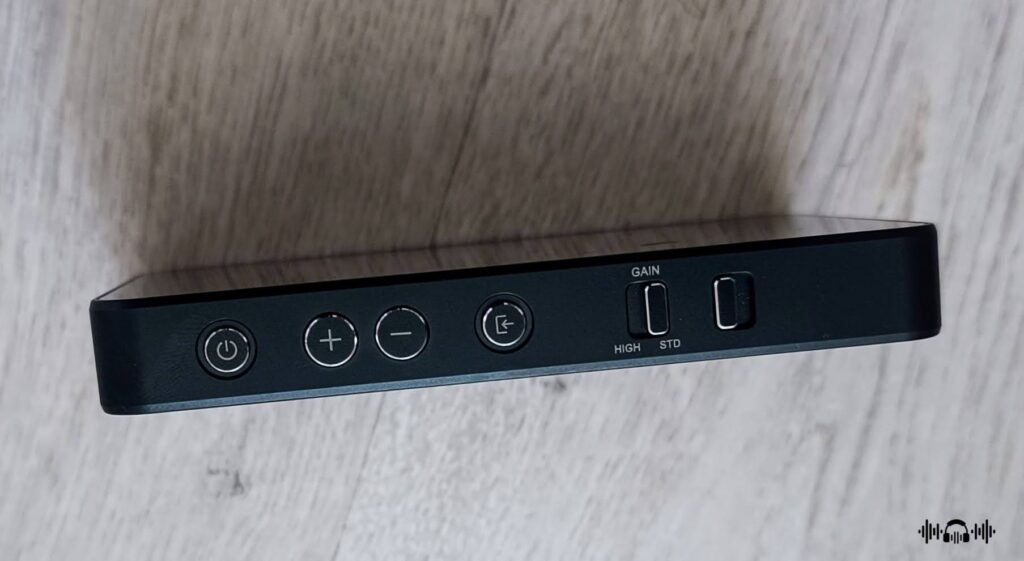
The operation of the CMA18 Portable is a straightforward process. All control buttons and switches are conveniently located on the left side of the chassis, while the input/output interfaces are situated at the bottom. Upon powering on the device, you can easily select your desired source using the input selector button (4.4mm Balanced Analog in, 3.5mm Analog in, optical, USB, and Bluetooth). You have the option to listen through balanced or single-ended wired headphones and earphones, with a gain switch to adjust between high and low settings based on the load.
Volume control is achieved through two buttons, allowing for both single-step and continuous adjustments. Additionally, the hold switch can be utilized to lock the device and prevent accidental actions. Please note that the CMA18 Portable does not support further customization through an application and lacks features such as an equalizer or digital filters.

The LED notification system
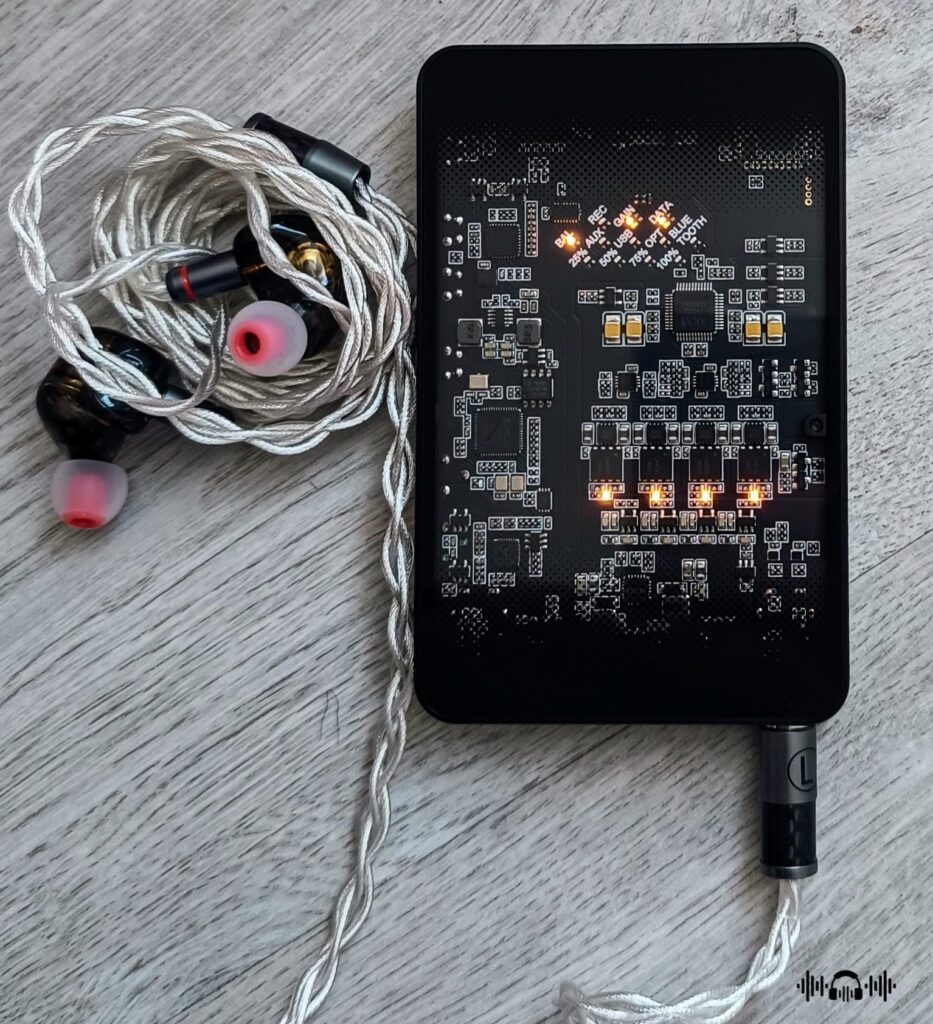
The device features a unique LED notification system that displays current working status and other useful information. On the upper part of the front face, there are three parallel rows of LEDs. The first row consists of three status indicator LEDs, which display the REC function (red), Gain high or low (red or amber), and input Data rate (red for high and amber for standard resolution). The second row contains five source indicator LEDs: Balanced, AUX, USB, OPT, and Bluetooth. The third row features the Battery/Volume indicator LEDs, with a total of four LEDs representing %25, %50, %70, and %100.
When the device is turned off and charging, the LEDs will indicate the level of charge. When the device is turned on, the LEDs will show the volume level. By briefly pressing the power button, the remaining battery level will be instantly displayed. Battery level is not very accurately displayed and is not to be trusted %100.
The CMA18 Portable features an additional row of four LEDs located at the bottom of the front face. These LEDs indicate the number of SiP modules currently in operation, with two LEDs for single-ended output and four LEDs for balanced output. Additionally, there is a single LED on the bottom left side that displays the USB connection status. However, too many active LEDs without the option to dim or turn them off gives the CMA18 Portable a resemblance to a Christmas tree. Moreover, the lettering surrounding the LEDs is hardly discernible, requiring users to memorize the displayed information.
Battery duration
The device operates on its own 4300mAh battery, ensuring that it does not drain the host device’s battery and remains isolated from any electrical interference. However, it should be noted that the battery does not support fast charging and requires approximately 3.5 hours for a complete charge. Questyle claims a running time of around 10 hours, but in my experience, I have never achieved more than 6-7 hours when using the balanced output at low gain with high-resolution content and Bluetooth turned off.
Unlike the FiiO Q15, the CMA18 Portable does not offer a desktop mode to bypass the battery, but you can charge and play at the same time. To manually enable “Charge and Play” mode when connected to a USB playback device, long press the Function Button for approximately 4 seconds. The battery indicator lights will illuminate and flash, indicating the CMA18 is charging, and audio playback will continue uninterrupted.
Accessories
The bundle comprises of Lighting to USB type-C, type-C to C OTG cables, an extended type-C to C charging cable, a type-A to C adapter, and a 3.5mm to optical connector. The documentation consists of a quick start guide and the warranty card. Additionally, customers have the option to purchase a leather protective case for an additional cost of $49.

Power output with comparisons
The CMA18 Portable outputs an impressive 1Wpc/32Ω with 2A peak current from its balanced output, making it a powerful option for a portable, battery-operated device. In comparison, the Chord Mojo 2 offers 600mWpc/32Ω (single ended), while the bulkier FiiO Q7 provides 1.5Wpc/32Ω that doubles to 3Wpc/32Ω with an external power supply. Of course, the FiiO Q7 is considerably larger and heavier than the CMA18 Portable and requires an external power adapter to achieve its maximum power output. On the other hand, the more compact FiiO Q15 only needs a phone charger to enable desktop mode, offering 1Wpc/32Ω with the internal battery and 1.6Wpc/32Ω with desktop mode enabled. While both devices share the same power output under battery mode, the Q15 performs better with the power adapter. However, the Questyle CMA18 Portable stands out as a slimmer, lighter, and more pocket-friendly option.
Headphones matching
The Questyle CMA18 Portable demonstrates exceptional skill in driving a wide range of headphones, although it may struggle with particularly challenging ones. Throughout testing, headphones such as the Meze Liric 2, Focal Clear Mg, and HIFIMAN Arya Organic performed flawlessly with the CMA18 Portable, showcasing great dynamics and ample headroom. While the device is compatible with high impedance headphones like the Sennheiser HD660S2, its true strength lies in driving lower impedance loads, delivering significantly more current than its competitors.
Noise floor
The CMA18 Portable has an impressively low noise floor, although it is not entirely devoid of hissing. When paired with highly sensitive earphones such as the FiiO FX15 and the Soundz Avant, faint background noise can be detected, although with all other loads it remains completely silent. It is worth noting that the Questyle CMA18 Portable offers a darker background compared to the Chord Mojo 2, yet it does not reach the same level of absolute silence as the FiiO Q7.
To ensure optimal transparency during the review I used Lavricables’ headphone and earphone cables. As per usual practice the CMA18 Portable was left playing music for about 100 hours before listening evaluation.

Listening impressions
The CMA18 Portable offers an exceptional sonic performance that truly stands out from the competition. Questyle’s promise of desktop-like performance is fully realized with the CMA18 Portable, effectively bridging the gap between the Questyle M15i and their flagship desktop models. Featuring Questyle’s signature blend of neutrality and warmth, this portable device delivers a more musical and organic sound compared to other Questyle products. The AKM DAC chip paired with the current amplification modules creates a harmonious combination, resulting in an engaging, full-bodied sound with strong technical capabilities and transparency.
The bass on the Questyle CMA18 Portable is not only visceral and weighty, but also fast, tight, and controlled, offering exceptional clarity and definition. Its dynamic behavior and physical impact are more akin to a desktop amp rather than a battery-powered one. When paired with a transducer that stays within its power limits, you can expect a powerful and thundering bass performance that will truly elevate your headphone listening experience, making them sound like a pair of high-quality speakers.
The middle range is harmonious and melodic as long as transparent and precise. It combines colorful harmonies and rich overtones to create a melodious sound that captivates the listener and excels at effortlessly reproducing the authenticity of musical instruments and vocals, preserving their natural timbre with impeccable realism.
More listening impressions
The upper range is extended, crystal clear, and luminous offering a detailed and refined sound without being harsh or tiring. The level of detail retrieval is impressive, yet the overall presentation remains musical and engaging, avoiding a cold or lifeless sound. The timbre is natural and free from any metallic coloration, with only occasional hints of digital glare that are more a result of the recording than the DAC. The CMA18 Portable delivers a sound that is organic and rich, with full-bodied textures that are not thin or artificial.
The CMA18 Portable excels in creating a spacious and expanded soundstage that adds speaker-like qualities to your headphones. It provides a wide and immersive soundscape with impressive depth, precise imaging, and rich ambient details. When paired with high-quality headphones, such as the Meze Liric 2, it becomes an exceptional choice for enjoying large scale classical.
Vs the Chord Mojo 2
The Chord Mojo 2, priced at around $600-650, is widely recognized as one of the top battery-powered, portable USB DAC/amps in the market. It features a well-crafted design that sets it apart, although its user interface may take some getting used to. In terms of connectivity, it provides USB, coaxial, and optical digital inputs, along with two single-ended headphone outputs that can be utilized simultaneously. While it lacks Bluetooth connectivity, the Chord Poly can be purchased separately to add Bluetooth and WiFi server reception capabilities. Additionally, it features a transparent (lossless) digital signal processing EQ and crossfeed functions, allowing for an enhanced audio experience. Furthermore, it allows for simultaneous charging and playback. On the other hand, the CMA18 Portable offers a more user-friendly interface, delivers higher power output with a cleaner audio background, supports ADC recording functionality, and is more compact in size.

In relation to sound characteristics, there is some similarity between them, the Mojo 2 is identified as a neutral and exceptionally clear audio device that has a touch of warmth and doesn’t lack in musicality and naturalness of timbre. However, when directly compared, the Questyle CMA18 Portable delivers a more relaxed and naturally flowing sound with some enhanced realism and more organic tone. The Mojo 2 offers greater transparency between the two, showcasing more intricate details and an improved sense of precision. Additionally, it demonstrates slightly superior imaging but lacks the same holographic and immersive quality found in the CMA18 Portable.
In the end
The Questyle CMA18 Portable may come with a higher price tag compared to its competitors, however, it more than makes up for it with its truly exceptional sound performance, many features, impeccable craftsmanship, and sleek design. If you’re in search of a compact, yet powerful battery-powered USB DAC/amp that delivers exceptional sound quality, the Questyle CMA18 Portable is right up your alley.
Copyright – Petros Laskis 2024.
+ Exceptional audio quality
+ Excellent technicalities and transparency
+ Natural and organic timbre
+ Resolving and refined
+ Musical and engaging
+ Holographic and immersive soundstage
+ Plenty of inputs and outputs
+ High resolution Bluetooth connectivity
+ Powerful enough for the size
+ ADC recording function
+ User friendly interface
+ Compact sized and slim
+ Can charge and play at the same time
+ Unique appearance
+ Excellent build quality
+ Accessories

- Too many LEDs that can't be dimmed or switched off
- Average battery duration
- Doesn't support desktop mode
- No application for further customisation
- A protective case is not included
- Slight hiss with very sensitive earphones
- Glass surfaces easy to break









Leave a comment