


The Gustard DAC-R26 review sample was arranged as a loan in cooperation with Audiophonics. The price of the Gustard DAC R26 is €1790 and you can order it from Audiophonics.

GUSTARD DAC-R26 Review
The Gustard DAC-R26 stands out as the company’s inaugural DAC to incorporate an R2R architecture, featuring discrete components of exceptional quality that have been meticulously optimized to deliver outstanding sound performance. This DAC utilizes two arrays, one for each channel, in a fully balanced configuration, while also providing RCA outputs for added convenience.
Alongside the standard digital inputs, including AES and I2S, the R26 boasts Bluetooth 5.0 with LDAC and aptX HD, as well as network connectivity, enabling remote control of your music playback. All of these impressive features are housed within a sleek, modern, and luxurious chassis. Furthermore, the Gustard DAC-R26 offers support for an external 10 Mhz clock, further enhancing its versatility and performance capabilities.

Further information and full technical specifications are available here.
Build quality and appearance
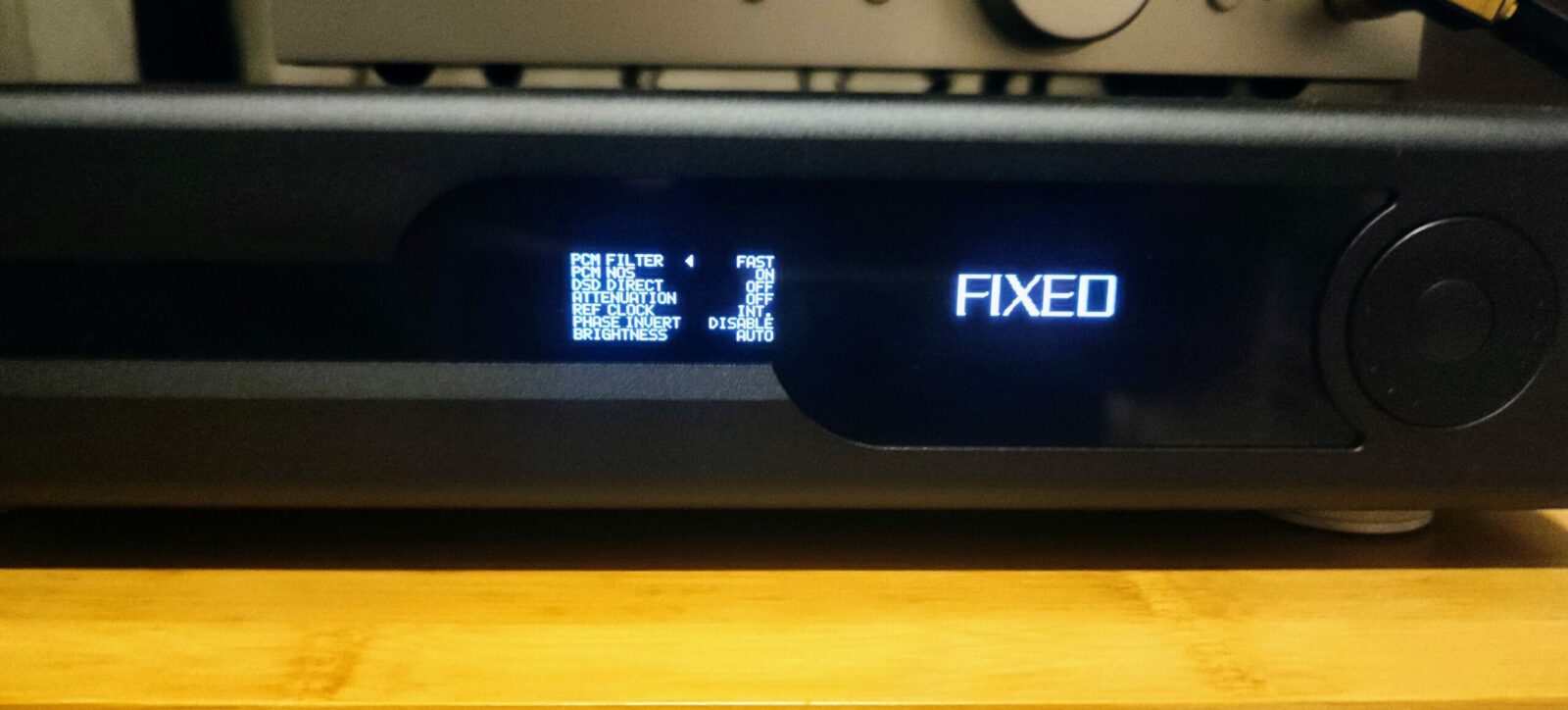
The R26’s frame is crafted from aluminum using CNC machine processing, resulting in a sleek, satin black appearance. Positioned at the center of the front face, a monochrome OLED screen serves as a display for the configuration menu and other pertinent details. However, it should be noted that reading the screen from a distance greater than 20-30 cm requires keen eyesight.
The build quality of the Gustard DAC-R26 is exceptional, boasting a flawless construction without any sharp corners or rough edges. Additionally, its contemporary design ensures it will seamlessly blend into any rack setup, enhancing its overall aesthetic appeal.

User interface and connectivity
The R26 is equipped with the standard digital inputs such as optical, coaxial, and USB, along with the less common AES and I2S via HDMI. Additionally, it offers high definition Bluetooth connectivity and LAN input, allowing you to utilize the built-in streamer. Despite already having high-quality internal oscillators, the R26 also provides an external 10 MHz clock input. Furthermore, it offers both balanced and unbalanced analogue outputs, which can be simultaneously connected without compromising the sound quality.

The configuration of the menu can be done in two ways. Firstly, you can use the multifunction rotary knob located on the right side of the faceplate. Alternatively, you can utilize the included remote control for a more convenient setup process.
The Gustard DAC-R26 functions as a preamplifier and offers adjustable volume control. You have the option to maximize the volume for a full-scale output.
Furthermore, you have the ability to choose from various custom PCM reconstruction filters such as fast, mid, and slow. Alternatively, you can bypass these filters by selecting the NOS (non oversampling) function. This function not only bypasses the filters but also sets the output volume level to a fixed position, effectively bypassing the preamplifier.
Additionally, the R26 provides options for DSD, attenuation, phase, brightness, and external clock adjustments.

The streamer
The embedded streamer is a compact computer board that operates on a customized Gustard OS, rather than a more commonly used OS like Volumio. To stream audio, you have the option to utilize the Bubble UpnP application, AirPlay, or Roon bridge.
My experience with the LAN streamer was a bit of a mixed bag. Occasionally, I encountered interruptions and buffering problems when streaming high-resolution files. However, for the most part, it remained quite stable. The sound quality is decent, although it doesn’t quite match up to the standards set by other digital inputs when paired with a top-notch streamer like the Musical Fidelity MX Stream or the iFi Neo Stream.
Therefore, if possible, I would recommend utilizing the other digital inputs along with a high-quality transport to fully maximize the sonic performance of the Gustard DAC-R26. However, if budget constraints prevent you from doing so, fret not, as you can still enjoy excellent sound quality right from the start.
Associated gear
The majority of the listening sessions took place in a specially designed room with acoustic treatment, utilizing a two-channel speaker system. Specifically, the audio physic Spark speakers were powered by the Kinki EX-M1 integrated amplifier.
When it came to headphone listening, I primarily relied on the Violectric V380² and Schiit Lyr+ amplifiers paired with the Focal Clear Mg, HIFIMAN Arya Stealth, and Meze Elite headphones.
To enhance the audio experience, I utilized pure silver headphone cables crafted by Lavricables.
Furthermore, the Gustard DAC-R26 underwent a burn-in period of approximately 250 hours, and I have been actively listening for over a month.
Listening impressions
Upon my initial listening experience with the Gustard DAC-R26, I was pleasantly surprised by the positive outcome. From the very beginning, it was evident that I was dealing with something truly exceptional.
The R26 is an incredibly musical DAC, delivering a natural and organic timbre with rich and vibrant overtones. While it possesses a slight warmth and analogue sound, it does not veer into the realm of being overly romantic or tubey. Instead, it strikes the perfect balance between musicality and technical prowess.
This DAC exhibits impressive speed and precision, offering crystal clear transparency and impactful dynamics. It effortlessly extends to both ends of the frequency spectrum, while maintaining a smooth and natural tonality in the treble region. It excels in detail retrieval and resolution, without crossing into analytical territory. The fidelity and linearity it provides are truly excellent.
The Gustard DAC-R26 boasts an almost inaudible noise floor, remaining dead silent and free from any hint of distortion. I have no doubt that it would perform exceptionally well in test bench measurements.
Moving on to the bass, it is fast, precise, and exhibits exemplary layering. It is tight and controlled, with contrasting and authoritative dynamics. The rise and fall times are swift, yet not rushed, resulting in a lively and impactful bass response that avoids becoming fatiguing and aggressive. While it may not possess the same visceral and full-bodied texture as the Denafrips Pontus, it still maintains a weighty presence and avoids sounding lean.
Both the mid-range and treble are presented with a remarkable sense of timbre realism. There is an absence of digital glare and perceived artificiality. Despite this, the R26 manages to maintain an airy, crisp, lively, and sparkling presentation. It excels in fast transient response and expressive articulation. The time decay is relaxed and consistent across the entire frequency range, allowing instruments to fade away naturally and enhancing the overall sense of realism.
The Gustard DAC-R26 is not tuned to impress with exaggerated bass, overblown mids, or sharp and forward treble. Instead, its focus lies in converting digital signals into streams of music that sound incredibly real. It creates a lasting and engaging experience for the listener, rather than relying on momentary thrills.

In the end
To put it succinctly, the Gustard DAC-R26 stands out as a highly musical DAC within its category, offering a remarkable sense of realism and natural timbre while it manages to maintain an impressively competitive level of technicalities. Furthermore, its exceptional build quality, wide range of digital inputs, and integrated streamer make it an obvious choice for those seeking a reliable and top-notch audio experience. Without a doubt, the Gustard DAC-R26 is a recommendation that can be blindly trusted.
Copyright – Petros Laskis 2022.
+ Musical sounding and engaging
+ Natural and lifelike timbre
+ Technicalities and transparency
+ Extremely low noise and distortion
+ Dynamic and impactful
+ No digital glare and artificiality
+ Many digital inputs
+ LAN streamer
+ Compact size
+ Build quality
+ Remote control

- Soundstage is not that holographic
- Streamer software
- The LCD screen is very difficult to read









Leave a comment