



The Cayin N3Ultra was kindly provided free of charge in exchange for an honest review. I didn’t receive monetary or any other kind of compensation and I don’t use affiliate links. The price of the Cayin N3Ultra is $529 and you can buy it from here.
Cayin N3Ultra
In August 2020, Cayin introduced the N3Pro, the first digital audio player (DAP) in the world to feature a pair of NOS vacuum tubes JAN6418 from Raytheon. Fast forward three and a half years, the N3Ultra is unveiled as an upgraded version of the N3Pro, still offering triple timbres (solid state and dual tube) at a very competitive price point. The N3Ultra stands as Cayin’s most budget-friendly player, providing an economical means to experience tube sound through a DAP.

Technical highlights
Cayin has equipped the N3Ultra with two Raytheon JAN6418 military-grade miniature direct-heated pentode NOS vacuum tubes. This device offers three user switchable modes: Classic Tube, Modern Tube, and Solid-State. In contrast to the N3Pro, all outputs of the N3Ultra, such as the 4.4mm balanced, 3.5mm single-ended, and line outputs, are compatible with both vacuum tube and solid-state timbres. The vacuum tubes are strategically positioned within a shock-absorbing frame developed in-house by Cayin, providing a suspension effect for optimal protection and minimal microphonic noise.
The Cayin N3Ultra features dual AKM 4493S DAC chips in mono mode setup to ensure fully differential output, along with a JRC NJW1195A analog volume controller. Each of the 32-bit DAC chips is utilized in mono mode, dedicated to one channel. By employing separate DAC chips with well-engineered amp sections, the device effectively reduces crosstalk, elevates the output quality with improved dynamic range, and maintains low distortion levels. This device is compatible with high-resolution 32-bit/768kHz PCM signals as well as native DSD512 audio signals.
Version 1: The N3Ultra is capable of delivering a maximum output power of 600mW through its balanced 4.4mm headphone output. Unlike the N3Pro, where the tube output power was almost half of the solid-state output, the N3Ultra maintains equal output power for both tube and transistor timbres. The JAN6418 is a single-channel tube, with one tube dedicated to handling only one audio channel, making the 4.4mm balanced headphone and line output balanced driven, although the circuit from DAC to LPF to amplification is not fully balanced. On the other hand, the transistor timbre maintains a fully balanced process throughout.
You can read everything about the Cayin N3Ultra here.
No wireless connectivity for a reason
The JAN6418 and other classic vacuum tubes (in contrast to the KORG Nutube 6P1), exhibit low susceptibility to wireless signal interference. When these tubes are in proximity to antennas or wireless devices, users might detect a noise resembling a “sizzling” sound in their headphones, significantly impacting the audio quality and transforming the meticulously crafted tube sound into a possible drawback.
The Cayin N3Pro came with OTA wireless updating and bidirectional Bluetooth/Wi-Fi music transfer capabilities, which required internal antennas. Several users mentioned experiencing noise while listening to music with vacuum tube timbre selected, and this issue was commonly resolved by advising them to disable the wireless function. Thus, Cayin has opted to remove the antenna from the N3Ultra, meaning that Bluetooth, WiFi, and online streaming capabilities are not available. The main focus for Cayin has been on the application and design of the vacuum tube audio, a crucial element of the N3Ultra.
This DAP does not come with a WiFi antenna, so individuals who do not engage in local file playback will need to link it to a PC or smartphone to utilize their preferred streaming platforms. Personally, I have moved away from file playback for quite some time now, which is why I view the Cayin N3Ultra more as a portable, battery-operated, USB DAC rather than a DAP. I simply connect it to a specialized streamer or laptop to enjoy listening to the N3Ultra.

Appearance and build quality
The Cayin N3Ultra has a rectangular chassis that is crafted from sand blasted, CNC machined aluminum featuring a sleek black finish. While the design may be considered somewhat ordinary and conservative, the golden buttons and volume wheel add a touch of elegance. The back panel is strengthened with glass, and the chassis edges are gently rounded for a comfortable grip. The build quality and finish of this device are undeniably outstanding.
The primary design element of the N3Ultra is the pair of the laser-drilled tube windows mounted on the side of the chassis. These are not the actual tubes glowing, instead they house two purposefully added LEDs that create a visually appealing warm glow, particularly in low light settings. Whether it’s the tubes or LEDs, what matters most is achieving a stunning and beautiful effect.
The Cayin N3Ultra, at a weight of only 240g and dimensions of 125×65.5×19.5mm, is slightly larger than the N3Pro yet remains compact and lightweight. This makes it ideal for one-handed operation and convenient everyday carry. Additionally, it is more portable than many other DAPs that lack internal tubes.

Hardware and software
As of writing this review, the Cayin N3Ultra was updated to the latest v1.3 firmware. Firmware updates can only be performed through the SD card.
The Cayin N3 Ultra is a puristic DAP that runs on Android 8.1 with optimizations for touch display and charging management. It features a closed, pure audio system design for its UI, dedicated solely to music playback. The device lacks internal storage but supports external TF cards and bidirectional USB DAC functionality, as well as coaxial SPDIF output through a special adapter. Its functions are limited to local music playback through TF card or OTG storage and USB DAC function. Additionally, the N3 Ultra can scan both SD card and external OTG drive content and integrate them into the same music library.
The Qualcomm 425 processor with 2GB of RAM powers the N3Ultra, which features a 4.1” HD 720×1280 TFT-LCD screen. While the display may not be very vibrant, it offers smooth touch operation and supports double tap to wake. The platform is quick and responsive, allowing for fast scanning of large capacity SD cards and lag-free access to libraries. Users can browse using folders or tags, and cover art is displayed during playback. The device also supports a global search function for album, artist, and music genre contents in the scanned music library. Despite the slightly underwhelming hardware and Android version, the closed OS platform means that the lack of third-party applications will guarantee smooth operation throughout the lifecycle of the product.
Operation
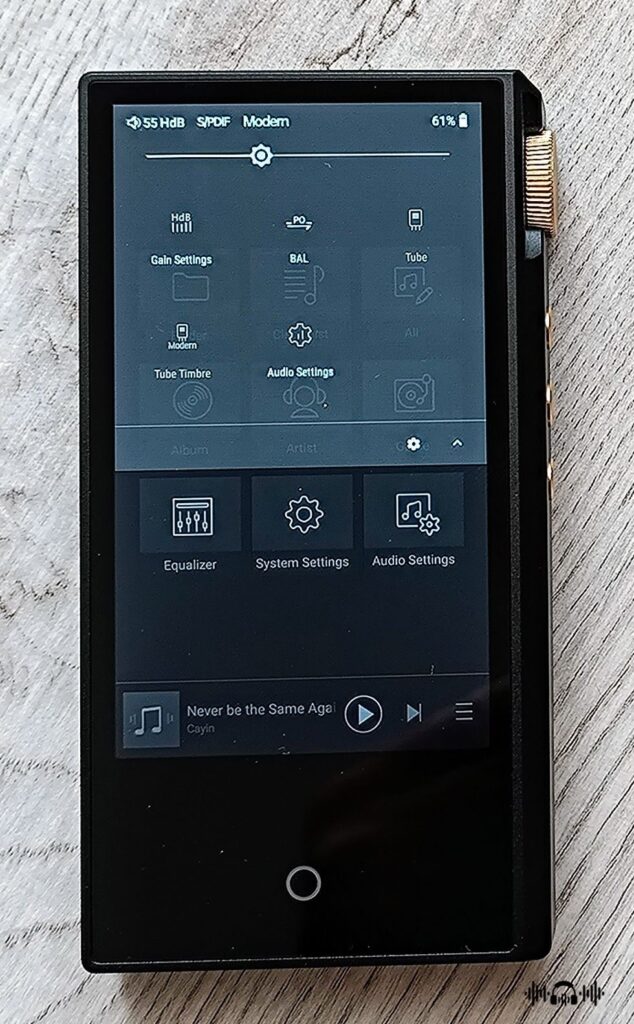
The N3Ultra provides a wide range of customization options for audio settings, including PCM and DSD filters, gain, line out level, DSD gain compensation, channel balance, and maximum volume limit. Users can also adjust standard Android system settings such as display, font size, and lock screen button configuration. The main screen features useful menu shortcuts, and the drop-down bar allows for quick access to functions like timbre selection and gain adjustment. Navigation is fast, smooth, and user-friendly, with support for gesture controls.
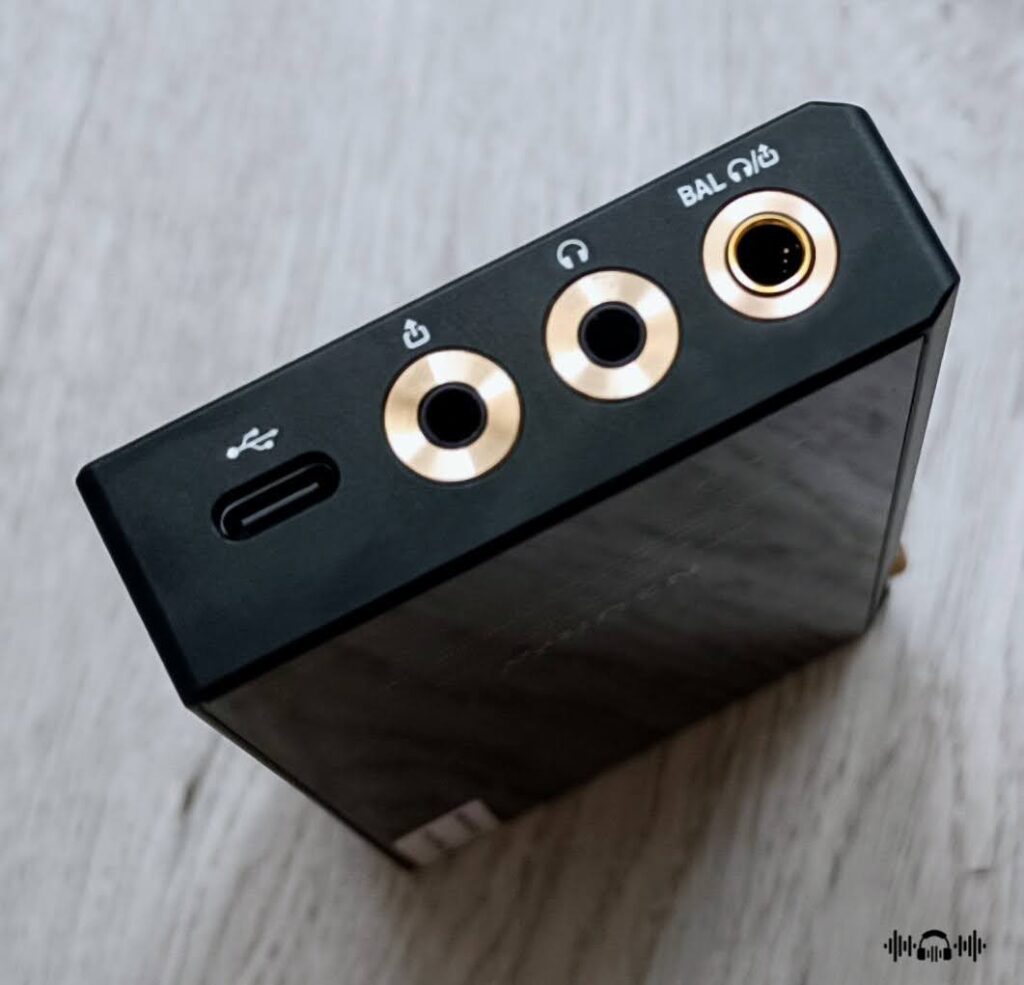
The N3Ultra features a volume control wheel with tactile click feedback and smooth operation, along with three playback control buttons. The TF card slot is positioned on the left side, while the headphone outputs are located at the bottom next to the USB type-C port. Dedicated 3.5mm headphone and line outputs are available, with the 4.4mm output shared on the same jack. A touch button at the bottom center of the front panel acts as a home and back button for various functions, and it changes color based on the input sampling rate, a customizable feature accessible from the menu.
The Parametric Equalizer
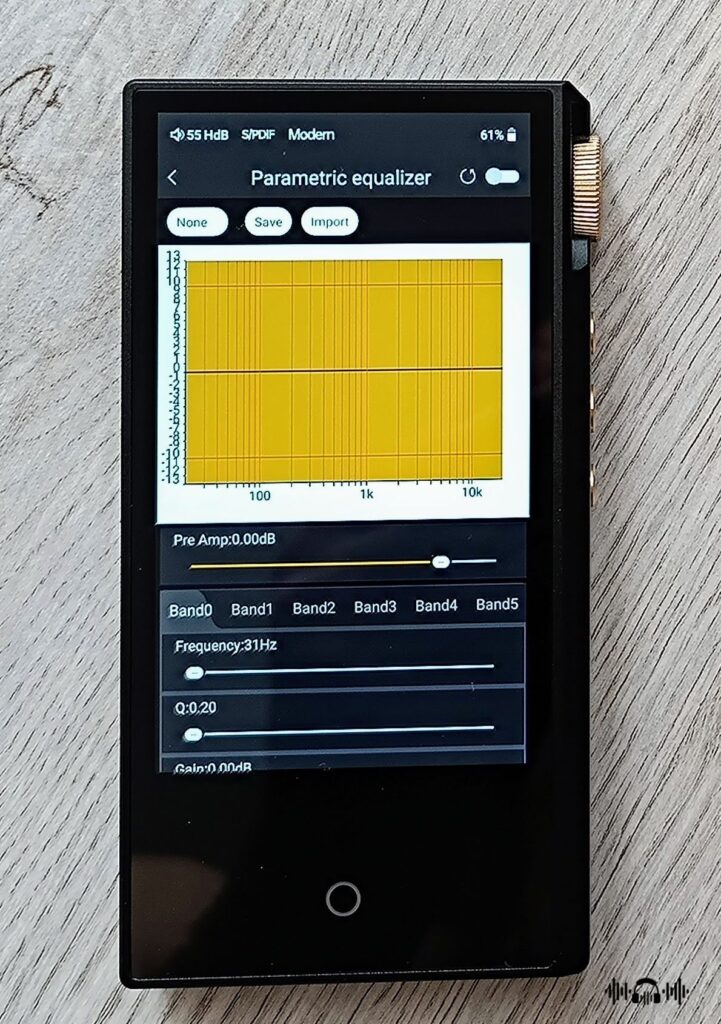
The Cayin N3Ultra offers a unique feature with its user-configurable, 10-band parametric EQ, allowing for precise sound customization based on individual listening preferences. Additionally, a traditional 10-band graphic equalizer is also provided, and both EQ modes are functional during USB DAC input, provided that the user enables it before establishing the USB connection. As I am not an equalizer expert, I can’t provide additional insight.
USB DAC input/output
The N3Ultra is equipped with bidirectional USB connectivity, allowing it to function as both a USB DAC decoder and a digital transport to an external DAC. If necessary, a special USB type-C to optical SPDIF adapter can also be used. The audio performance of the USB DAC is of the utmost quality, making it my primary input method when assessing the device. The only notable issue is that the drop-down menu is non-functional in this mode, requiring users to access various audio adjustments by pressing the small settings icon in the upper right corner of the screen.
The USB DAC function offers a convenient feature that allows you to customize the device to either charge or not while in use. This means you can connect it to a smartphone without draining its battery, or connect it to a PC and simultaneously enable charging and playback.
Battery duration
The Cayin N3Ultra features a 4500mAh battery with fast charging support and a meticulously calibrated power management system. Achieving a charge of 20% to 80% takes approximately an hour. The battery life is impressive for a DAP running two tubes, providing around 7-8 hours of playback time from the balanced output in tube timbre.
Accessories
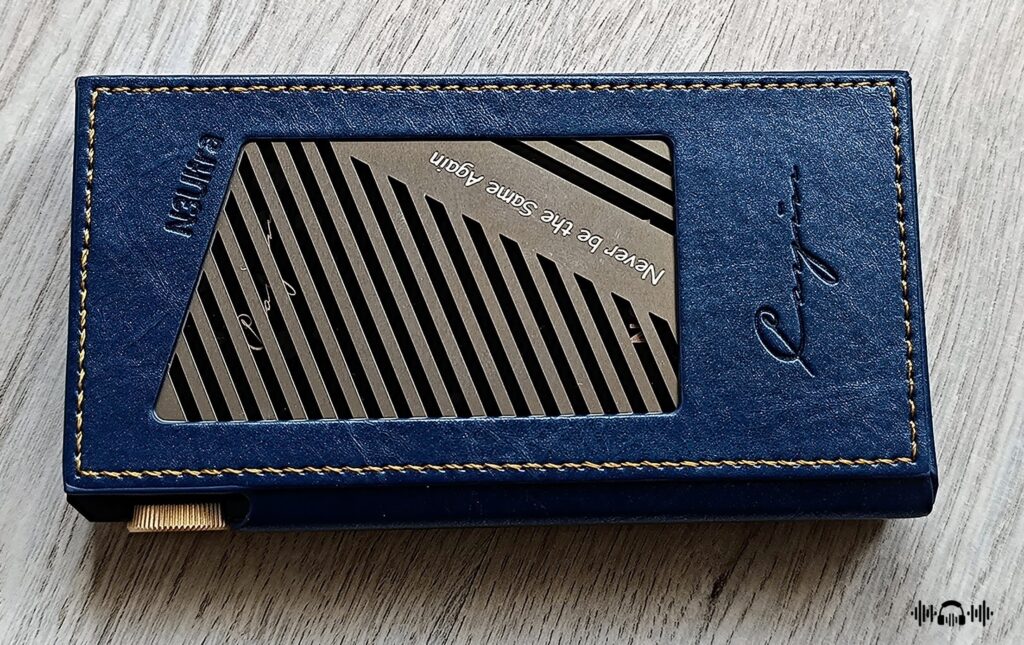
The bundle consists of a silicon protective case, tempered glass screen protectors for both the front and back panels, and a high-quality USB type-C cable. An optional purchase of a stylish leather protective case in blue is available for $29.99.

Power output, noise and heat management
The Cayin N3Ultra has a maximum power output of 600mW/32Ω, making it suitable for a variety of sensitive headphones and most earphones. While it may not be class-leading in this aspect, it performed admirably with headphones like the Focal Clear or HIFIMAN Arya Organic. Additionally, background noise was virtually non-existent when paired with sensitive earphones such as the Soundz Avant. In solid-state mode, the device is completely silent, while in tube mode, high gain is required to detect any faint background noise with sensitive earphones. Cayin has effectively managed to control tube microphonic noise, ensuring that the N3Ultra remains free from such disturbances even when subjected to tapping or movement.
The Cayin N3Ultra has exceptional heat management, ensuring the device remains cool even in stress conditions. I have tested the Cayin N3Ultra in a room with an ambient temperature of 30⁰ Celsius, and the chassis only became mildly warm at most. In fact, I can recall several USB DAC dongles that tend to get warmer than the N3Ultra. This is an impressive feat, especially considering the presence of two tubes within the device.
Listening impressions
Throughout the majority of the listening evaluation, I utilized the Cayin N3Ultra in USB DAC mode, connected to the Volumio Rivo streamer. As customary, the device underwent a 200-hour music playback session to ensure the tubes settled properly.
Solid state timbre
The Cayin N3Ultra delivers outstanding sound quality that exceeds typical expectations for its category. This digital audio player is neutrally tuned, offering a balanced sound signature that emphasizes musicality while also paying attention to technical details. The solid state mode provides a clear and transparent sound with exceptional precision, making it the best option for technical performance among the three sound modes.
The bass is profound and powerful with excellent clarity and depth. The textures are visceral and weighty, providing a rich and full-bodied listening experience, rather than a thin or dull one. The dynamics are remarkable, delivering impactful and well-defined bass tones that are tight, controlled with impressive timing and speed.
The mid range of the Cayin N3Ultra delivers exceptional timbre realism, providing an analog and organic sound with a wide range of harmonics. The presentation is incredibly lifelike, offering fluidity and richness without veering into overly sweet or dark tones. The N3Ultra delivers a musical and captivating sound while maintaining clarity, separation, and articulation. It brings your music to life without interfering with the frequency response of your headphones.
More solid state impressions
The treble range on the Cayin N3Ultra is vibrant, clearly defined, and extended without being overly bright or too soft. It strikes a good balance with plenty of energy and bite, yet it remains easy on the ears and naturally toned without being overly smooth or laid back. The resolution is top-notch for its category, delivering refined and transparent sound with excellent detail retrieval while avoiding any hint of sterility. The timbre is also very natural, free from any significant artificiality or digital harshness, although it can sometimes sound slightly metallic. One standout feature is that the textures in the treble are just as weighty as in the lower frequencies, ensuring that high-pitched instruments sound full-bodied rather than thin or dry.
The soundstage offers a greater sense of space and depth compared to other DAPs featuring THX amplifiers. With its wide and precise imaging, the soundstage can be further enhanced to become more immersive and holographic by incorporating either of the tube modes.
Tube talk
The tubes have been integrated to avoid altering the frequency response or introducing excessive warmth and color to the sound. These small tubes are not very efficient in enhancing second order harmonics as is typically the case with authentic tube setups. Some pleasant distortion is achieved, but the sound does not become as rich and harmonious as with traditional, all-tube amplifiers. It is important to remember though, that this is a hybrid device, not a fully tube-based one. Between the two tube types, the classic one provides a more lush and atmospheric sound.
Modern tube timbre
The modern tube flavor offers the same level of technical performance and transparency as the solid state mode. The sound is equally clear and well-defined, to the extent that one might believe that nothing has changed when switching to the modern tube flavor. However, this is far from the truth, as after a few minutes, one will notice that the soundstage gains in holography and dimensionality, the presentation becomes more immersive and vibrant with added grandeur. The notes also seem to have a thicker and rounder sound, with a more relaxed decay, while the timbre becomes more natural. The bass is also more weighty, full, and intense compared to the solid state mode, without sacrificing dynamic impact, control, speed, and definition.
The paradox
Tubes are commonly thought to produce smoother and slightly less extended treble. However, in this case, the modern tube flavor actually enhances the sharpness of higher frequencies, providing more bite as long as better resolution and refinement. The treble quality in the modern tube flavor surpasses that of solid-state, allowing the player to resolve details exceptionally well and present the finest nuances in a more natural and seamless manner.
Classic tube timbre
The classic tube flavor introduces an extra pleasing distortion that was lacking in the other two modes, while still preserving very good transparency and clarity without becoming too tubey or loose. The notes gain some extra richness, and the soundstage in this mode is the most atmospheric and holographic of all three, while the timbre has the most analog and organic texture by a significant margin.
In this mode, the harmonies are more colourful and varied while the overall presentation is relaxed yet the sound remains solid and clear. The bass becomes richer and more visceral, although the classic tube mode is the least dynamic and impactful. Despite subtle differences, the player still maintains excellent technical performance and resolution across all three modes. Returning to the classic mode, the mid-range offers extra fluidity and lushness, while the treble is airy and sparkling, albeit less sharp compared to the modern mode. This particular timbre embodies a more “tubey” sound signature and is my preferred choice for enjoying classical music due to its realistic tonality, enhanced expressiveness, and immersive soundstage.
The line outputs
The Cayin N3Ultra features fixed voltage line outputs that bypass volume control and headphone amplification, delivering a clean and pure sound. These outputs can be used as a high-quality audio source for headphone amplifiers, both portable and desktop, as well as integrated amplifiers in home audio systems. Additionally, the line outputs of the Cayin N3Ultra offer configurable output levels for improved versatility, with options for 2.1V (High), 1.6V (Mid), and 1.0V (Low) for the 3.5mm output, and 4.2V (High), 3.2V (Mid), and 2.0V (Low) for the 4.4mm output.
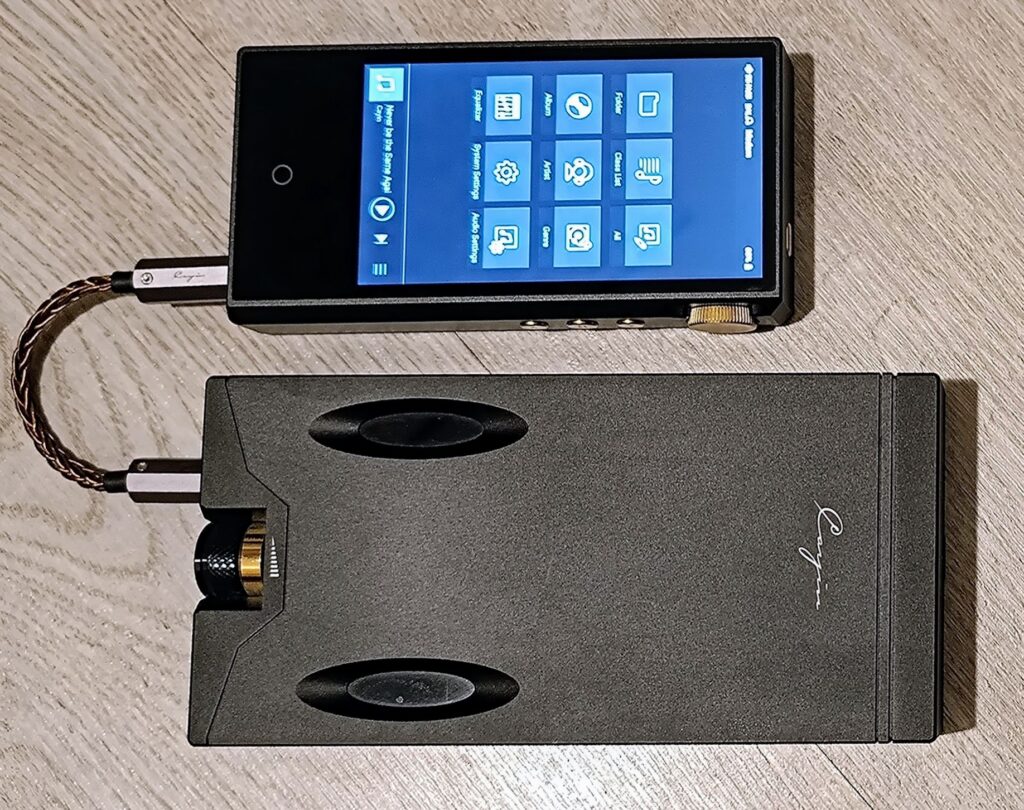
I have conducted an evaluation on the balanced line output of the N3Ultra alongside the Cayin C9, a battery-powered headphone amplifier, confirming that the sound characteristics and overall audio excellence meet the high standards mentioned earlier. The inclusion of dual tube timbre support for both line outputs sets a new standard for the N3Ultra, enabling users to appreciate their preferred tube sound profile when connecting the DAP to a headphone or integrated amplifier.
Against the competition
The Cayin N3Ultra offers solid state sound performance comparable to other competitive DAPs such as the FiiO M23 or the iBasso DX180, with slight differences in sound shaping and signature. When used as a battery powered, portable USB DAC/amp, it competes well with devices like the FiiO Q15. However, what truly sets the N3Ultra apart is its unique tube timbre, making it a standout feature that other similar devices lack. This distinctive characteristic is the main selling point of the Cayin N3Ultra, appealing to those who prioritize tube sound over functionality or solid state performance.

In the end
The Cayin N3Ultra is a highly recommended device, even if it was solely a solid-state DAP, due to its exceptional sound quality that rivals its competitors. What truly makes it stand out, however, is its unique hybrid tube design, allowing users to experience high-quality tube sound from a portable DAP. This feature makes up for the absence of wireless connectivity, as the focus is on delivering noise-free and crystal-clear sound. Those who do not stream may not find this to be a significant drawback, and for others, the N3Ultra can always be used as a portable USB DAC. Whether used as a DAP or a portable DAC, the Cayin N3Ultra provides outstanding sound in three different flavours and is the only option with tubes in its price range.
Copyright – Petros Laskis 2024.
+ Tube-hybrid with solid state and two tube timbres
+ Stellar sound quality in all three modes
+ Great technical performance in all three modes
+ Natural timbre and musicality
+ No tube microphonics or background noise
+ Bidirectional USB interface
+ True line outputs with tube timbre
+ Compact and lightweight
+ Fast and responsive UI
+ Parametric Equalizer with global effect
+ Powerful search function
+ Good battery duration for a tube device
+ Doesn't get very hot
+ Excellent build quality

- Closed Android system and limited functionality
- No internal storage
- No wireless connectivity
- SPDIF is embedded in the USB port
- Not as powerful as the competition
- The leather case is optional
















Leave a comment