


The ONIX Beta was kindly provided free of charge in exchange for an honest review. I didn’t receive monetary or any other kind of compensation and I don’t use affiliate links.
The price of the ONIX Beta is $349 and you can buy it from Amazon.
ONIX Audio
ONIX Audio is a high-end Hi-Fi audio brand with roots in British audio design known for producing premium music players, DACs, amplifiers, and stereo components. The brand traces its origins to the early 1980s in Brighton, England, where its founders began designing powerful, high-quality amplifiers that gained international attention and popularity.
During the years, the brand changed ownership a few times and eventually, Mr. Pu Hsao Hsiung from Taiwan Sound Art Co., acquired the core technology and brand ownership of ONIX back in 1997.
ONIX has been working with Shanling since 2003, keeping up with the original audio design and the traditional look, launching a wide range of models over the years. Their fruitful cooperation continues to the present with ONIX representing the high-end branch of Shanling.
ONIX Beta (XI2)
One of the most known (and affordable) audio devices by ONIX is the Alpha, a high quality USB DAC dongle that is quite popular in the audiophile community.
Building upon the success of the Alpha, ONIX has designed a newer model, the Beta, which is essentially the Alpha with the addition of a vacuum tube stage and several circuitry enhancements.
Technical overview
The ONIX Beta is a tube-hybrid USB DAC dongle with two headphone outputs and a USB type-C input that supports sampling rates up to 32bit/768kHz PCM and DSD512.
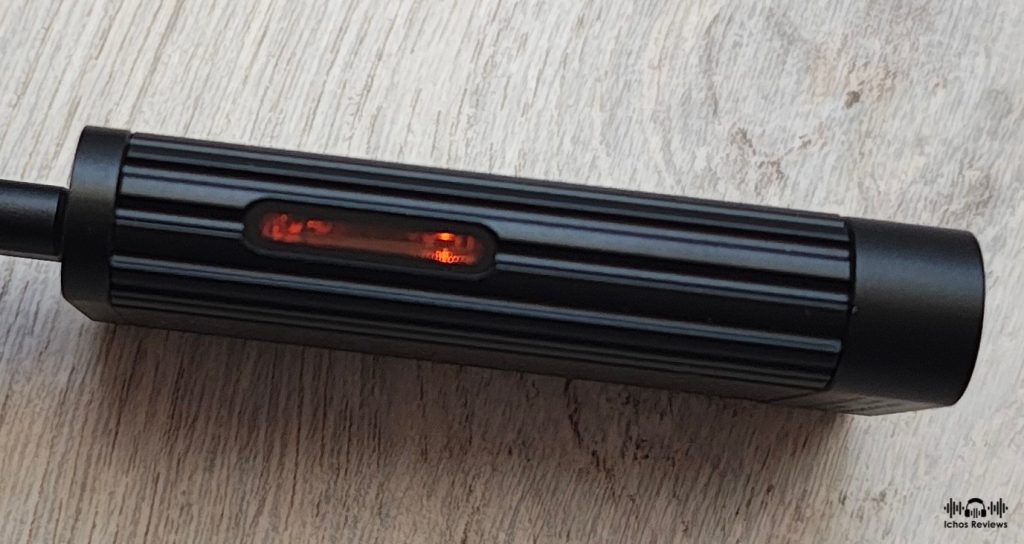
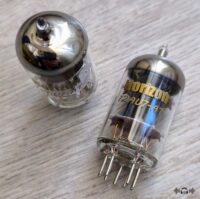
It utilizes dual JAN6418 mini-tubes for voltage gain that can be manually bypassed for a pure solid-state output. The tubes are mounted with the aid of a custom-made tube suspension system to minimize microphonic noise.
The D/A conversion is done by dual CS43198 DAC chips, the same used in the Alpha. However, the Beta features a more advanced headphone amplifier stage with a combination of dual OPA1622 and quad BUF634 op-amps, rather than the dual SGM8262 used in the Alpha.
Design and appearance
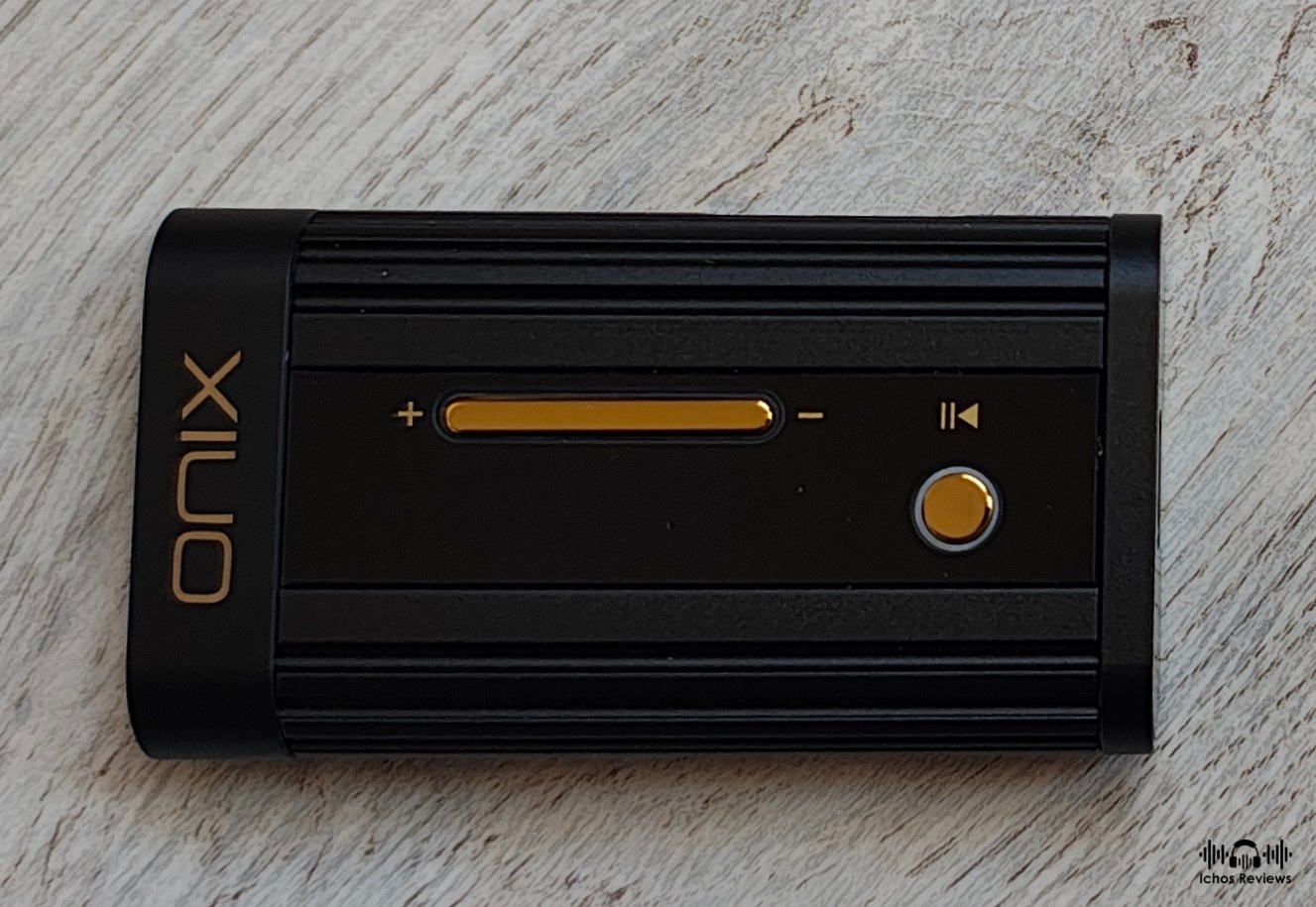
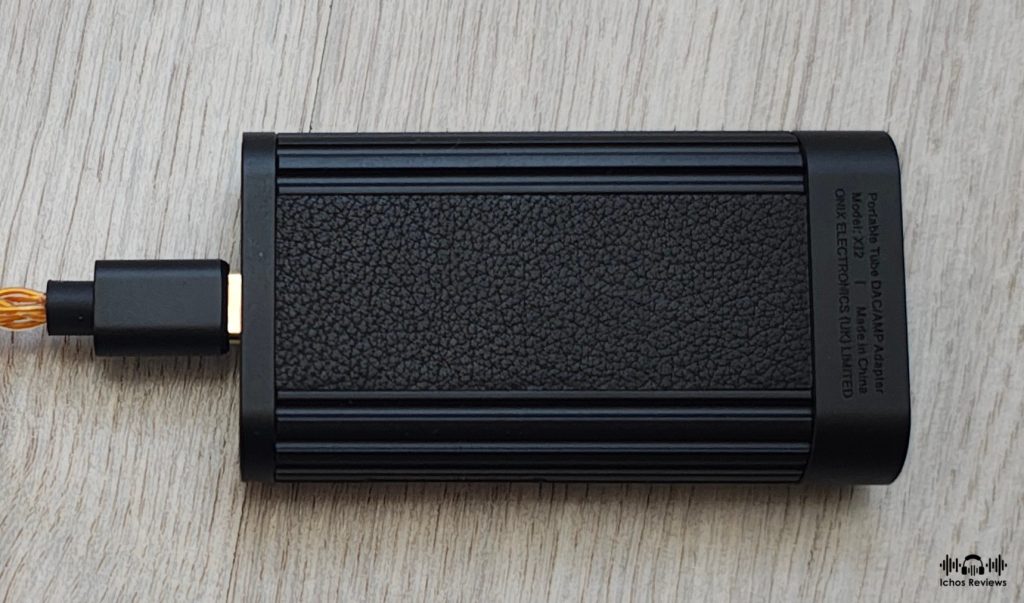
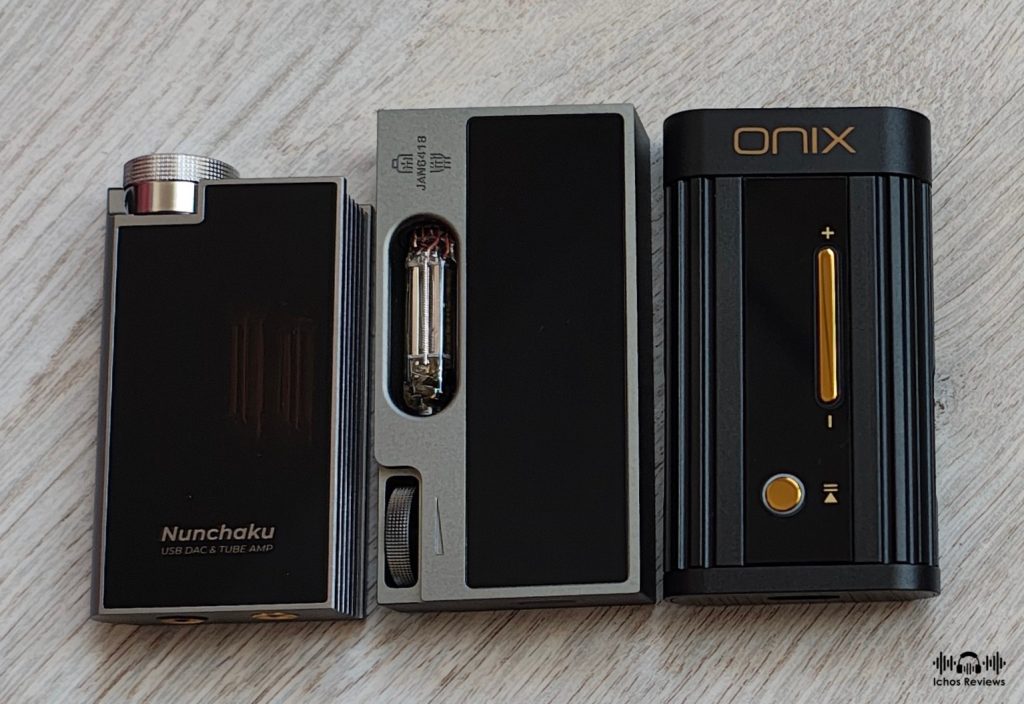
The ONIX Beta is slightly bigger and heavier than the Alpha but not that much considering that it houses all the extra electronic components. It measures 69.8x39x14mm and weighs 45.3g so it is not bigger or heavier than similar devices like the iBasso Nunchaku or the Shanling UA7. It is suitable for portable use and just a little bulkier than regular USB DAC dongles without tubes.
Optically it resembles the Alpha, the only real difference is the addition of two side windows that offer a view of the glowing tubes. The screen is the same 0.87” monochrome display while the Beta has three hardware buttons for quick volume changes and playback control/menu settings.
It has a rectangularly shaped body with rounded edges and corners that make it palm friendly and easy to handle. The three buttons are ergonomically placed so you can use the device with one hand.
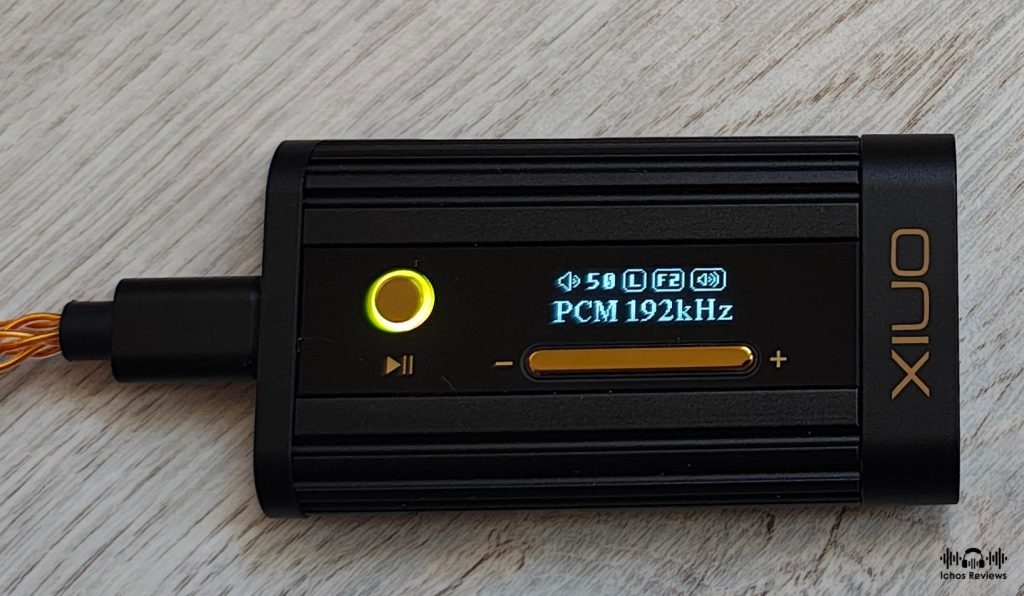
The chassis is made from durable aluminum alloy with a high quality black finish that has a few golden accents to add premium elegance. The front panel is reinforced with a glass frame and the back surface is covered with anti-slip material. A circular indicator LED surrounds the control button and changes colors according to the input sampling rate.
User interface and the Eddict application
The device has an onboard menu system that allows the user to perform all the adjustments without the need to connect with an application.
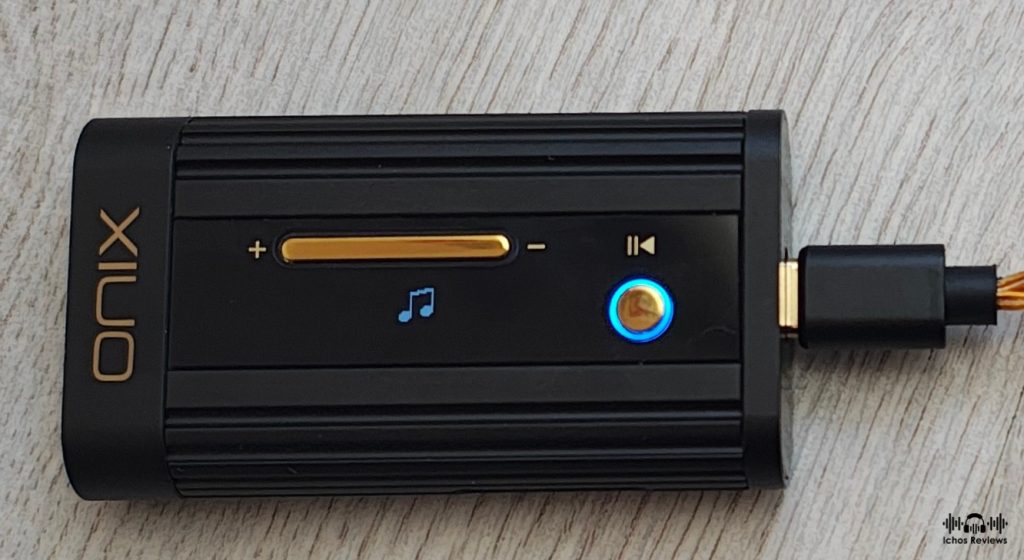
When in use, the screen displays input sampling rate, volume level, gain setting, key mode function and the number of the selected digital filter. There is also an attractive screensaver theme featuring moving musical notes that activates automatically after a preset period of inactivity.
Long pressing the playback button enters the main menu where you can adjust gain, enable tube mode, select PCM filter, set the action of the buttons, select font style, adjust brightness, set screensaver time and rotate the display orientation.
The Beta is compatible with the Eddict application that is developed by Shanling and it also doubles as a handy music player with many features.
Accessories
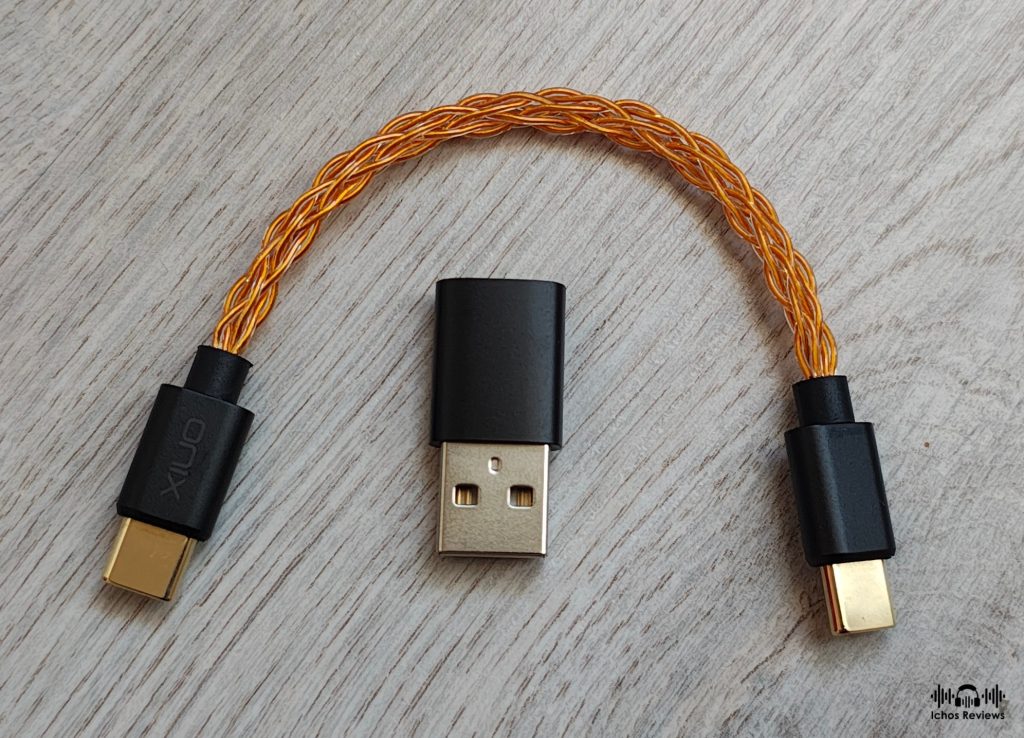
The package includes a high quality USB type C-C cable with an orange coloured sheathing that matches that of the glowing tubes and a USB adapter. A leather protective case is available as an optional accessory, not a smart marketing move considering the premium price tag of the Beta.
Power output and efficiency
The maximum rated power output of the ONIX Beta is 550mW*2/32Ω from the 4.4mm plug and 180mW*2/32Ω from the 3.5mm. The maximum power output remains the same both in transistor and tube modes. The Beta is slightly more powerful than the Alpha (500mW*2/32Ω) and one of the most powerful USB DAC dongles. Plenty of power to drive most earphones, like the FiiO FH19, plus a lot of sensitive headphones like the Aune SR7000.
Additionally the Beta doesn’t produce microphonic noise when you tap it or any other kind of background hissing even in tube mode. However, as it usually happens with all tube-hybrid devices, some phones can cause strong electromagnetic interference in tube mode so you might need to use a longer USB cable. The device runs cool and is also exceptionally efficient as it was measured to consume 90mA in solid-state mode and 120mA in tube.
Listening impressions
Solid-state mode
The solid-state mode of the ONIX Beta produces neutral / reference sound with a touch of warmth that is not commonly found in similar devices with the same DAC architecture. The frequency response is flat without any deviations from linearity, the Beta sounds clean, transparent and resolving but not clinical or sterile, especially with the NOS filter that minimizes digital artificiality.
The advanced audio architecture of the amplifier produces authoritative bass that is strong and impactful with excellent control and definition. The textures are balanced, not too thick but not dry or lean either. Fast and with the right timing, the bass of the Beta stays precise, textured and focused even under stress conditions.
The mid-range is tonally balanced and realistic with the right amounts of expressiveness and emotionality to connect the listener with the music. The solid-state mode isn’t as organic or harmoniously rich as the tube mode but the Beta fairs much better in these regards than most of the competition without lacking in clarity and articulation.
The treble is airy and energetic, however it doesn’t sound bright or sharp. It is not overly smooth or subdued but it doesn’t cause long term fatigue so you will not have problem pairing the Beta with brighter earphones. Transparency and resolution are stellar and among the best of the category but they never cross the borders to make the Beta sound analytical or unforgiving with lower quality recordings.
The textures have weight and a decay that is slightly relaxed rather than aggressively fast, giving high-pitched instruments a distinctly analogue character in their presentation.
The soundstage is surprisingly wide and open sounding with average depth and stellar positioning accuracy. The Beta performs admirably well and is never going to handicap your earphones even with large scale symphonic and operatic music.
Tube mode
The tubes are effectively implemented and add more character to the music than they do in similar competitive devices. Don’t think though that they sound old-school warm or mess with the frequency response of the Beta. What they do is to enrich the harmonic structure and make the timbre more organic and natural with less digital artificiality, all while retaining almost the same kind of transparency and fidelity.
There is a faint reduction in clarity and overall resolution but the sound becomes more expressive and melodic, especially in the mid-range. The treble smoothens out and at the same time the bass becomes more elastic and visceral with a mild loss in firmness. The soundstage feels more diffused and holographic with a touch less accurate imaging.
The tubes add an analog flavor to the music, making for an immersive and engaging listening experience especially with acoustic music. Of course, there is a great chance that some users are going to prefer the advanced technical precision and transparency of the transistor mode. No need to worry though, as you can easily switch modes according to your mood, music style and earphones in use.
Vs the iBasso Nunchaku
The iBasso Nunchaku ($299) is a similarly designed USB DAC dongle with dual CS43198 DAC chips and dual JAN6418 tubes for the user selectable voltage gain.
Both devices have similar functions, they output the same amount of power and are equally efficient.
The Nunchaku is a tad more compact but 5g heavier than the Beta while it comes more generously accessorised with two USB cables and a high quality protective case.
There are some differences in their sound signature. In solid-state mode, the Nunchaku is slightly more flat and clean sounding than the Beta. It resolves better and offers higher levels of transparency and technical fidelity but with the downside that it is a tad clinical and sterile in comparison to the Beta that also has lesser digital artificiality.
Their tube modes are also slightly differ in character. Put simply, the Beta sounds slightly more “tubey” and organic, while the Nunchaku remains more technical and transparent, with a bit less harmonic richness and expression depth than the Beta.
Vs the Shanling UA7
The UA7 ($289) is Shanling’s tube-hybrid USB DAC dongle. ONIX and Shanling are essentially the same brand so it doesn’t come as a surprise that these two dongles have the exact same menu system and functionality. Even the screensaver theme is the same.
They also share common circuitry, the only difference is on the DAC chip, a single ES9069 for the UA7, instead of dual CS43198 of the Beta. The UA7 is a touch more powerful (577mW/32Ω) but it is also a bit more power hungry than the Beta as it consumes 120mA in transistor mode and 160mA in tube.
The Shanling UA7 has a much more modern appearance than the Beta and the three buttons are replaced by a handy multifunction wheel. This different design philosophy also extends to their sonic character.
As you have probably guessed, the Shanling UA7 sounds more youthful and fresher than the ONIX Beta in both audio modes. It presents a more technical and transparent sonic character than the Beta, in both tube and solid-state modes.
The UA7 sounds faster, more energetic, and slightly brighter, the bass is more controlled and the treble is crispier. It has less harmonically rich and organic sounding mids than the Beta but it compensates with greater resolution and enhanced clarity.
The Shanling UA7 is recommended for listeners that would like to buy a modern and detailed sounding DAC that can also offer a touch of tube flavor without too much warmth and relaxed textures.
In the end
The ONIX Beta is a tube-hybrid USB DAC dongle with stellar audio quality in both modes, a powerful headphone amplifier for its class, low power consumption and excellent noise control even in tube mode. It is also very well made and easy to use with plenty of customization options.
Compared to similar devices by other brands, it stands out for its more musical nature and greater tube effectiveness, making it an ideal choice for people that seek to experience the most analog timbre without compromising too much in technicalities. The ONIX Beta sounds as “tubey” as it can get from a compact sized USB DAC dongle and is going to become the favorite audio gadget of all vacuum tube aficionados.
Copyright – Petros Laskis 2025.
+ Stellar audio quality in both modes
+ Competitive technical performance in both modes
+ Class-leading tube implementation
+ Harmoniously rich and organic timbre
+ Deep and impactful bass
+ Musical and expressive mids
+ Controlled and non fatiguing treble
+ Holographic and immersive soundstage
+ Powerful headphone amplifier with low power consumption
+ Easy to use and handle
+ Excellent build quality

- More expensive than the competition
- Tubes can pick EMI noise
- Poorly accessorised for the asking price






Leave a comment