


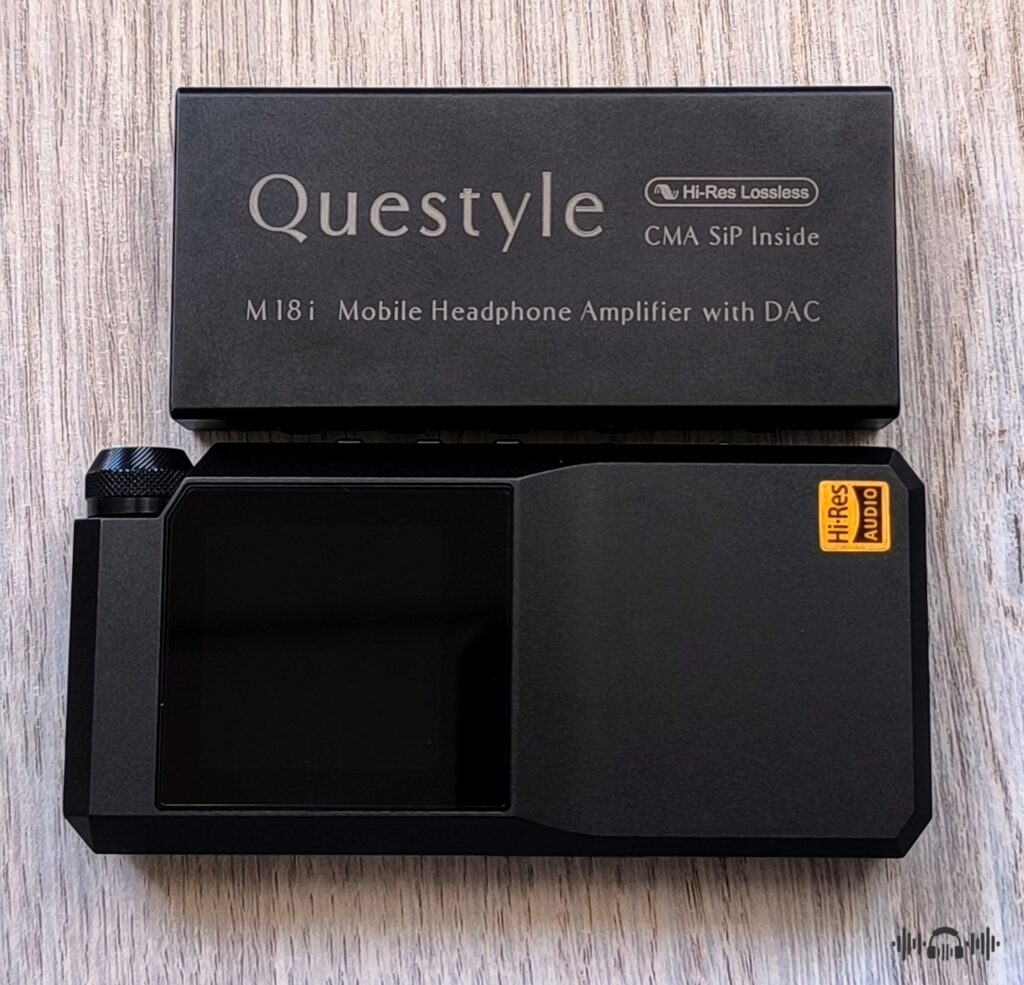
The Questyle M18i was kindly provided free of charge in exchange for an honest review. I didn’t receive monetary or any other kind of compensation and I don’t use affiliate links. The price of the M18i is $349 and can be bought from Questyle’s online shop.
Questyle
Questyle doesn’t need any lengthy introductions. It is a brand not only known for making some great sounding and award winners audio devices, like the Questyle CMA Fifteen and the Questyle CMA18 Portable, but also for patenting the Current Mode Amplification (CMA) technology.
Current mode amplification (CMA)
It is well known that processing high resolution lossless audio and powering amplifiers typically consumes a lot of energy. This is not an issue for AC powered Hi-Fi systems but becomes a drawback when designing mobile devices. Questyle’s patented Current Mode Amplification (CMA) technology was developed to solve this issue.
As its name implies the CMA technology is processing the signal as a current rather than a voltage in a circuitry that uses discrete transistors. The power consumption of a Current Mode Amplifier is only one-tenth of conventional systems but it provides 10 times the bandwidth and dynamic signal processing capability with ultra-low distortion.
Questyle has developed a series of audio SiP modules, like the MA2430 chip, that integrate Current Mode Amplification and full-link lossless audio signal processing. It operates at a minimum voltage of 2V and a working current of only 3mA – less than half of the power consumption of a pair of TWS earbuds.
Questyle M18i
Questyle’s catalogue includes three portable USB DAC dongles, the entry level M12i, and the M15C/M15i that are an upgraded version of the much acclaimed Questyle M15. Their latest installment is the M18i, a portable USB DAC dongle that differentiates from the rest as it has its own internal battery and supports wireless Bluetooth connectivity. The letter “i” in all these models designates that the device comes with an official Apple MFi certification.

Technical highlights
The Questyle M18i uses two ES9219Q DAC chips by ESS to handle audio decoding. Questyle and ESS have worked together to develop the TTA (Triple Decoding Architecture) DAC framework in order to take the performance of M18i to its limits.
The headphone amplifier section is divided into separate preamp and power amp stages that incorporate two CMA SiP modules that translate into four Current Mode Amplification (CMA) engines.
The M18i incorporates a separate 16-Core XMOS XU316 USB receiver that is fully compatible with iOS, HarmonyOS, Android, Windows 10/11 and macOS, as well as PSP gaming consoles. It supports 384kHz/32bit PCM and DSD256 high resolution audio decoding through the USB type-C input.
The device is also equipped with a Qualcomm Bluetooth 5.4 receiver that supports AAC, SBC, aptX, aptX HD, aptX Adaptive, LDAC and LE Audio decoding. In Bluetooth mode the M18i relies on its own battery for power supply.
You can even use the M18i for HD calls with Advanced Noise Reduction Technology thanks to Qualcomm’s cVc Generation 8.0 ClearVoice Capture technology. Environmental noise is suppressed while providing clear sound to the user.
Separate USB type-C power input
The Questyle M18i features a separate USB type-C input that is used for powering the device so you can charge the battery and use it at the same time. After the battery gets fully charged it is bypassed and the M18i draws power from the external power adapter. Please note that this feature is for power supply only and unlike FiiO’s desktop mode, it will not increase the power output of the M18i.

Design and build quality
The Questyle M18i has a rectangularly shaped chassis with a plain industrial design similar to that of the CMA18 portable and the M15i. The material used is CNC anodized aluminum with a smooth, black matte finish while the front panel is reinforced with tempered glass. The chassis has rounded corners and edges that let you conveniently handle the device.
The M18i is exceptionally well made without visible imperfections and with good integration of the buttons that don’t wobble or feel loose. The device measures 75x35x14.5 mm and weighs 50g so it is compact and lightweight enough, not much bigger and heavier than similar USB DAC dongles.
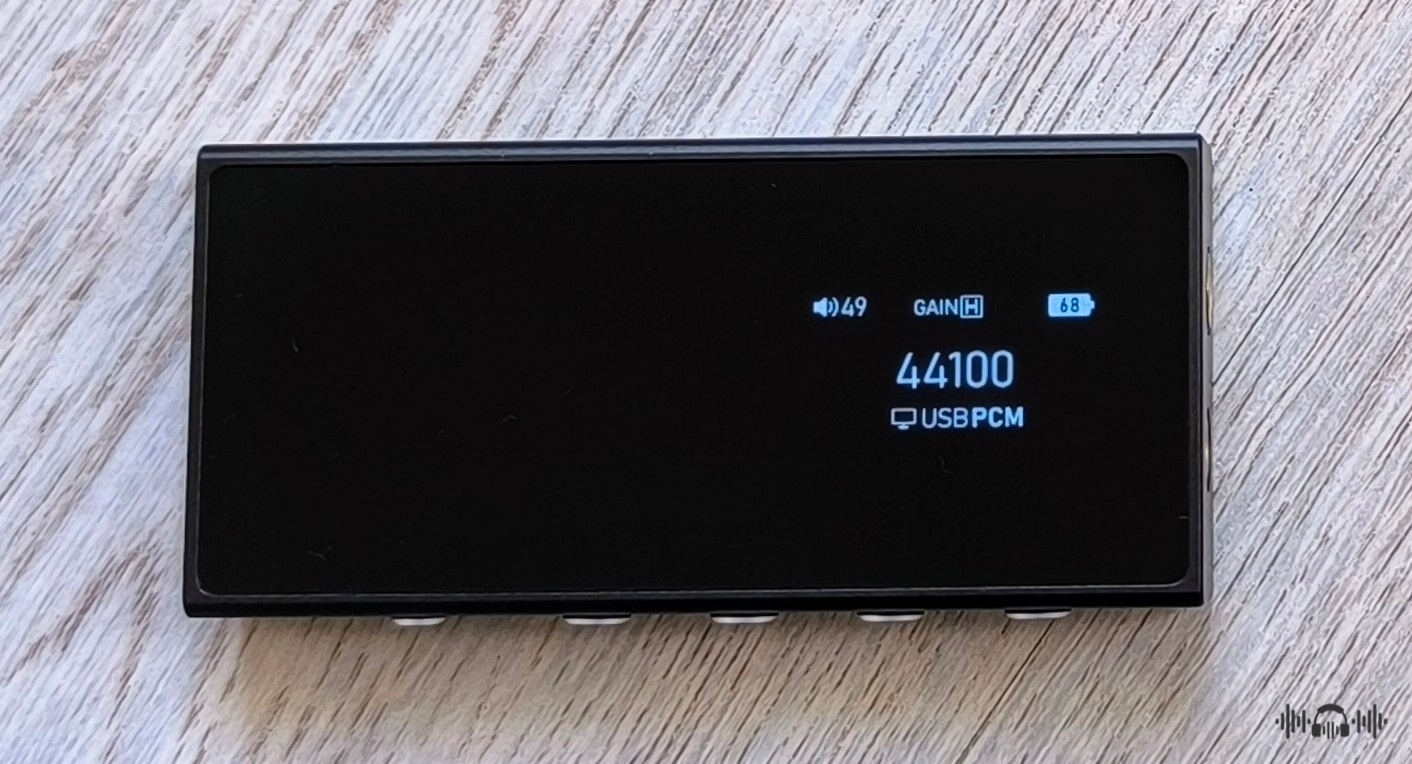
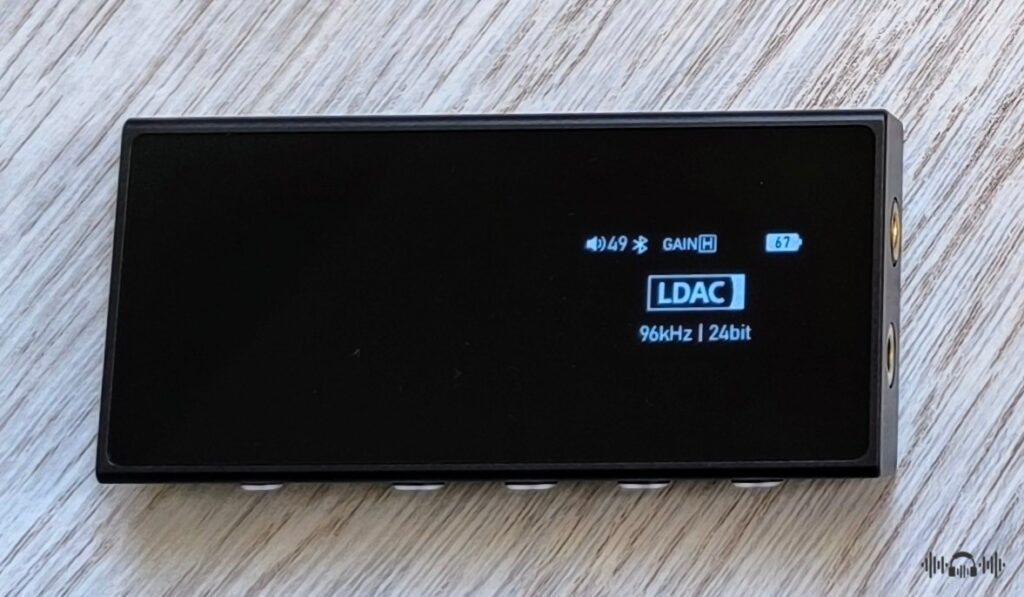
The M18i doesn’t have the unique transparent glass panel that allows a view of the internal components as it happens in other Questyle portable DAC/amps. Instead, it is equipped with an OLED screen that displays useful information at a glance, like volume level, gain setting, battery level, working mode and input sampling rate.
Operation and working modes
The M18i supports three working modes and is equipped with four push buttons and a switch. You can use the switch to toggle between PC, Phone and Bluetooth modes. The first button is used to power on/off the device and wake the screen, the second and third are for raising and lowering the volume while the fourth is a multifunction button (MFB) that doubles as a gain switch and to perform various actions in Bluetooth mode.
In Phone mode, the M18i uses its own battery for power supply, the USB port is for data transfer only and will not drain the phone’s battery. The same happens in Bluetooth mode where the M18i is set as a wireless receiver and relies on its own battery for power supply.
In PC mode the USB port transfers data and draws power at the same time by the aid of an intelligent power management system that cleverly distributes the power between battery charging and the main system needs according to the host’s current limit. In all three modes you can use the second USB type-C input to power the M18i with an external adapter.
The M18i is not compatible with an application and doesn’t have an internal menu for adjusting audio or any other working parameters.

Bluetooth connectivity
Upon selecting Bluetooth mode, the M18i will enter pairing mode and automatically lock on the best available codec that is supported by the transmitter device. The codec is then displayed on the OLED screen.
During Bluetooth playback mode the gain button is not effective and you will have to select the desired gain before enabling it. Instead you can single press this button to toggle between pause and play or click it twice to skip to the next track. Previous track is not supported. Moreover, when a call comes in Bluetooth mode, click the button to answer the call, click it twice to reject the call or click it to end the call.
The Bluetooth connection is very stable within the same room and the audio performance is absolutely stellar, especially with the LDAC codec. The sound quality is so good that someone will have to do attentive listening in order to find out that the wireless connection gets slightly outperformed by the wired.
Accessories
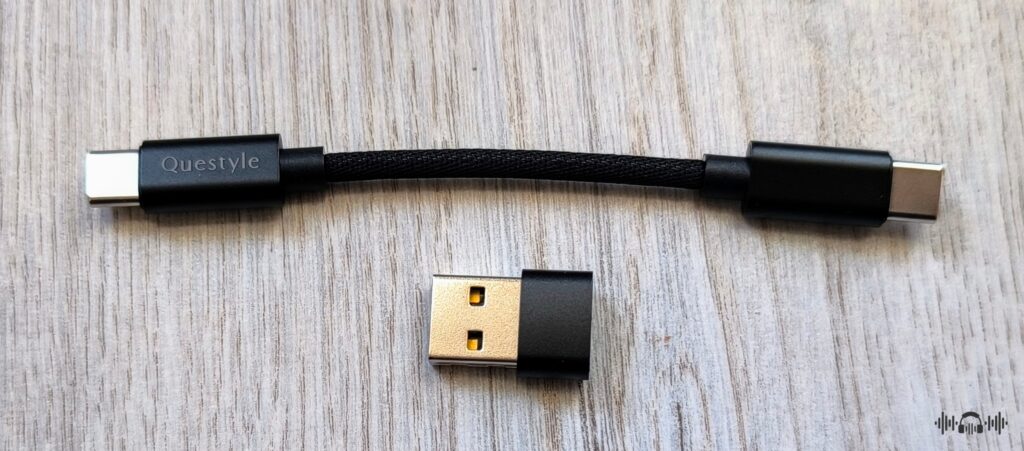
The supplied accessories are rather poor and not competitive considering the price of the M18i. A high quality USB OTG cable and a USB adapter are all you get. Apple users will have to buy a separate USB type-C to Lightning cable and the nice Questyle protective case is sold for $29.99 extra. Questyle should have included a USB type-C to Lightning cable and the case for free in order to make the whole package more appealing.
Power output and noise
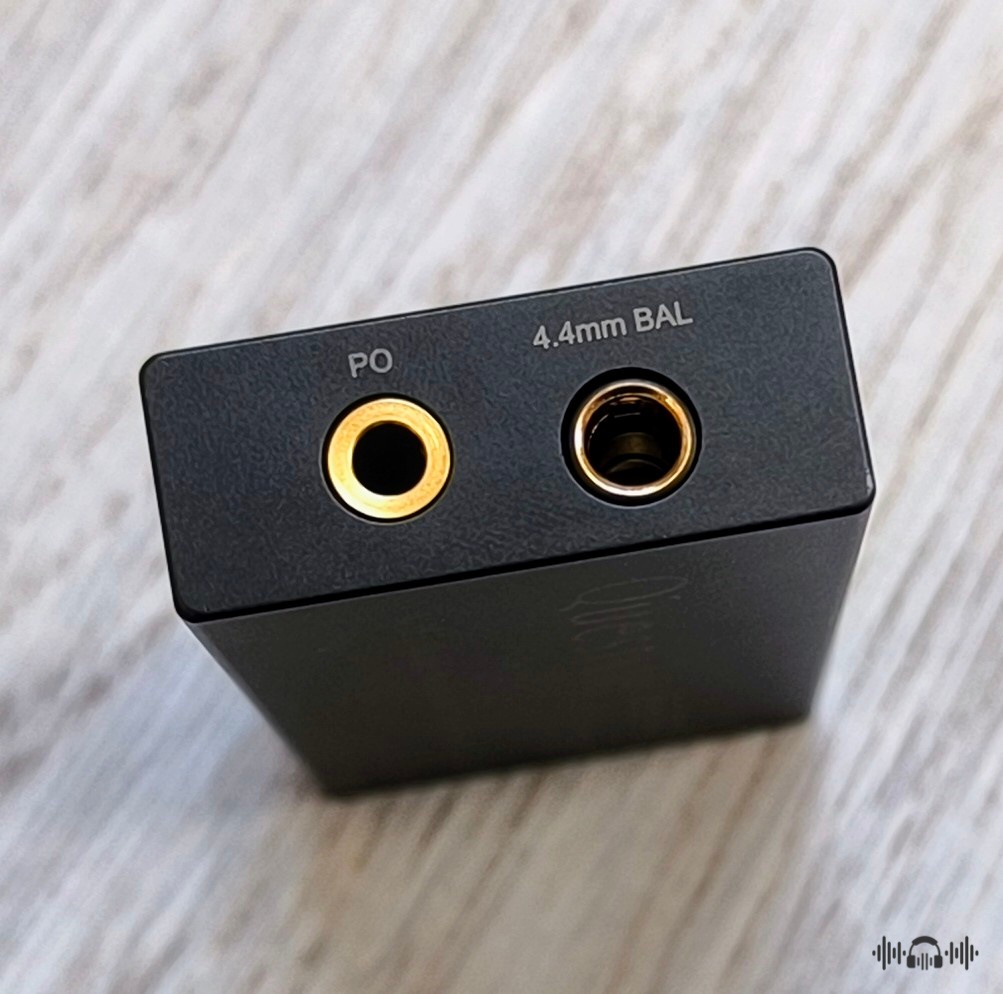
Questyle specifies the power of the balanced output as 28mW/300Ω and doesn’t provide any ratings for 32Ω or 16Ω loads. In actual use conditions, I found the M18i powerful enough and had no problem driving various full sized headphones such as the Sennheiser HD660S2, the Hifiman Hifiman HE1000 Stealth and the Meze Audio 105 AER. The M18i is also very suitable for use with sensitive earphones because it has undetectable background noise and doesn’t get affected by EMI.
Battery duration
The M18i is equipped with a small 500mAh capacity battery that can keep it working for 2 hours at the maximum no matter if you are using the Phone or Bluetooth working modes. The battery’s charge drops from 100% to 80% in less than half an hour at high gain. An underwhelming performance that makes the M18i pretty much unusable as a battery powered USB DAC dongle and Bluetooth receiver unless you are prepared to do frequent charges. Also consider that the battery doesn’t support fast charging and it needs two hours to get a full charge.
Just out of curiosity, I measured the power consumption of the device in PC mode and found it 0.26A with the battery fully charged. A rather high value so it doesn’t come as a surprise that the battery doesn’t last too long.
Listening impressions
The good news is that the audio performance of the M18i is absolutely stellar and is one of the best USB DAC dongles to buy if you value neutrality and transparency. Frequency response is dead flat and the M18i reproduces the music with class-leading fidelity and precision without adding any sonic character of its own.
At the same time, Questyle has done an excellent job into taming the usually aggressive treble of the ES9219Q DAC chip so it sounds crystal clear and energetic without being bright or sharp. The M18i offers impressive resolution and detail retrieval but it doesn’t come as a sterile or analytical sounding device.
The M18i might not have the intense organic and analog-like characteristics of certain competitive USB DAC dongles, like the Cayin RU7 or the iBasso Nunchaku, but it manages to sound realistic and lifelike with exceptionally low amounts of digital glare. It is not going to add extra richness to the melodic line of the music, like if it had tubes, but it can definitely explore and highlight all the harmonic variety that lies hidden inside a high quality recording.

More listening impressions
The CMA modules deliver an astounding bass performance with wide dynamic contrast, strong impact and excellent technicalities. The bass is fast, tight and controlled with exceptional layering and separation. The textures are not that visceral and weighty but they are rich enough and not dry while they don’t lack in elasticity and lushness. The performance of M18i is very balanced, it is technical enough to satisfy the most discerning audiophiles and at the same time fun and exciting to sound pleasing with modern tunes.
The mid-range and treble are reproduced with exceptional articulation, strong presence and crystalline clarity without lacking in harmonic diversity. The textures are weighty enough and in consistency with the low-end, so the higher pitched instruments don’t sound thin and artificial. The timbre is natural and devoid of any metallic artifacts or clinical elements.
The M18i offers a remarkably wide soundstage that is not artificially stretched and is distinguished by class-leading imaging and separation. It might not be the most holographic DAC dongle among the competition, the iBasso Nunchaku slightly surpasses it in this regard, but it still sounds immersive and grand enough with very good depth layering.
It is safe to conclude that the Questyle M18i is an excellent match with all types of earphones, don’t be afraid to pair it with brighter ones, and sounds good with all kinds of music. Feel free to listen to all your favorite tunes and use your most expensive earphones, the M18i is never going to be the weak link but also keep at the back of your mind that it is pretty revealing and rather unforgiving.
Vs the FiiO BTR17
The BTR17 ($199) is FiiO’s flagship USB DAC dongle with an internal battery and Bluetooth connectivity, just like the M18i. These two devices share a lot of common features but they are also quite different. The BTR17 is $149 less expensive and the package includes a leatherette protective case as a standard.
The FiiO BTR17 is slightly bigger and heavier than the M18i but not without a reason as it houses an 1.3” IPS color display, a multifunctional volume control wheel and a higher capacity battery that can keep it running for 7-8 hours.
Their basic functions are the same but the BTR17 has a true desktop mode that completely bypasses the battery and raises power output to 650mW*2/32Ω. Another notable difference is that the BTR17 is compatible with FiiO’s control application that allows the user to adjust various audio parameters, like digital filters, and enable a 10-band lossless PEQ.
The FiiO BTR17 is also a neutrally tuned device but it has a tendency to highlight the treble and sound brighter than the M18i. The BTR17 might have the slightest edge in overall technical performance and detail retrieval but is also somewhat more clinical and sterile sounding than the M18i. It is equally impressive in bass slam and dynamics but the M18i sounds fuller, a little more elastic and has better flow. There is also a difference in their timbre characteristics as the BTR17 is perceived as slightly more artificial and digital sounding than the M18i.
In the end
The Questyle M18i is an excellent sounding USB DAC dongle with equally impressive wired and wireless performance. The CMA modules are very unique in how they handle the dynamic range of the music and offer desktop-like driver control and bass presentation.
The M18i is very well made, not that big or heavy, and has a separate USB power input that adds great versatility. The two things that keep it short of being perfect are the disappointing battery duration and the lack of any customisation options.
Still, the M18i is so good sounding that I would suggest to forget about its underwhelming battery performance or lack of extra features and just think of it as a plain USB DAC dongle with the extra benefit that it can work for a couple of hours without being connected to a power source.
Copyright – Petros Laskis 2025.
+ Class-leading neutrality and transparency
+ Punchy and dynamic bass
+ Excellent technical performance
+ Natural timbre without much artificiality
+ Powerful headphone amplifier
+ High resolution Bluetooth connectivity
+ Excellent wireless performance
+ Separate USB power input
+ LCD display and various control buttons
+ Exceptionally low noise floor
+ Desktop and phone modes
+ Very well made and finished
+ Not that big or heavy

- Not as organic and analog sounding as some competitors
- Pretty revealing and unforgiving nature
- Disappointing battery duration
- The desktop mode doesn't raise the power output
- No app connectivity and lack of any customisation options
- Poor in accessories




Leave a comment