


The FiiO Warmer was kindly provided free of charge in exchange for an honest review. I didn’t receive monetary or any other kind of compensation and I don’t use affiliate links.
The price of the Warmer is $349/ €379 and you can buy it from here.
About FiiO
FiiO is among the most recognized and largest brands in personal audio, with a vast catalogue that includes digital audio players (DAP), earphones, headphones, portable USB DACs, and desktop DAC/amps. Most of their products have earned numerous prestigious awards and enjoy widespread popularity among audio enthusiasts worldwide.
Ichos Reviews has reviewed many FiiO products, you can click here to explore past reviews.
FiiO Warmer
FiiO has recently embarked into a journey to design and produce more traditional audio devices, like active speakers and full sized desktop components. Notable examples are the SP5, a pair of active monitors, and the multi-awarded S15, a streamer and DAC combination.
Part of this new range is the Warmer, a device that’s half the size of the S15 but it is FiiO’s first standalone DAC without a headphone amplifier and their first time to use tubes. Yes, you have read it right, FiiO has designed a DAC with a vacuum tube buffer. The FiiO Warmer is a desktop sized R2R DAC with a vacuum tube buffer at its output stage.
FiiO’s R2R ladder DAC
Digital to analog decoding is handled by FiiO’s proprietary four-way, fully differential 24-bit R2R DAC that is built with a total of 192 high precision 0.1% thin-film resistors (48 per phase).
The DAC accepts sampling rates up to 384kHz/32bit PCM and DSD256 (converted to PCM), and supports two decoding modes: NOS (non oversampling) that preserves the original sampling rates and OS (oversampling) where everything is upsampled to 384kHz.
The Tube buffer
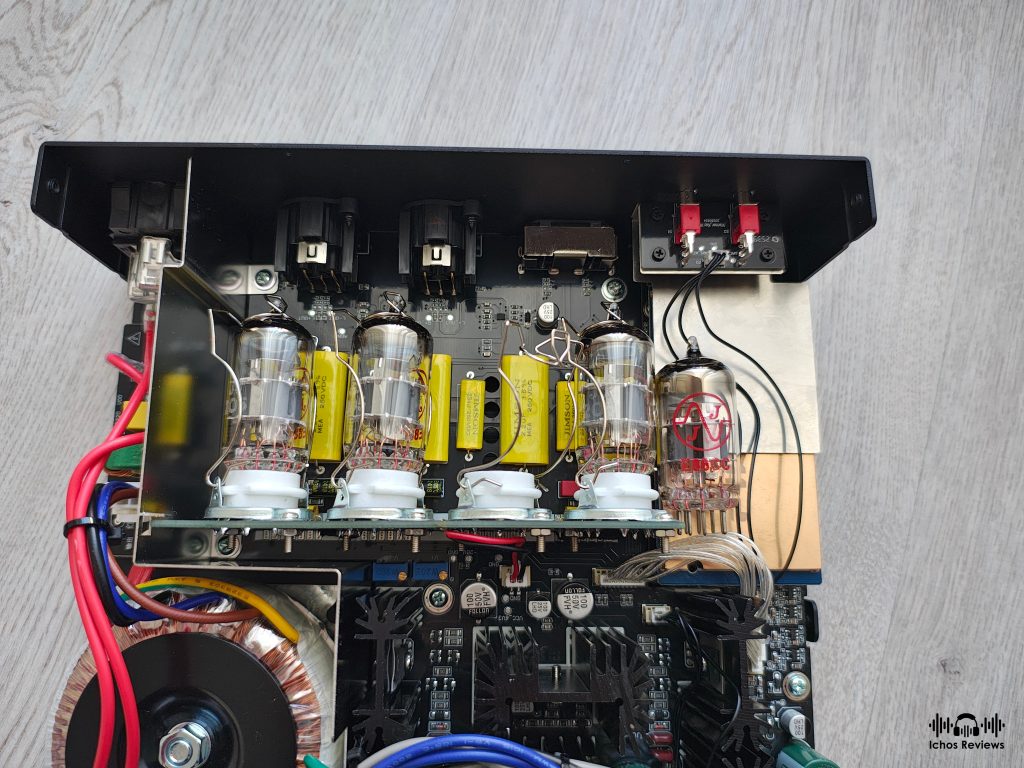
This might be FiiO’s first attempt to design a tube buffer but they were not afraid to dive deep right off the bat. Instead of using the traditional configuration of two tubes (one per channel), FiiO decided to go fully differential and use four tubes, one per phase.
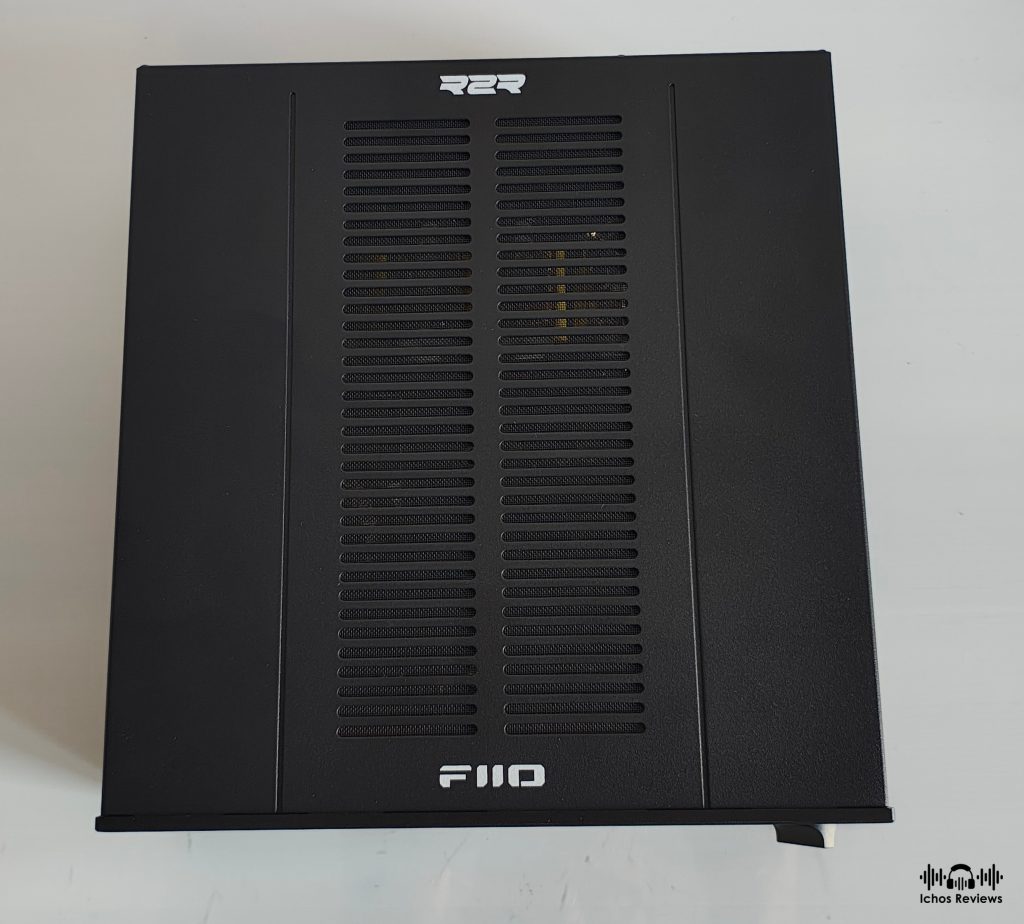
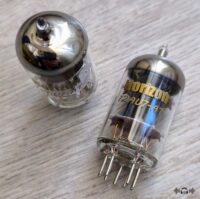
Inside you will find four E88CC vacuum tubes, manufactured by the renowned Slovakian factory JJ Electronic. The tubes are powered by a ±28V power supply and are placed into tube sockets for easy replacement or tube rolling, a hobby that can get quite expensive with so many tubes. Accessing the tubes is not very difficult, the only thing you have to do is to unscrew several screws and remove the top lid.
The analog output
For the signal path, FiiO decided to use metallized polyester film capacitors by Jimson. The analog output is delivered in both stereo RCA and XLR connectors with a fixed 1.8V and 3.8V output levels respectively. The Warmer doesn’t support preamplifier function so it can’t be used with power amplifiers or active monitors without their own volume control.
The power supply
FiiO has always paid special attention when designing their power supplies because they know that clean and steady power is the foundation of good audio. The Warmer is equipped with an internal linear power supply based on a 46W low noise, low ripple toroidal transformer that has three secondary windings, one for the digital, one for the analog and one for the master circuit.
Design and layout
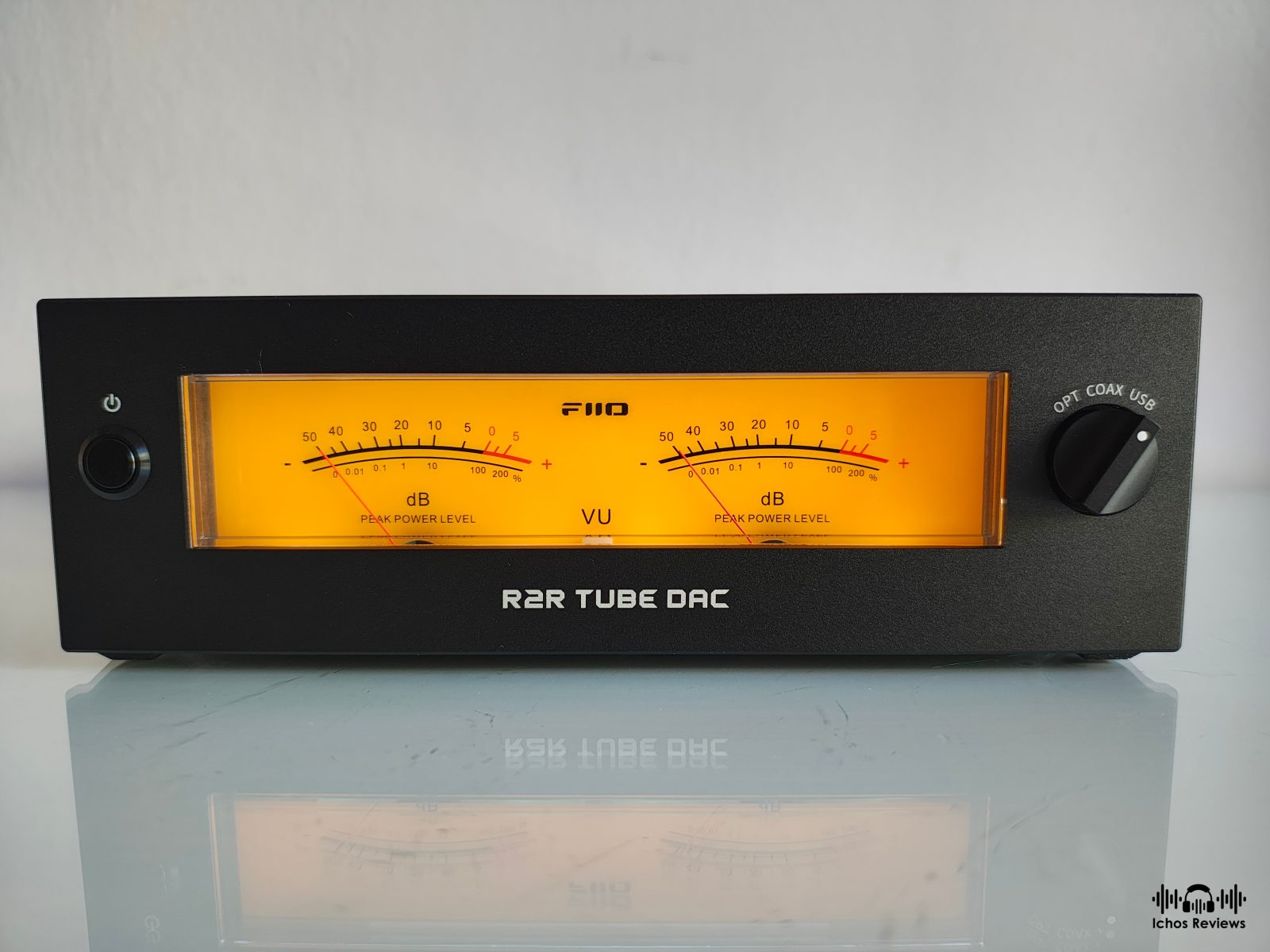
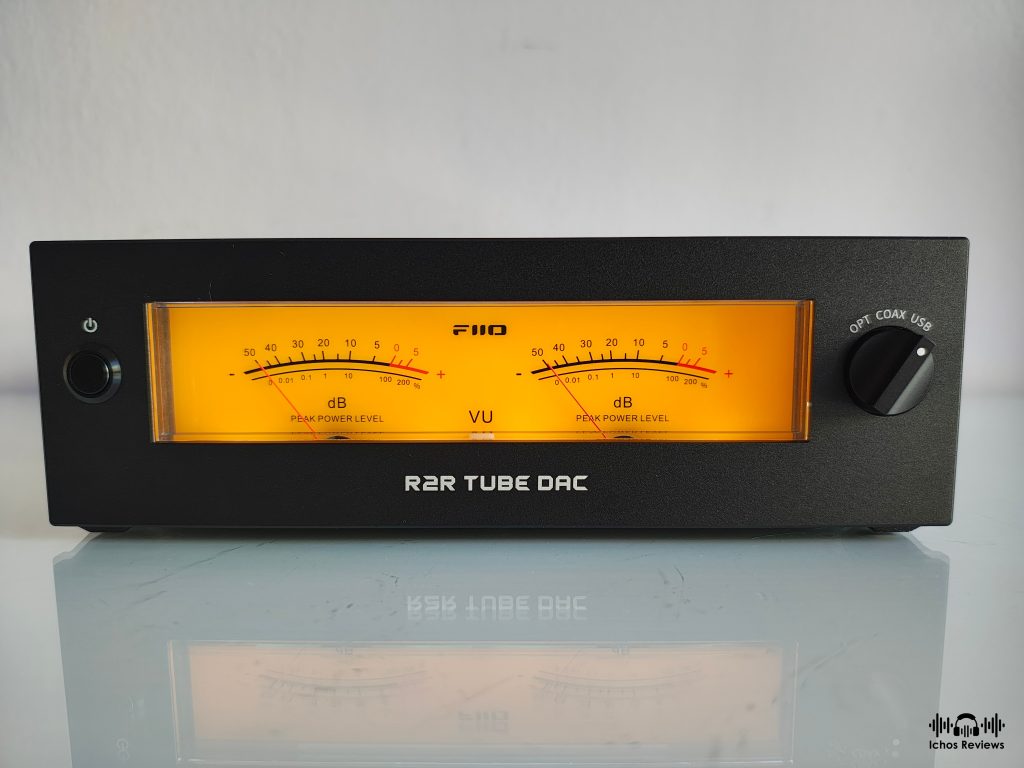
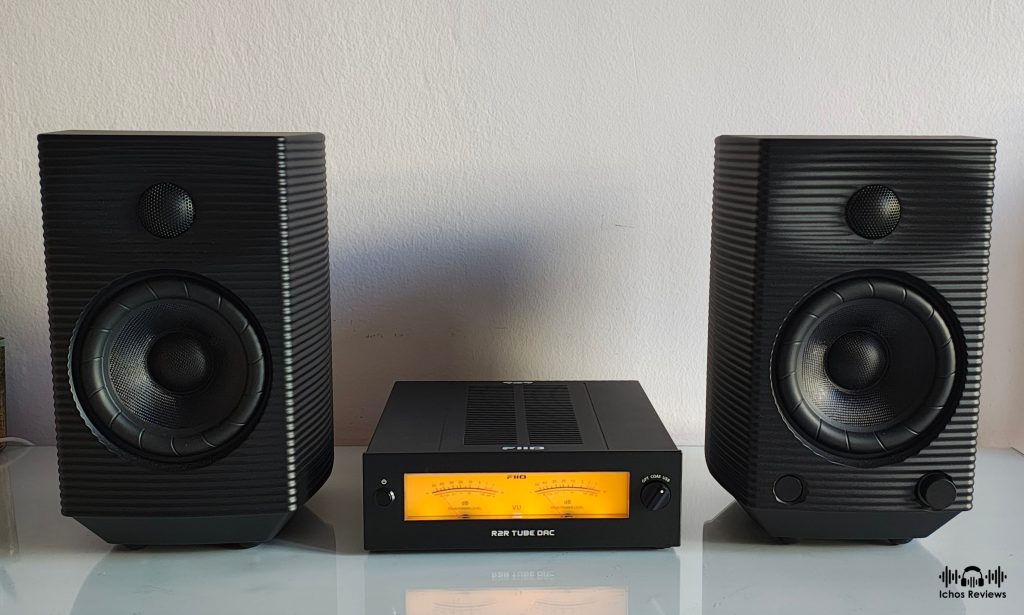
The Warmer has a plain, vintage-inspired design, dominated by an oversized front panel that houses a two-channel mechanical VU meter with a warm yellow LED backlight. The light intensity can’t be adjusted or turned off but it is relatively dimmed and not bright. The VU meter looks good only when viewed directly and not from an angle. A power on/off switch button at the left side and the digital input selector knob at the right, complement the ultra minimalistic front face.
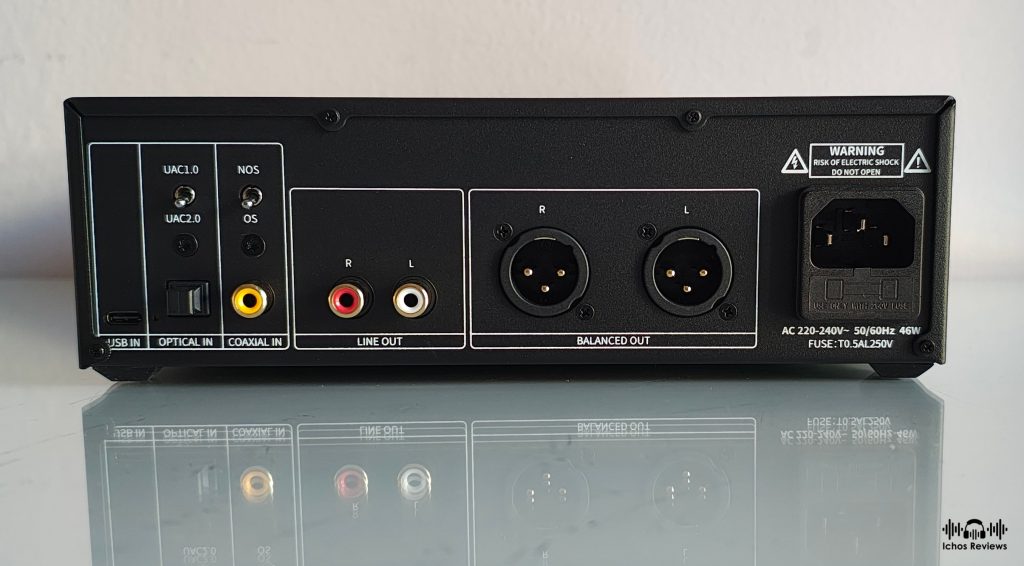
At the rear panel, there are stereo RCA and XLR analog outputs, together with three digital inputs (USB type-C, coaxial and optical), the UAC and DAC mode selector switches and the AC inlet. The position of the NOS/OS switch makes it impractical to use, especially when you have the Warmer placed in a HiFi rack.
Measuring 223.5x213x66.8mm, the device has a compact footprint that is suitable for desktop placement but it is still big enough to look great at a traditional HiFi rack. The very well made metal chassis is available in two finishes (black and silver) and is designed with grills at both its top and sides for effective heat dissipation.
Speaking of heat, the Warmer gets really warm, almost hot, and should be placed in a well ventilated area without other devices at its top.
Listening impressions
The FiiO Warmer was evaluated both in a two-channel speaker system, where it temporarily replaced the reference Lab12 DAC1, and with a variety of headphones paired with the Aune N7 headphone amplifier.
Just as its name suggests, the Warmer’s overall sound profile is indeed slightly “warm” but not to the extent that this warmth comes at the expense of transparency and fidelity. What we have here is a modern designed DAC that does not shy away from clarity, resolution and definition.
The Warmer carries all the analog and organic character one would expect from a well designed R2R DAC, while at the same time the sound is being enriched by some pleasing harmonic distortion thanks to the vacuum tube buffer.
People familiar with vacuum tubes will know that the JJ Electronic E88CC tubes are famous for their excellent clarity, transparency and technical performance, qualities that point closer to solid-state than traditional tube behavior.
These tubes do not introduce much unwanted coloration or tonal shifts. Instead, they subtly reinforce even order harmonics and gently round off the extremes at both ends of the frequency spectrum.
The resulting sound is mildly relaxed, smooth, melodic and naturally organic, entirely free of any digital artifacts or treble glare but still the Warmer’s technical performance remains pretty competitive. It may not be the absolute benchmark of its class but it does not lag far behind the competition either, especially when we consider that it is a DAC that combines R2R technology with tubes.
More listening impressions
Its overall technical competence is clearly evident in the dynamic and well controlled low end, the excellent separation of the midrange and the very respectable resolution in the treble. The sound produced by the Warmer is not slow or dark, it has excellent texture definition and is not deprived of energy and light in the higher frequencies.
Where it unquestionably stands out from the competition and takes the lead, is in tonal density, textural weight, timbral realism and the organic nature of its sound. The Warmer is expressive, melodic and harmoniously rich, a DAC that sounds emotionally engaging and connects the listener with the music.
The Warmer can handle all kinds of music but the truth is that it excels with classical and other acoustic genres. This is not the DAC that would be my first choice for listening to electronic or similar types of music and I would not recommend it for people that need the most technical and transparent sounding source.
Special mention must be made of the complete absence of noise. Even though FiiO is relatively new to tube based circuits, it has achieved an exemplary implementation in every respect where the Warmer surprises with its totally black background.
NOS vs OS modes
Engaging the NOS mode further trims and smoothens the peaks in the upper frequencies, producing a more romantic, euphonic and laid-back presentation. Technicalities and transparency are pushed slightly back in favor of a more traditional tube sound. There is some loss in overall control and firmness but the sound becomes more expressive and colorful.
In OS mode, the Warmer delivers higher fidelity and stronger technical performance without sacrificing the sonic qualities described above. The special R2R and tube magic is combined with solid transparency and resolution to offer a holistic listening experience.
In both configurations, the soundstage is impressive, particularly in speaker-based systems where it is rendered with convincing width, good separation between individual elements and a distinctly three-dimensional sense of the recorded space, although a bit more depth would have been much welcomed.
Vs the FiiO K11 R2R and K13 R2R
Both the FiiO K11 R2R and K13 R2R use the same R2R DAC board with the Warmer but they lack the tube buffer and the internal linear power supply. These two devices are multifunctional and also have an embedded headphone amplifier so they are differently positioned than the Warmer.
The K11 R2R is the world’s most affordable R2R DAC and the K13 R2R is a tier higher but honestly speaking, they can’t match the overall sonic realism and maturity of the Warmer’s sound as a pure DAC. Still, the K11 R2R is an unbeatable entry-level option and the K13 R2R offers a great portion of the Warmer’s sound without the tube coloration so it is an excellent choice for anyone looking to experience FiiO’s R2R sonic character in its purest form.
In the end
FiiO’s first standalone DAC successfully marries two well regarded technologies of the past – tubes and resistors – in a modern implementation that delivers a rich, melodic and realistic sound that effortlessly draws the listener into the music without that lacking in transparency and technical performance.
I would have absolutely no hesitation recommending the FiiO Warmer even at twice the asking price, let alone now that it is so low that one can’t help but wonder whether FiiO has made a mistake. Just consider that four JJ Electronic E88CC tubes currently cost around $100.
Honestly speaking, the Warmer is so affordable for what it delivers that it doesn’t come as a surprise that FiiO’s factory can’t meet the increasing production demand.
The FiiO Warmer has become one of my favorite sources and found a permanent place in the HiFi rack together with much more expensive DACs. Now, I can’t wait for its matching headphone amplifier that FiiO has promised to release in the very near future.
Copyright – 2026.
Authored by Petros Laskis for Ichos Reviews. All content is original and copyrighted. Republishing full reviews or substantial portions without written permission is prohibited. Excerpts up to 100 words are allowed with a direct link.
+ Tonally balanced and relatively neutral sound signature
+ Extremely natural, expressive and organic timbre
+ Weighty and harmoniously rich textures
+ Zero digital artificiality or treble glare
+ Competitive technical performance and transparency
+ Grand and immersive soundstage
+ NOS and OS decoding modes
+ Complete absence of background noise
+ Vintage appearance with mechanical VU meters
+ Easy respectable tubes
+ Excellent build quality
+ Exceptionally high value for money

- Produces a lot of heat
- NOS/OS switch inconveniently placed at the back
- Too many tubes can make tube rolling very expensive











Leave a comment