


The Muse HiFi M6 Double was kindly provided free of charge in exchange for an honest review. I didn’t receive monetary or any other kind of compensation and I don’t use affiliate links.
The price of the Muse HiFi M6 Double is $399 and you can buy it from HiFiGo.
Muse HiFi
Muse HiFi is a relatively new audio brand from China that has already built a strong reputation. Established around 2022, they have produced some acclaimed DAC/amps and earphones but it was the M5 Ultra that made them famous in the portable audio scene. An affordable, battery powered USB DAC/amp with a user selectable transistor or vacuum tube mode, and sound quality that exceeded all expectations. Click here to read the M5 Ultra review.
Muse HiFi M6 Double
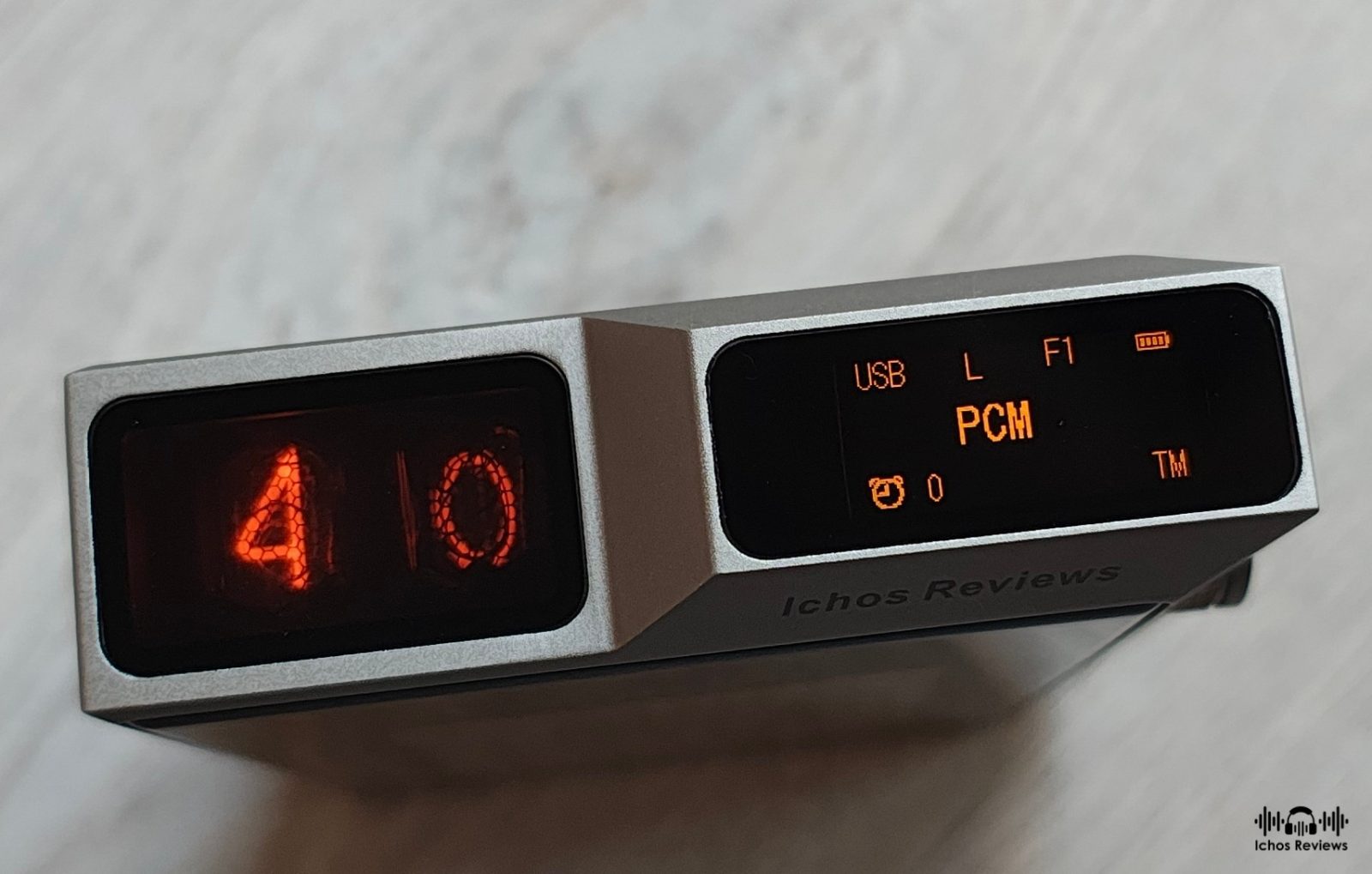
Following the success of the M5 Ultra, Muse HiFi recently released the M6 Double, another battery powered USB DAC/amp with a user selectable vacuum tube output stage and a unique analog cascading display with dual neon Nixie IN-17 tubes.
The M6 Double doesn’t really break new ground, Muse HiFi clearly understands the old saying “if it ain’t broke, don’t fix it,” so it doesn’t come as a surprise that the newer model is not radically different from its predecessor. The audio architecture and the overall design remain the same, however the M6 Double has some notable technical innovations under its sleeve.
Technical overview
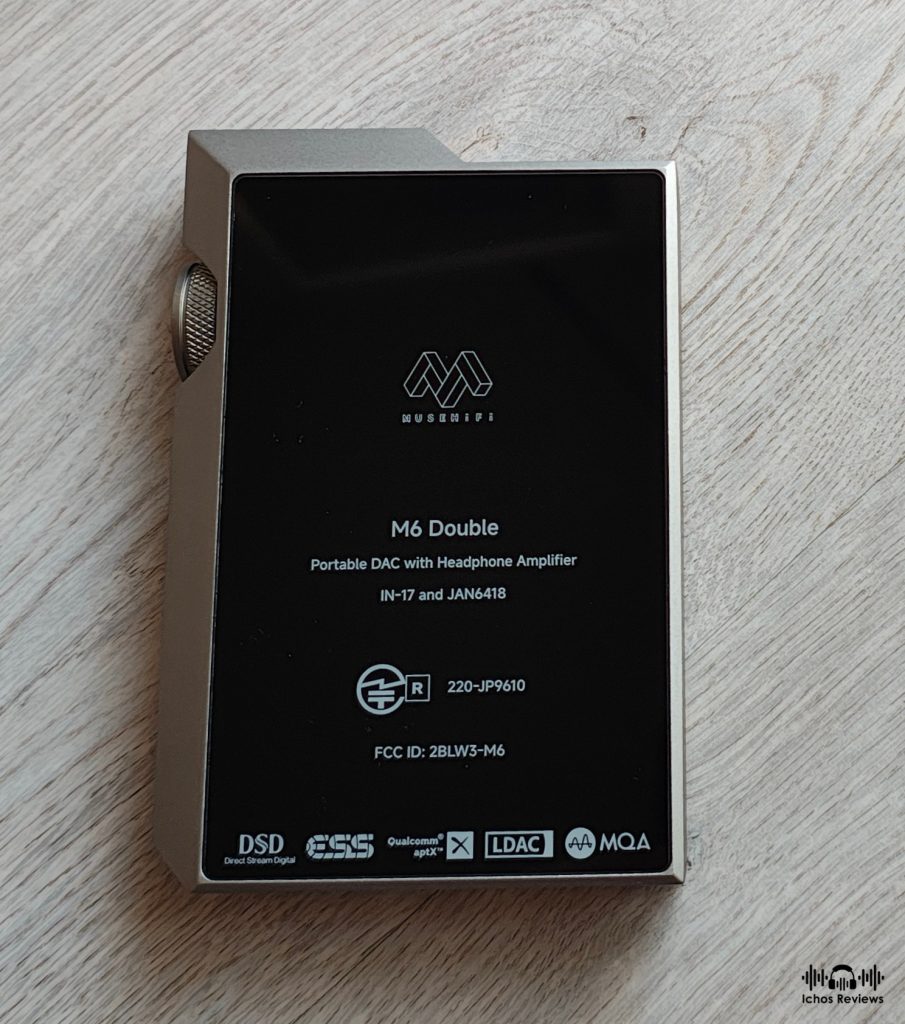
Instead of the ES9038Q2M DAC chip that was used in the M5 Ultra, the M6 Double comes equipped with the latest flagship ES9039Q2M chipset by ESS. Muse HiFi has closely collaborated with ESS and used a deeply customized version of the ES9039Q2M, paired with two Accusilicon AS318B series clocks running at 45.158MHz and 49.152MHz respectively for low-jitter performance.
The supported sampling rates are not disclosed but they must be 384kHz/32bit PCM and DSD512. The M6 Double doesn’t have any SPDIF inputs or outputs and is limited to a USB type-C input and wireless Bluetooth connectivity through the QCC5125 chipset that supports the LDAC and aptX Adaptive codecs.
The user-selectable tube output stage is based on dual JAN6418 mini tubes in a radically redesigned circuitry which significantly increases the power output in tube mode. The tubes are placed suspended in a specially designed shock absorber frame to protect them from vibrations and reduce microphonic noise.
The power supply is also completely redesigned as it requires independent 170V power rails for the Nixie tubes and 25V for the JAN6418 tubes. The power supply is based on a large 4500mAh capacity battery.
The Nixie Tube display
The major attraction of the M6 Double is its cascading Nixie IN-17 tube display that is used to show the volume level in two digits, ranging from 00 to 99 in 1 unit increments that correspond to 1dB each.
The Nixie tubes are vintage, gas-filled, cold-cathode electronic devices that were developed in the 1950s and used for displaying numbers and symbols via a distinctive orange neon glow discharge. The tubes contain a wire-mesh anode and multiple cathodes shaped like digits. When voltage is applied, the gas glows around the chosen digit. They require high voltage, typically around 170V but operate at very low current, making them especially efficient but not directly compatible with low-voltage power supplies.
The IN-17 model is the world’s smallest Nixie tube with a lifespan reaching up to 200,000 hours. Their commercial production ceased around the early 1990s so Muse HiFi had to search and collect NOS tubes from Russia and other Eastern Europe countries. They were able to acquire about 2200 pieces that were used to produce 1000 M6 Double units. The Nixie tubes are rare collectors items so there is a great chance that the value of the two IN-17 tubes that are used inside the M6 Double will exceed its actual price.
Design and layout
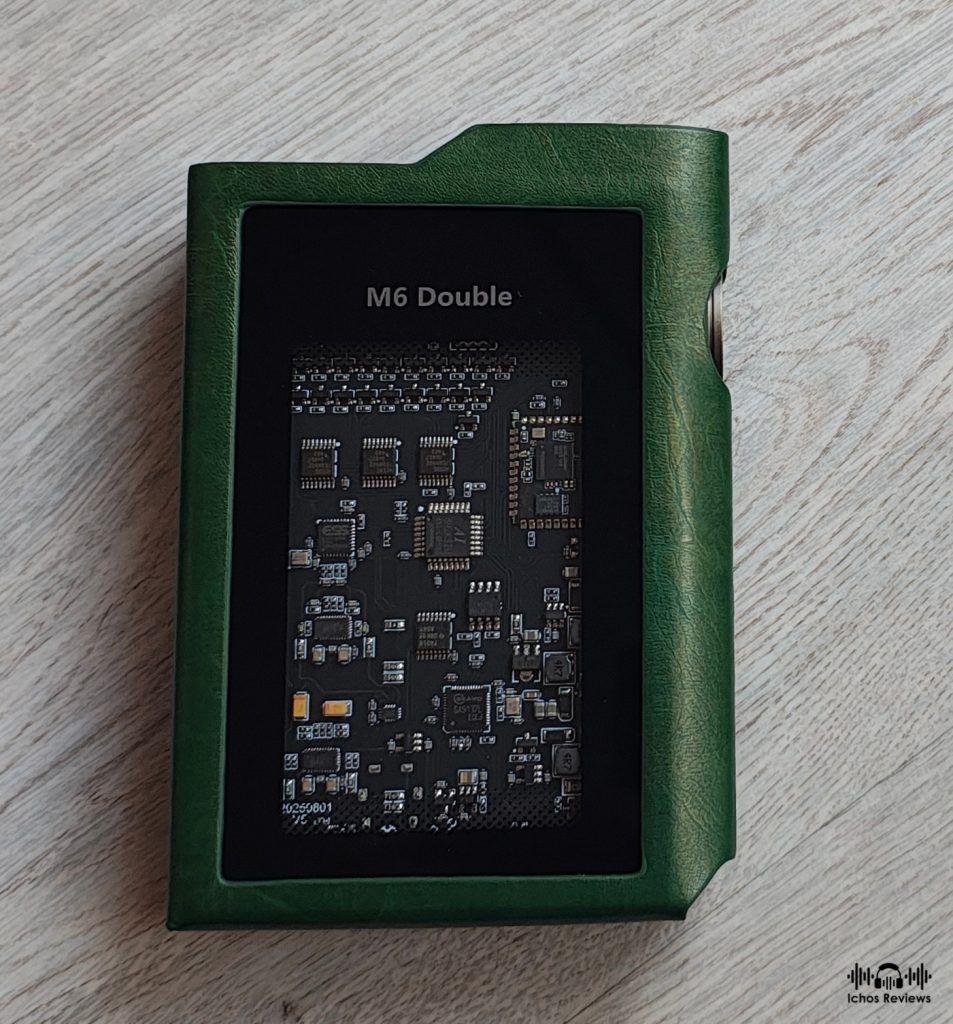
The frame of the device is made using solid CNC-machined aluminum and has a box-like shape with nicely squared edges and corners. The design blends modern industrial minimalism with vintage elements. The front and the back panels feature tempered glass surfaces that are fitted edge to edge. The front glass panel has black colored perimeters and an inner center part that reveals the internal PCB just like in the M5 Ultra.
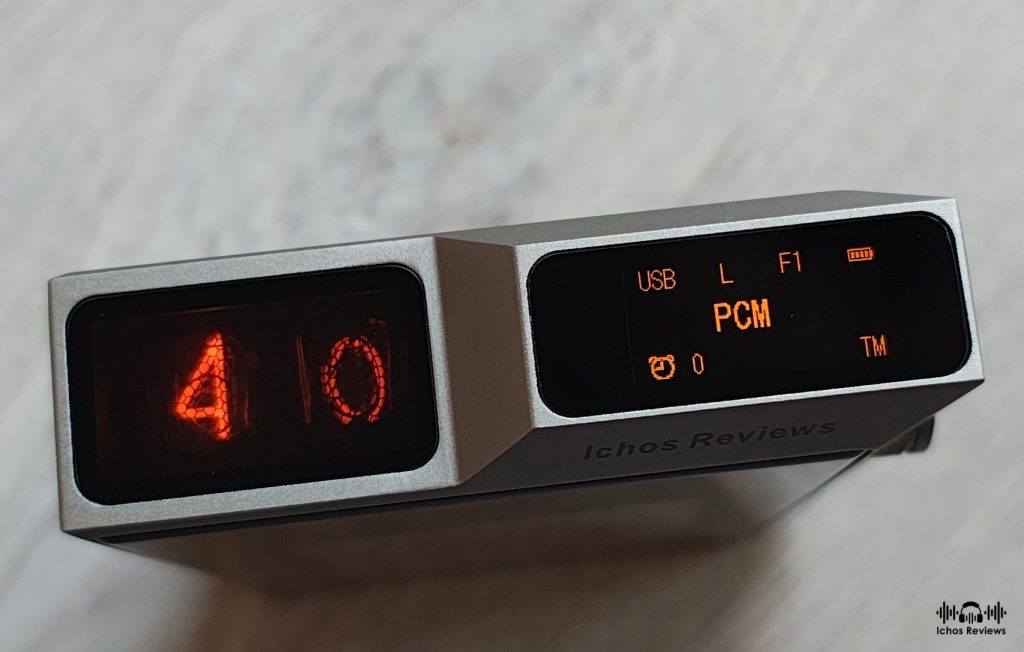
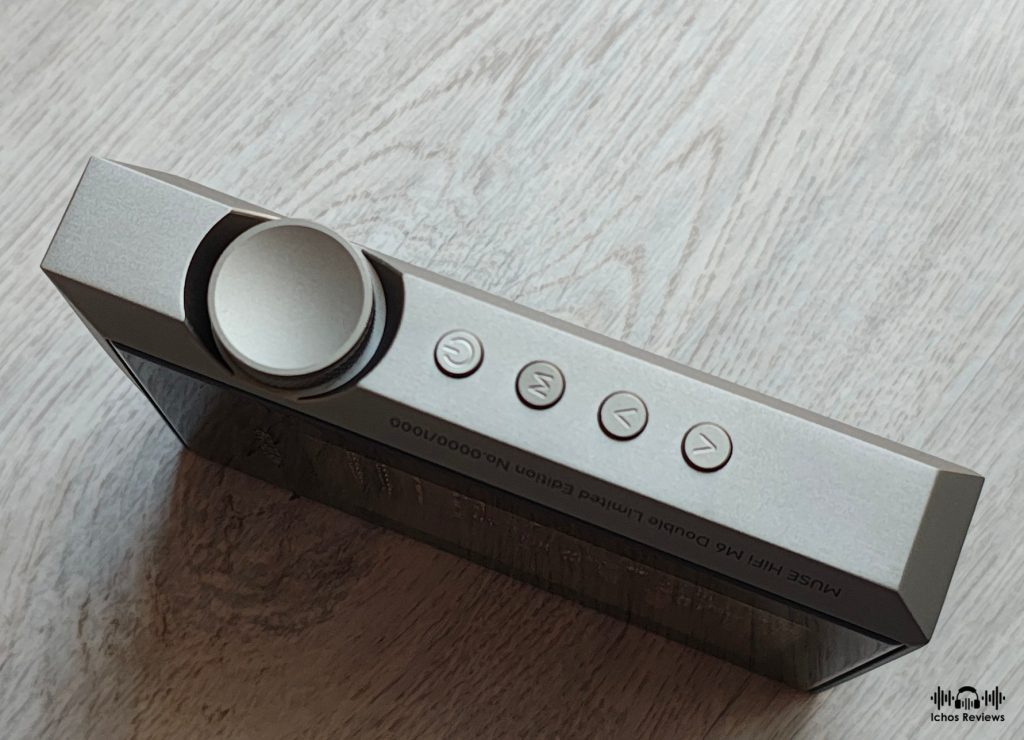
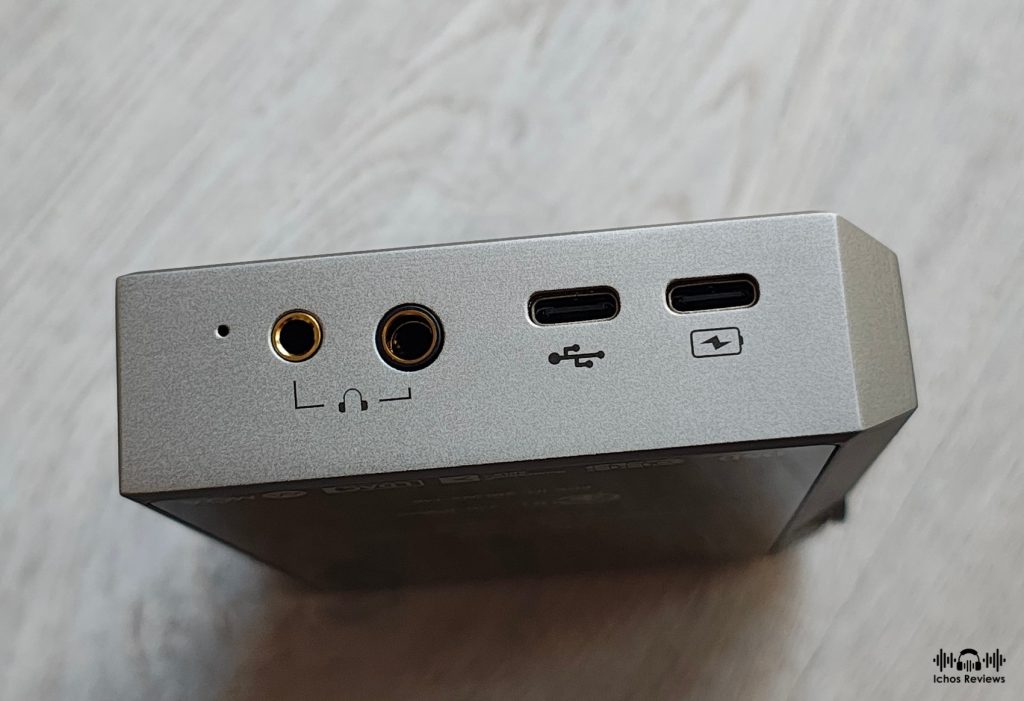
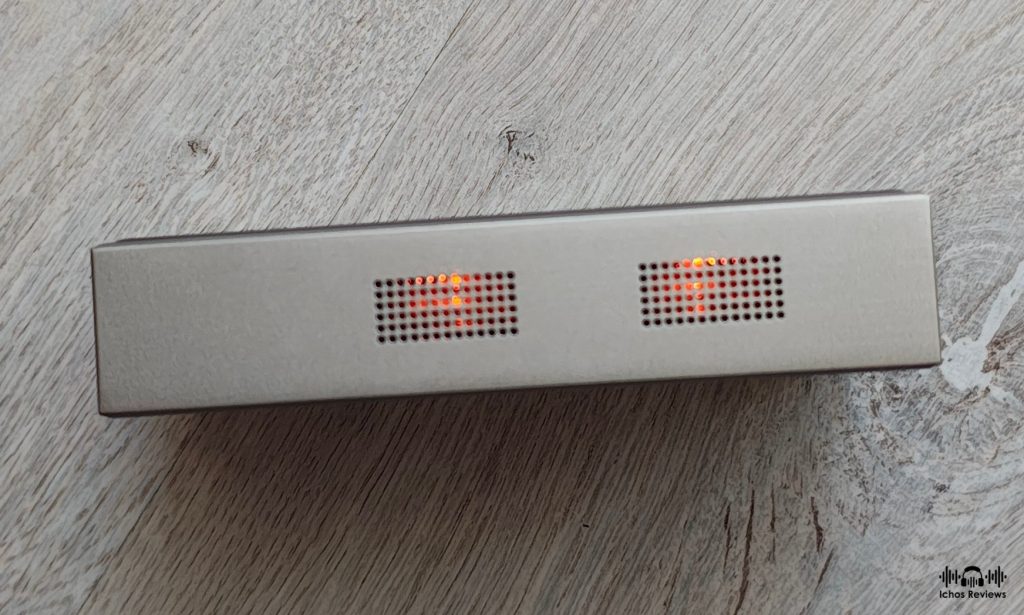
The upper asymmetrical top is divided into two recessed windows, the right one is a small elongated OLED display and the left is the Nixie tube display. At the right side there is an aluminum volume control wheel together with four aluminum buttons. At the left side there are two perforated frames that reveal the glowing tubes and let them vent. At the bottom there are 3.5mm and 4.4mm headphone outputs plus two USB type-C inputs, one for data alone and one for charging, as well as a small microphone for voice calls in Bluetooth mode.
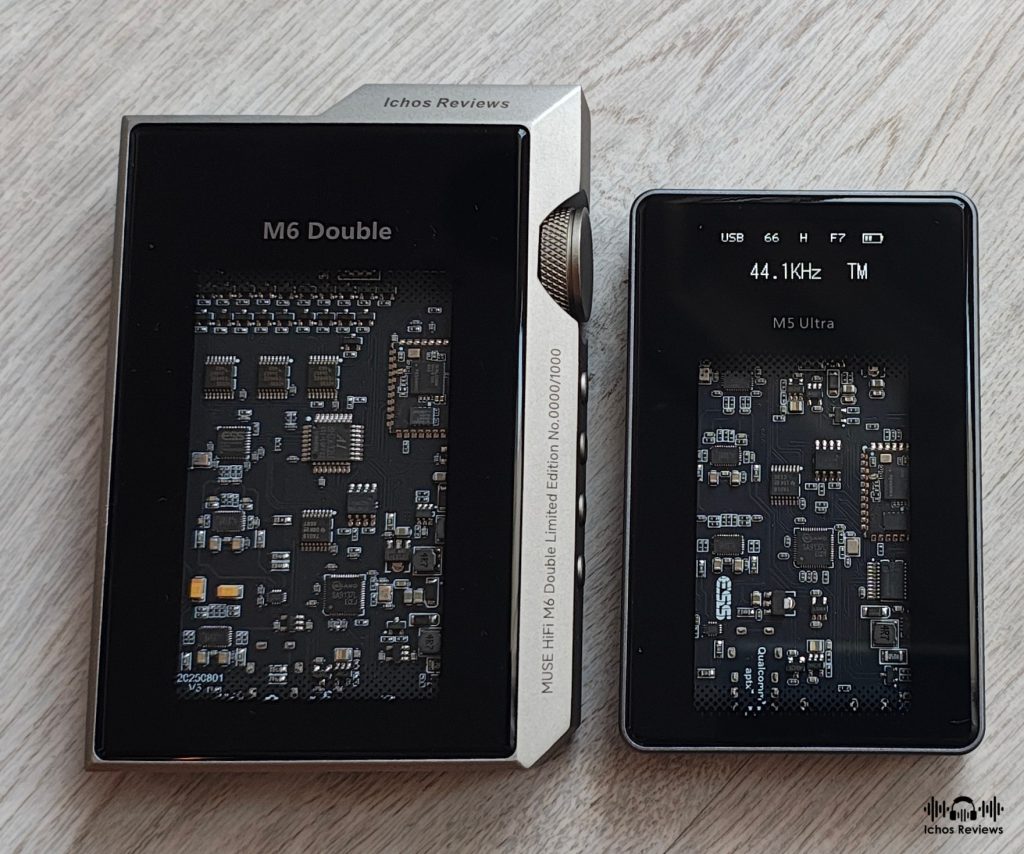
All the technical advancements and the inclusion of the Nixie tubes have made a severe impact on the size and weight of the M6 Double which is much bigger and heavier than the M5 Ultra. It measures 120x80x20mm and weighs 285g so it is more transportable rather than portable to be used stacked together with a phone.
Build quality and finish are excellent, the buttons won’t rattle and the overall feeling is that of a premium and well made audio device that stands out from the competition thanks to its unique Nixie tube display.
User interface
Just like the M5 Ultra, the M6 Double’s user interface is designed to be as plain and straightforward as possible. Muse HiFi adopts a simple operation logic without complex menus that are difficult to use when listening to music.
The user interface is neat without second and third level setting pages, all functions are simultaneously displayed on the screen. The only thing the user has to do is to use the “M” button to cycle through them, and then the two arrow buttons to change their value when selected. The functions are input (USB or Bluetooth), gain (L, M, H), digital filter (eight options), output mode (Valves or Transistor) and a 60min power off timer adjusted in 10min steps.
You can also use the two arrow buttons for previous/next track during music playback and the menu button to manually switch the display off which wakes again every time you adjust the volume or press a button. The display will not switch automatically off after a certain amount of time.
If there is something to complain about is the orientation of the displays which makes them impractical to use as the only option to view them correctly is while holding the M6 double upwards. But this will not happen frequently because you will either have it placed in a flat surface or vertically but with the display facing downwards because the cable inputs are located on the opposite side.
Accessories
The M6 Double comes generously accessorised, especially considering that it retails for $399. The package includes a high quality protective case made from genuine leather, a USB charging cable, plus type-C to C and type-C to Lighting cables and a USB adapter.
Battery duration
The 4500mAh battery doesn’t support fast charging and it needs about 4-5 hours to get a full charge but it lasts a monstrous 18-20 hours, playing music from its balanced output. In the rare case that you run out of battery, you can use the secondary USB type-C port to charge the device while playing music. The battery doesn’t support desktop bypass mode, so it is recommended to utilize full charge and discharge cycles in order to extend its lifespan.
Bluetooth performance
Bluetooth pairing is done simply, the only thing the user must do is to switch to Bluetooth input mode and wait until the M6 Double gets discovered by the phone. Once connected, the reception is stable and reliable within a distance of a few meters. Using the LDAC codec, sound quality is very good and on par from what is to be expected from the Bluetooth’s lossy nature. Not as good as with the USB cable but still great for the ease of use that it offers.
Power output and noise
The M6 Double is dead silent in transistor mode while switching to tubes introduces a very faint hissing noise that is only audible with very sensitive earphones like the FiiO FA19. The Nixie display doesn’t add any audible interference while you must tap the JAN tubes with force to make them ring. Really excellent performance by any means that produces a pitch black background during music playback that enhances resolution and detail retrieval in both modes.
Muse HiFi doesn’t publish any power ratings, exactly as they did with the M5 Ultra, so we are left to guess the real power output of the M6 Double and wonder why the company is so cryptic and less transparent in this regard.
The only known fact is that the circuitry of the M6 Double is designed to produce more power than the M5 Ultra in tube mode, something that gets immediately confirmed when you compare them side by side with the same headphones. My estimation after using various headphones is that the device must produce more than 600mW/32Ω but less than 900mW/32Ω.
Associated equipment
The M6 Double was paired with phones and tablets but most of the critical listening was done with the Volumio Rivo Plus as the digital transport. I have used various headphones and earphones, like the Meze Audio Silva and the BGVP Astrum.
The device was left playing music for about 100 hours in order to let the tubes settle down.
The M6 Double is a tube-hybrid DAC/amp that supports both solid-state and vacuum tube listening modes. Switching modes is easily done through the menu. The tube circuit engages immediately without any waiting time, however it is advisable to let the tubes warm for about half an hour before listening.
Listening evaluation
Transistor mode
In solid-state mode, the sound signature of the M6 Double is neutral with a hint of warmth. The ES9039Q2M DAC chip is generally speaking smoother sounding than the ES9038Q2M and Muse HiFi engineers have done an excellent job to further control digital artificiality and treble glare.
The tonal balance might be flat by reference standards but it never sounds clinical or sterile. This is an excellent implementation of this particular DAC chip in a tuning that successfully combines its renowned technical fidelity and transparency with a musical and engaging sonic character.
The treble is fresh, brilliant, airy and energetic but stays controlled without becoming piercing sharp or overly bright. The M6 Double is not a forgiving DAC that is going to smooth out lower quality recordings, but it is not going to highlight their deficiencies either.
High pitched instruments are reproduced with good weight and a natural decay, they don’t sound thinned out or artificially metallic. The timbre is natural and realistic enough, the M6 Double doesn’t exhibit much of the typical Delta/Sigma glare and digital artifacts are kept under control. It is pretty resolving and offers excellent detail retrieval without sounding too analytical as other competitive devices.
More transistor mode impressions
The mid-range is neutral and transparent but it also surprises pleasantly with its harmonic richness that is not usually expected from such a DAC/amp. It might not have the most analog and organic timbre but it still sounds natural and realistic with good tonal balance. Precision and clarity are on the highest levels but the sound doesn’t become lifeless or monotonous. The textures are refined enough, instruments and voices don’t sound lean or bland and the music flows with plenty of sentimental excitement.
The bass is exceptionally dynamic and impactful with weighty, visceral textures but at the same time fast, tight and controlled. The M6 Double offers class-leading technical performance that rivals even desktop components as long as you are using headphones that are within its driving limits. It produces an impressive low-end, both in quality and quantity, that is going to satisfy critical listeners and bass lovers alike.
The transistor mode is ideal for listening to all kinds of music while it can easily match with a great variety of headphones/earphones, from warmer to brighter ones, keeping its owner happy and satisfied under all circumstances.
Vacuum tube mode
Switching to the tube mode enriches the harmonic structure of the sound without adding much coloration or reducing bass and treble extension. Second order harmonics get an ear pleasing boost but the overall technical performance and the transparency remain pretty much intact.
There is some loss in bass firmness and control but it gains weight and elasticity plus a tiny bit of extra reverb. The mid-range might not sound as precise and crystal clean as in transistor mode but it becomes more expressive and melodic. The tubes enrich the organic elements of the timbre and make it more natural and realistic. The treble sacrifices some brilliance and resolution in favor of a smoother and more relaxed presentation.
The vacuum tube mode mixes a great deal of the ESS DAC’s technical precision and fidelity with some extra harmonic richness and tonal density while also reducing digital artificiality to very low levels. Muse HiFi has accomplished an excellent implementation that gives the listener a great taste of the tube’s unique sonic characteristics without much compromises in technical performance and fidelity.
The soundstage is open, spacious and extended in both modes with some minor differences between them. Imaging precision and placement accuracy are a little better in solid-state mode. It creates a grand soundscape on its own, but the tube mode pulls ahead in layering and the overall sense of holography, creating a more immersive listening experience albeit less precisely focused.
Vs the Muse HiFi M5 Ultra
The Muse HiFi M5 Ultra is also a battery powered, tube-hybrid DAC/amp with a smaller size and weight but similar outer appearance except the Nixie tube display.
Sonically speaking, the M6 Double is like the M5 Ultra on steroids, a more powerful device that sounds better in both transistor and tube modes. It outperforms the M5 Ultra in technicalities and transparency while it also sounds a bit more natural and realistic. The treble is less bright, digital glare is more controlled and the tube mode offers a greater deal of melodic expression and harmonic richness with less coloration or lack of technical control as in the M5 Ultra.
However, the differences are not that big to make the M5 Ultra obsolete, which additionally has the extra benefits that is more portable and less heavy than the M6 Double and also more affordable.
In the end
Muse HiFi made a statement in the market with the release of the M5 Ultra as the most affordable and excellent sounding battery powered, tube hybrid DAC/amp. But now, with the M6 Double they have gone a step further by elevating its sonic performance and exterior design into new heights while keeping its price very competitive.
The Muse HiFi M6 Double should not only be remembered for its unique Nixie tube display, but also as one of the best sounding battery powered DAC/amps regardless of price. Its overall sound quality is so good that it can easily compete with devices much more expensive, like the Questyle Sigma or the Cayin RU9, thus crowning it as the value king among the competition. Wether you like tubes or not, this is a DAC that deserves your attention and be warned that 1000 units are not as much as they might sound, so you better hurry and grab one before they vanish.
Copyright – 2026.
Authored by Petros Laskis for Ichos Reviews. All content is original and copyrighted. Republishing full reviews or substantial portions without written permission is prohibited. Excerpts up to 100 words are allowed with a direct link.
+ Tube and transistor operation modes
+ Stellar sonic performance in both modes
+ Excellent transparency and neutrality in transistor mode
+ Natural and organic timbre in tube mode
+ Low digital artificiality and treble glare
+ Big and immersive soundstage
+ No tube microphonic or background noise
+ Plenty of power to drive full sized headphones
+ Enormous battery duration
+ Separate charging USB type-C input
+ LDAC Bluetooth receiver
+ Unique Nixie IN-17 tube display
+ Excellent build quality
+ Comprehensive accessory bundle
+ Easy and simple to use
+ Competitive and affordable price

- Actual output power is not disclosed
- No SPDIF input or output
- No battery bypass mode
- Big and heavy for portable use










Leave a comment