

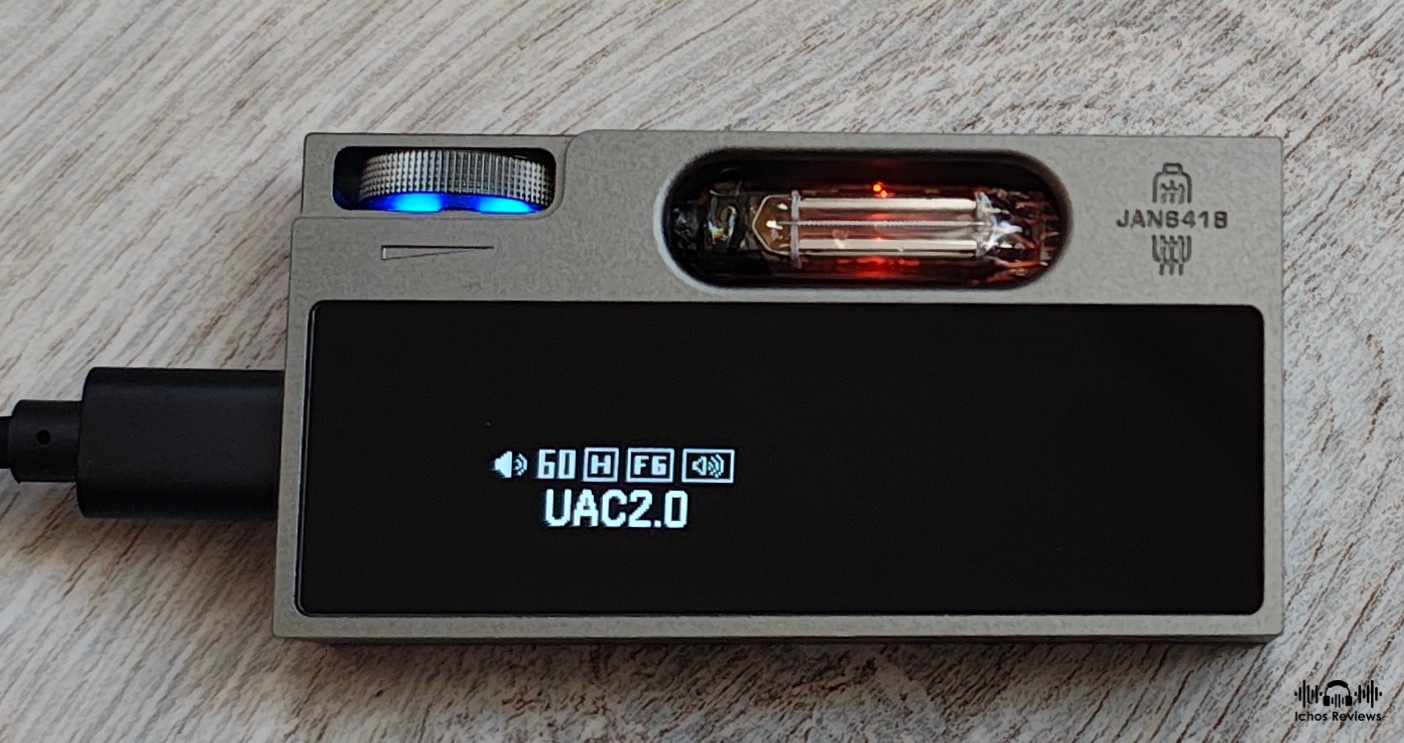

The Shanling UA7 was kindly provided free of charge in exchange for an honest review. I didn’t receive monetary or any other kind of compensation and I don’t use affiliate links.
The price of the UA7 is $269 and you can buy it from Amazon.
Shanling
Among audio enthusiasts, it’s hard to imagine anyone unfamiliar with Shanling, however every review must have an introduction.
“Shanling is a China-based audio brand that manufactures premium Hi-Fi gear, including digital audio players (DAPs), headphones, amplifiers, DACs, CD players and many other portable audio devices.
Backed by decades of experience in sound engineering, the company has earned a strong reputation among audio enthusiasts for blending refined design, high-quality materials and modern technology, together with traditional tuning practices.”
Ichos Reviews has reviewed many Shanling products. Click here to read past reviews and discover their extensive catalogue.
Shanling UA7
Shanling is a pioneer maker of portable USB DAC dongles, their catalogue includes many acclaimed models such as the UA6, the UA4 and the UA1 Plus, just to name a few from the most recent ones. The latest addition to the lineup is the UA7, which is the first USB dongle from Shanling with a tube-hybrid output stage.
The Shanling UA7 is a portable USB DAC/amp with user-selectable solid-state and tube output modes. Shanling knows the game very well, let’s remember that it is essentially the designer behind the ONIX Beta. Unsurprisingly, these two devices share a lot of common characteristics but also some key differences as we are going to find later on.
Technical overview
Inside the UA7 there is the ES9069 DAC chip by ESS, together with an OP + BUF advanced amplifier design. The DAC supports sampling rates up to 768kHz/32bit PCM and DSD512, boasting an impressive 117dB SNR.
The UA7 is the first portable DAC by Shanling with such an advanced circuitry, which is essentially borrowed from their high fidelity DAPs. A pair of OPA1612 op-amps is responsible for the I/V conversion, and two OPA1662 together with four BUF634 form the fully balanced headphone amplifier.
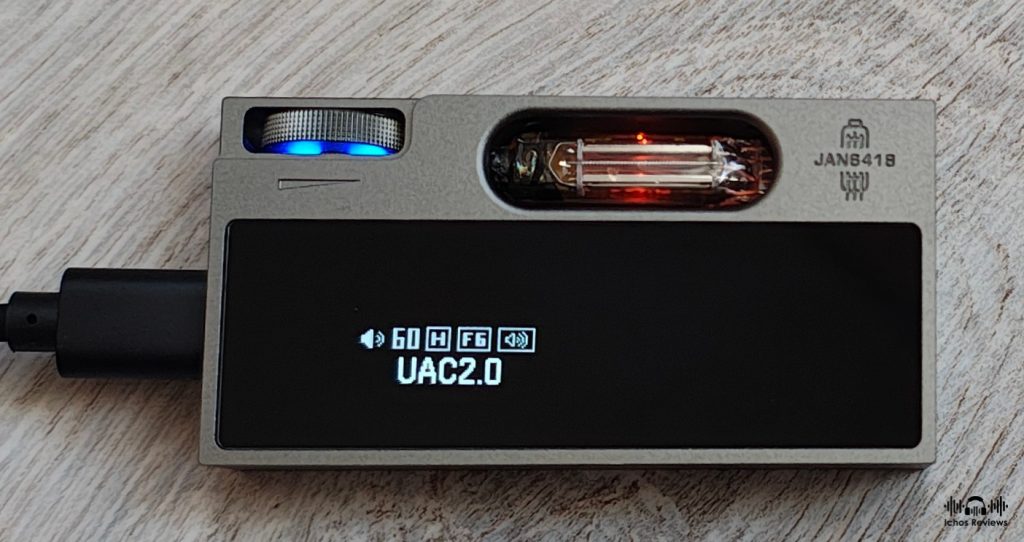
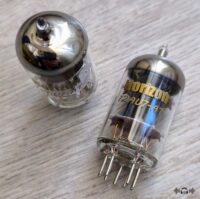
The user-selectable tube voltage gain stage is designed with dual JAN6418 mini-tubes that are placed in a custom-designed shock absorption structure that reduces vibrations. The user can easily switch modes from the menu.
Design and build quality
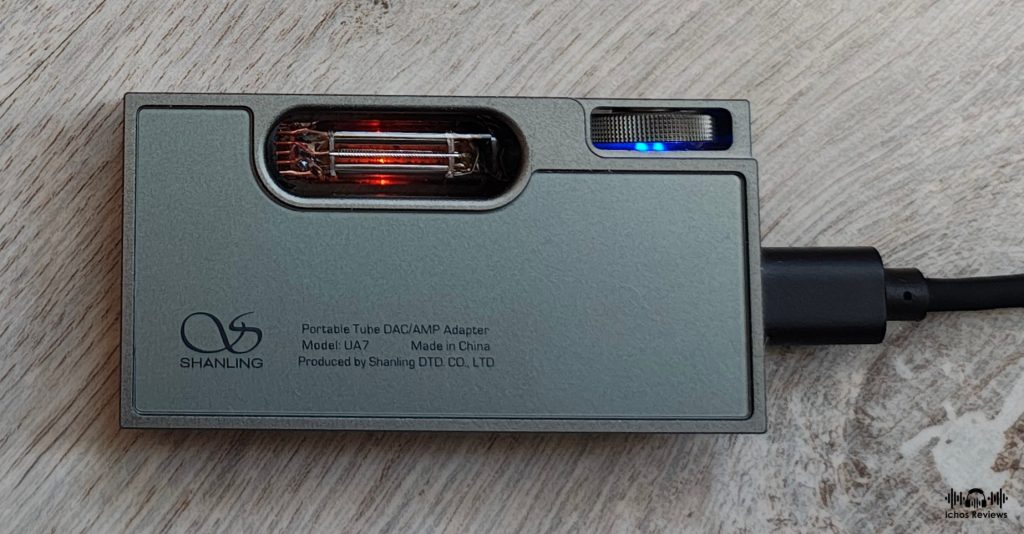
The UA7 has a plain, rectangularly shaped chassis that is made from CNC machined aluminum with glass panels at the front and back surfaces. It is available in three colors to choose from: deep black, titanium grey and radiant orange.
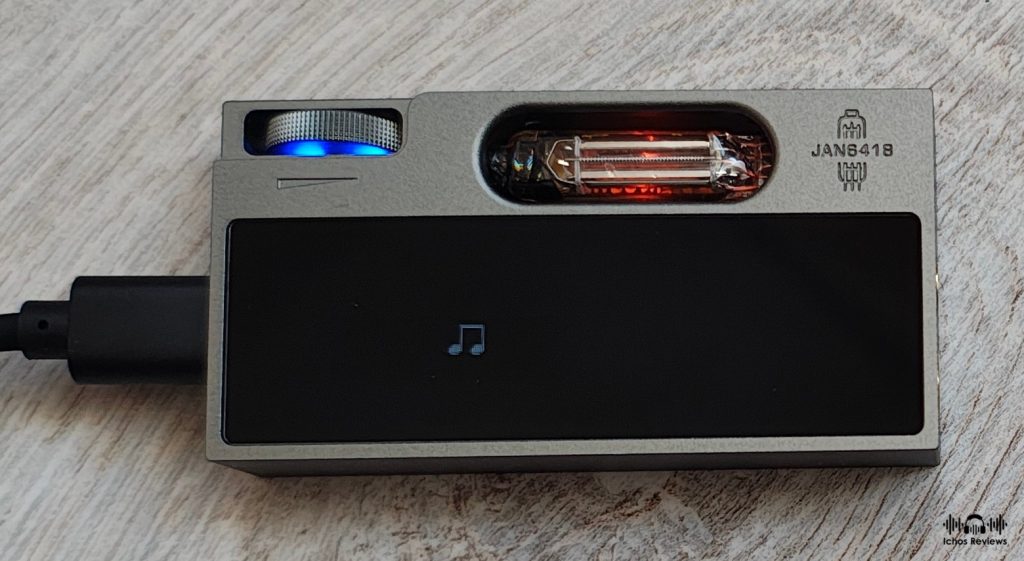
The U7 is also equipped with a 0.87” OLED screen and a multifunctional wheel which has a backlight that changes colors in accordance to the input sampling rate. The device is easy to handle and use but its sharp corners make it feel rather uncomfortable when held at the hand.
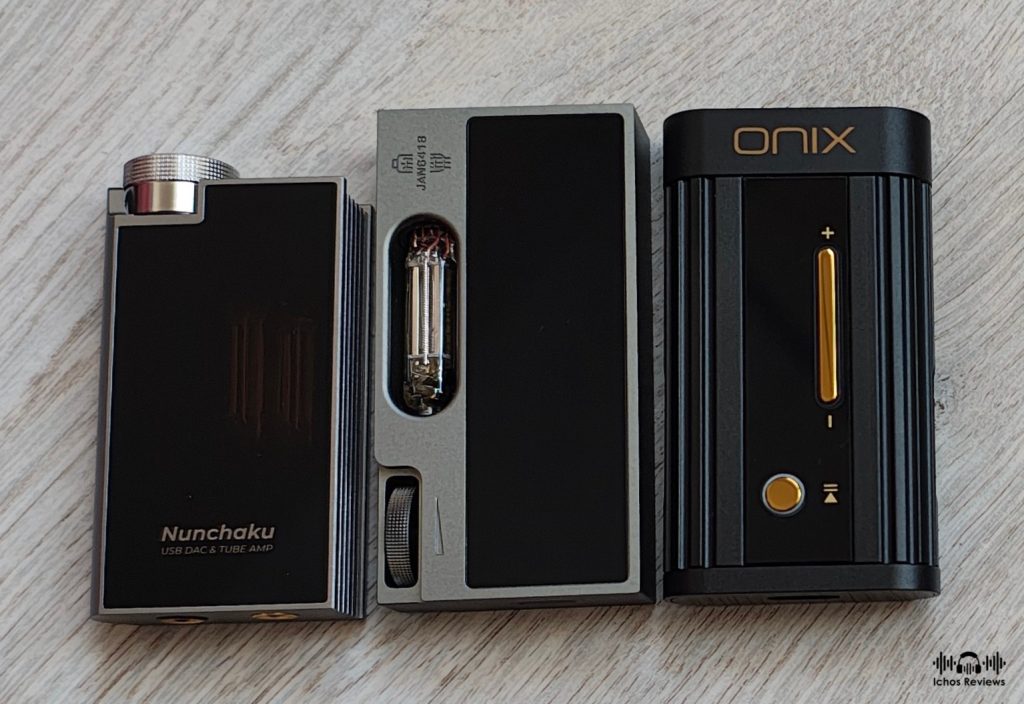
The chassis measures 70x36x15mm and weighs 48.5g so it is compact and lightweight enough. Still the iBasso Nunchaku is slightly more compact and less heavy than the UA7 or any other dongle with tubes.
What differentiates the UA7 from the competition and makes it look unique, is that the tubes are directly exposed and not protected underneath glass or grills. This design is reminiscent of a traditional tube amplifier and lets you enjoy the glow of the tubes but also leaves them completely unprotected. Considering that the UA7 is going to be used on the go, it becomes pretty clear how easy it is to damage the tube’s outer surface or even break them.
User interface
The UA7 has an onboard menu which is activated by long pressing the multifunction wheel and allows the user to adjust all parameters without the need to connect with an application.
During music playback the screen displays the input sampling rate, as well as volume level, gain setting, digital filter and the function of the multifunction wheel.
The user can adjust the amplifier gain (low, high), enable the tube mode, set the menu font (eight options), select digital filter (eight filters), adjust channel balance, set the action of the button during music playback (DAC volume ± or system volume ± or previous/next track), select UAC mode, set the screensaver time out, rotate screen orientation and adjust its brightness.
You can also adjust all these parameters through Shanling’s Eddict application which further allows for easy OTA firmware updates and can be used as a music player.
The multifunction volume wheel is very practical but the absence of other buttons limits its functionality during music playback where you can either use the wheel to adjust volume or change track. In the second case, you are left to adjust the volume from the host device.
Accessories
Included in the box are a short USB type-C to C cable and a type-C to A adapter. A PU leather case is sold separately.
Power output, noise and efficiency
The maximum output power of the UA7 is 577mW/32Ω (288mW*2/32Ω) from its balanced output and 195mW/32Ω (97mW*2/32Ω) from the single ended, both in transistor and tube modes. Numbers more or less the same with similar portable USB DAC dongles and enough to drive most earphones plus some easy to drive headphones, like the Meze Audio 105 Silva.
The amplifier has two gain settings (low and high) and the volume can be adjusted in 100 individual steps, making it a breeze to match with various loads. The tubes are not microphonic during normal use and the noise level is exceptionally low with just a faint hissing that is barely audible. The solid-state mode is completely silent.
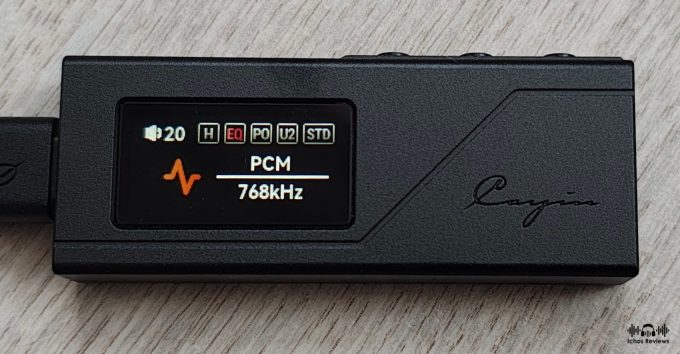
The power consumption of the device was measured at 0.15A in tube and 0.12A in transistor mode. The Shanling UA7 might not be as powerful as the Cayin RU3 but it consumes half the power, making it very efficient and battery friendly.
The UA7 was updated to the latest 01.00.01 firmware and was left playing music for about 100 hours to let its tubes settle down.
Listening evaluation
Solid-state mode
The solid-state mode produces neutral and uncolored sound with great transparency and class-leading technical performance. The tuning is energetic and brilliant but it carefully avoids becoming clinical or sterile. The UA7 is less warm sounding than someone would have expected from Shanling but its timbre is sufficiently realistic with very low amounts of digital artificiality.
The bass is fast, tight and controlled with excellent layering. The presentation leans on the technical side, with clean and well defined textures that are not that elastic or weighty. The UA7 produces powerful low-end that might be slightly lacking in physical impact but it is equipped with all the technical skills to handle the most demanding music.
The mid-range is neutral without additional coloration or warmth but it doesn’t sound lifeless or flat. The presentation focuses on clarity and precision, rather than trying to extract the harmonic richness of the music. The UA7 is not the most organic and colorful source among the competition, however it doesn’t sound boring and is expressive enough to connect the listener with the music.
The treble is fast, exciting and a touch bright but not brittle or sharp. The UA7 offers class-leading clarity and resolution, letting the user focus on individual details without veering into analysis. It is a very transparent and mildly unforgiving source but not up to the point to make lesser quality recordings unlistenable. However, some careful earphone matching can help a lot to make them sound more enjoyable.
Tube mode
If you have been expecting strong tube flavor, extra warmth and old-school bloom, you better look elsewhere. The UA7 is considerably less “tubey” sounding than any other portable USB DAC with tubes that I have tested thus far.
The tubes are implemented in such a way to just sparingly enhance the harmonics of the music without adding much coloration or warmth. The presentation does become a touch more relaxed and the treble smoothens out a little bit but the technical and highly transparent attitude of the UA7 doesn’t change a lot.
The bass gains some elasticity and weight, while the mid-range becomes more expressive and melodic in comparison to the solid-state mode, but not as much as it happens in other tube dongles. Activating the tube mode also lowers the already low amounts of digital artificiality and makes the timbre more natural but not too organic or analog.
The soundstage
The soundstage is big and wide in both modes with plenty of inner spaciousness and very precise imaging. Switching to the tube mode, pulls the listener a little further away from the stage and adds some extra depth at the expense of some imaging accuracy. From solo singers, to small sized ensembles and large symphony orchestras, everything you throw at the UA7, sounds realistic and convincingly arranged in the stage.
Vs the ONIX Beta
The ONIX Beta ($349) is a tube-hybrid USB DAC dongle that was co-developed by Shanling and ONIX so it doesn’t come as a surprise that it shares common characteristics with the UA7 both in circuitry architecture and the software.
The Beta uses dual CS43198 DAC chips and a headphone amplifier that is based on dual OPA1622 and quad BUF634 op-amps. The Beta is slightly less powerful (550mW vs 570mW) but it also consumes a little less power. The actual differences are negligible though and not to be considered seriously when trying to decide which one to buy.
The Beta adopts a more retro design and is a bit more practical to use because it comes with three buttons and has a rounded shape that makes it easier to handle.
Sonic comparison
This classic vs modern styling also extends to their overall sonic character. The Shanling UA7 is more modern and fresher sounding than the Beta in both tube and solid-state modes. It presents the music in a more technical and transparent way, offering stronger fidelity and precision.
The UA7 is faster and more energetic with a bass that is firmer and more controlled plus treble that is more brilliant and vivid. Its mid-range is not as rich and melodic as in the ONIX but it is more defined and clean.
The great difference is in the tube mode where the Beta sounds considerably more organic, slightly warmer and more expressive, with much greater harmonic richness and colorful textures, all while keeping respectable transparency and fidelity.
In the end
Shanling’s first USB DAC dongle with tubes is not only a great sounding one but it also breaks the rules as it comes with a different sonic presentation in comparison with the competition.
Shanling decided to adopt a fresher and more unconventional tuning, slightly limiting the effectiveness of the tubes in order to make the UA7 more appealing to users that are willing or curious to experience some tube flavor but without crossing the borders.
The Shanling UA7 is like an inspired and skilfully composed variation of a musical theme that sounds better and more enjoyable than the main theme itself that is boring familiar in comparison.
Copyright – 2026.
Authored by Petros Laskis for Ichos Reviews. All content is original and copyrighted. Republishing full reviews or substantial portions without written permission is prohibited. Excerpts up to 100 words are allowed with a direct link.
+ Solid-state and tube output modes
+ Excellent sonic performance in both modes
+ Class-leading fidelity and technical performance
+ Modern implementation of the tube stage
+ Powerful enough and efficient
+ Exceptionally low noise in tube mode and dead silent in solid-state
+ Unique appearance with fully exposed tubes
+ Internal menu and accompanying app
+ Excellent build quality
+ More affordable than the competition

- Not for those seeking strong and organic tube flavor
- Relatively lean and dry textures
- Exposed tubes are easy to damage
- Limited playback control and no support for EQ
- The protective case is sold separately






Leave a comment