

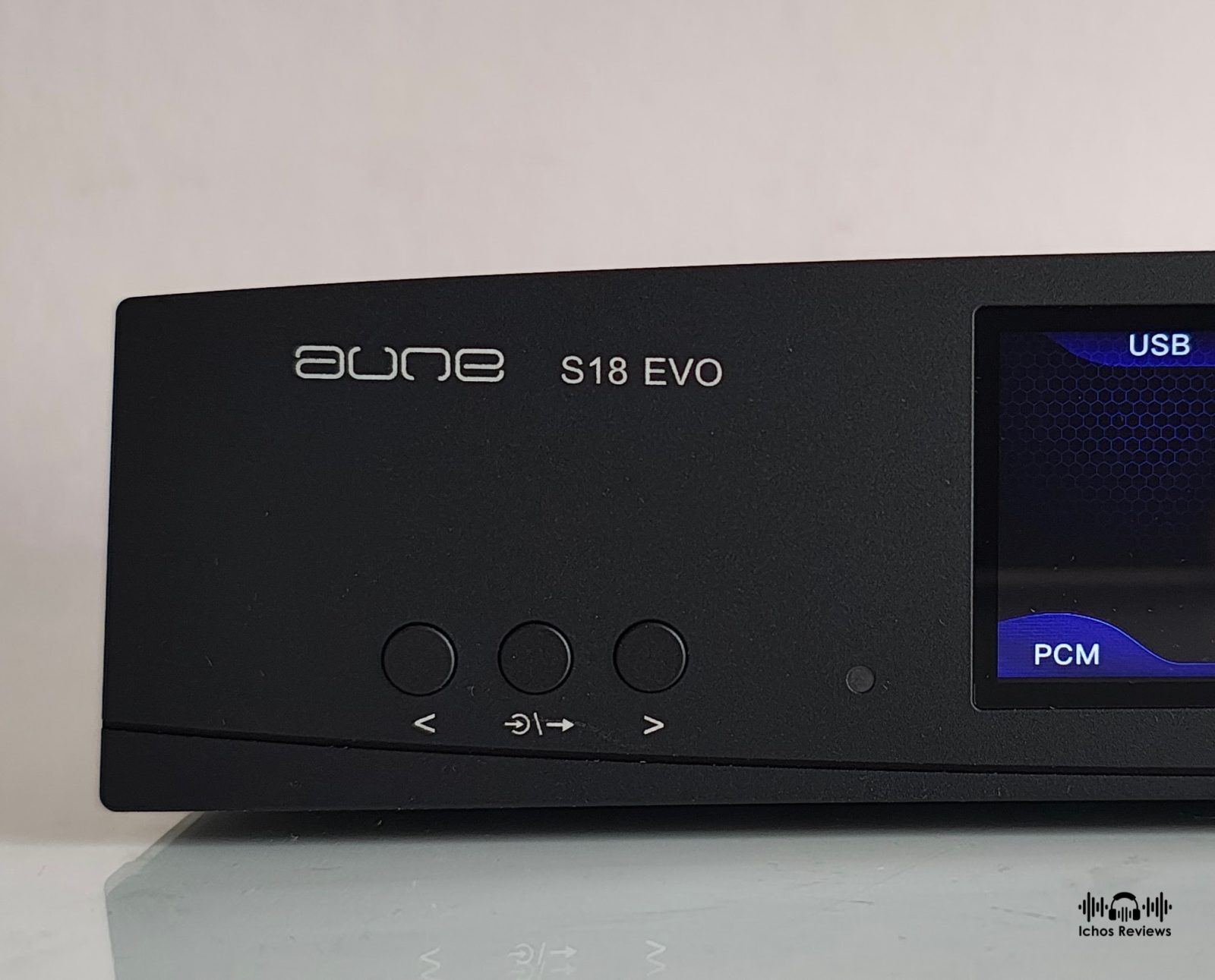

Today’s review is about the Aune S18 EVO, the brand’s flagship DAC that uses dual AK4497 DAC chips and 3rd generation PLL technology.
The review sample was kindly provided free of charge in exchange for an honest review. I didn’t receive monetary or any other kind of compensation and I don’t use affiliate links.
The price of the S18 EVO is 839€ and you can buy it from Aune Store or Aune’s official Amazon store.
Aune Audio
Aune Audio is an audio manufacturing company that was established back in 2004. Based in Wuhan, China, the brand has built a strong reputation in the audiophile community with many successful products that are well regarded for offering great value for money. The Aune S17 Pro EVO and N7 headphone amplifiers, as well as the SR7000, AR5000MK2 and AC55 headphones, are some notable examples of the brand’s product lineup.
Click here to read Ichos Reviews full Aune Audio coverage.
Aune S18 EVO
The Aune S18 EVO is a desktop DAC equipped with dual AK4497 DAC chips and third-generation PLL technology, which dynamically tracks and eliminates errors between the reference and feedback clocks.
Unlike conventional DAC designs, the S18 EVO employs an ultra-low-jitter PLL to provide a superior clock signal to the XMOS USB receiver, ensuring full-device synchronization and minimizing jitter. Furthermore, all digital inputs are reconditioned and fed to the DAC through the IIS interface.
The device supports PCM up to 768kHz/32bit and DSD512 decoding through the USB input, while the remaining inputs are limited to 192kHz/24bit.
The mirrored, fully balanced circuit is powered by a 50W toroidal transformer, with separate power supplies for the digital and analog sections and more than 32,000μF of total filtering capacitance. As is usually the case with Aune, both the driver and output stages feature custom discrete designs. Carefully selected, high-quality components, including Panasonic, Nichicon and Nippon capacitors, Vishay resistors and Neutrik connectors, are used to ensure the best possible sound quality.
Design and Build Quality
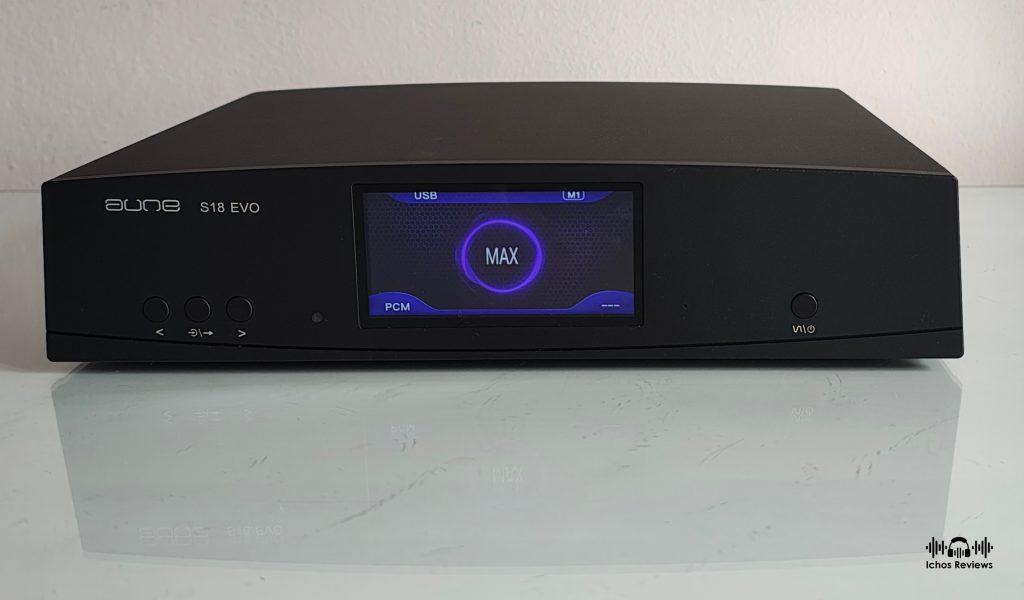
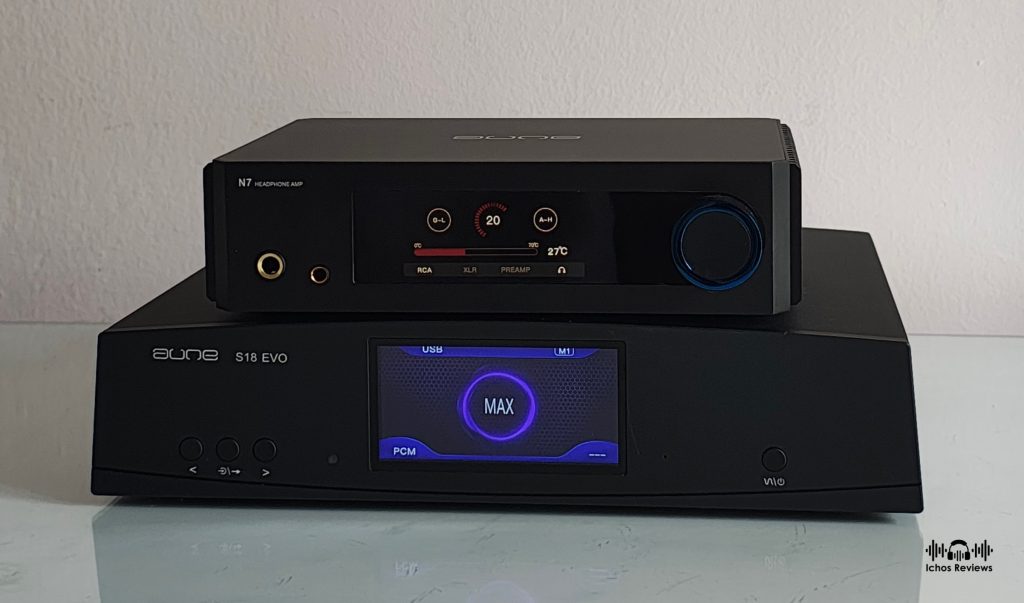
The S18 EVO has an arc-shaped chassis, just like all other members of Aune’s “S” family. It is visually attractive and minimalist, but not that practical when stacking one device on top of another, as it leaves a visible gap on both sides.
The exceptionally well-made enclosure is made of aluminum alloy and is available in either a black or silver finish. Measuring 288×211×63mm, the Aune S18 EVO has the right dimensions for both desktop use and placement in a HiFi rack.
Connectivity and User Interface
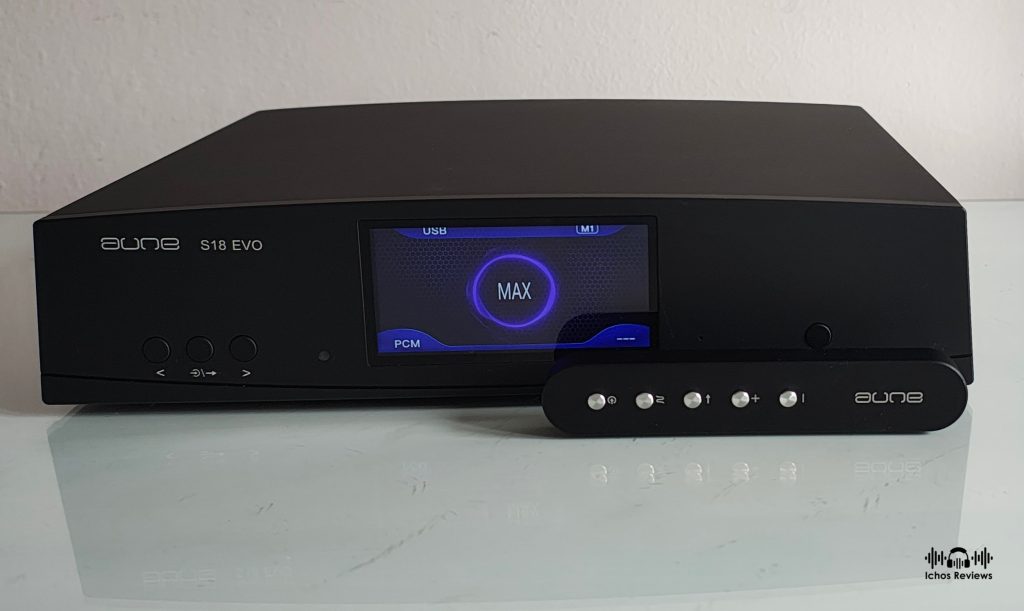
At the center of the front panel, there is a large color screen that is easy to read and displays all the useful information at a glance, including the volume, sampling rate, selected input and digital filter.
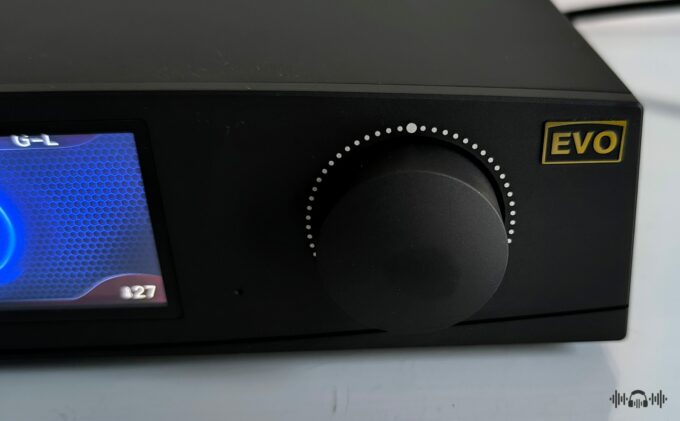
The device is equipped with three push buttons on the left side and another one on the right. They can be used to adjust the volume, switch digital inputs, mute the device, select the digital filter and switch the unit to standby or wake it up. Even better, all these functions can be controlled with the high-quality aluminum remote control.
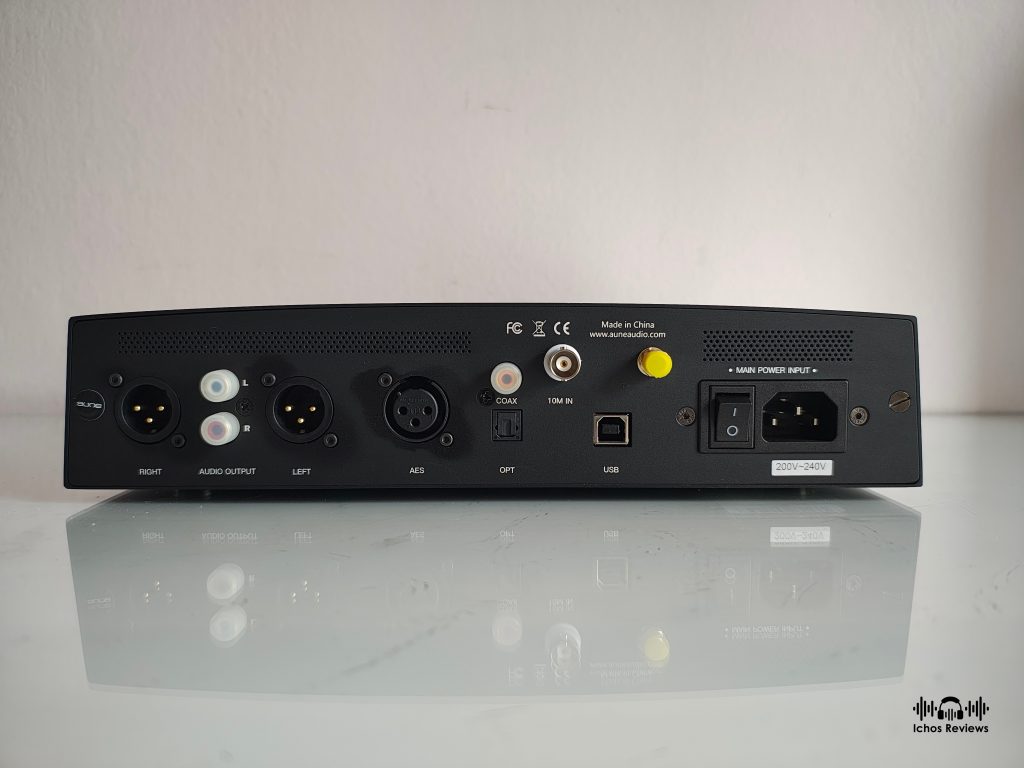
At the rear of the S18 EVO, you will find four digital inputs (AES, USB, optical and coaxial), stereo XLR and RCA analog outputs, an input for a 10MHz external clock, the Bluetooth antenna, the mains inlet and the power switch. The rear panel also features two elongated, perforated sections to improve heat dissipation.
Everything is included but I would prefer an I2S over HDMI digital input over the almost obsolete AES, and a USB-C interface instead of the outdated USB-B.
Bluetooth Connectivity
The Aune S18 EVO supports an advanced Bluetooth reception technology in which the incoming signals are also reconditioned through the PLL core before being transmitted to the DAC, achieving better sound quality than traditional Bluetooth. The receiver supports the LDAC, aptX HD, aptX, AAC and SBC codecs.
Using Bluetooth is straightforward, with the device being instantly discovered and paired with a phone. The connection remained stable within the same room during my tests, and sound quality was exceptionally good in LDAC mode. The wired connection is undoubtedly better, but Bluetooth offers great convenience in certain use cases without much sonic degradation.
Listening Set-up
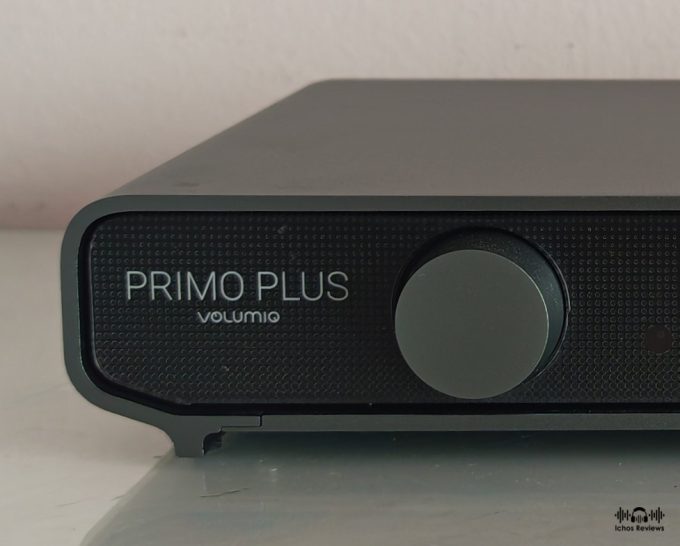
I used the Aune S18 EVO as a source in a two-channel speaker system comprising the Kinki EX-M1 integrated amplifier and Audio Physic Spark speakers. I also tested it with various headphones, including the Aune AR9000 and Grell Audio OAE2, paired with the Aune N7 and Aune S17 Pro Evo headphone amplifiers. In both setups, the Volumio Rivo Plus served as the digital front end.
Listening Impressions
Readers familiar with Aune Audio will already know that the brand aims for a traditional analog-like sound, with different models ranging from the more neutral presentation of the N7 to the warmer and thicker character of the S17 Pro EVO. The engineers take care to fine-tune using their ears and not just design by the book as most other Chinese brands do.
This is exactly what happens with the S18 EVO, as Aune has managed to create a DAC that sounds quite organic while retaining a solid amount of transparency and technical fidelity. It doesn’t sound exactly like an R2R DAC or a tube-based device, but it still manages to be exceptionally musical and engaging without sacrificing the clarity, definition and neutrality associated with delta-sigma (D/S) modulators. The frequency response is actually flat, without deviations from linearity, and the S18 EVO’s distinctive sonic character stems from the sophisticated shaping of harmonics.
The Low-end
The bass is extended and weighty, with rich, full-bodied textures, while remaining fast, tight and controlled. It is very well-layered and defined, maintaining its pace and composure under the most demanding conditions. The DAC doesn’t throw the bass at you by artificially enhancing its presence and physical impact, but it easily follows highly contrasted dynamics when the music calls for it, sounding realistic and convincing.
The Mids
The secret to the midrange lies in two basic ingredients: AKM’s velvet textures and Aune’s particularly harmonious tuning. The presentation is musical and engaging, with rich, organic textures and natural timbre, but also clean, balanced and articulate. Voices and instruments are reproduced with a lifelike quality, blending together cohesively to make the music sound alive and true to life.
The Treble
The higher frequencies have a touch of smoothness that makes for a fatigue-free listening experience, but this doesn’t mean that they lack extension, airiness or clarity. The S18 EVO isn’t as sparkling and energetic as some competitors, and it may not satisfy those seeking the utmost detail retrieval or an ultra-analytical presentation. Others, however, will appreciate its easygoing and musical nature.
In fact, the Aune S18 EVO is one of the least digital-sounding sources based on a D/S modulator, being devoid of metallic artificiality. High-pitched instruments, whether bowed or plucked, sound tonally correct, with full-bodied textures and natural decay, while the resolution is more than sufficient to reveal even the finest details.
Not Only for Headphones
You need to connect the Aune S18 EVO to a speaker system to truly appreciate its sound staging abilities. The soundstage expands beyond the speakers, making them seem to disappear. It creates a solid central image, with precise placement of performers across the stage, which can expand or contract depending on the size of the ensemble. Depth layering is good, although not class-leading, and the S18 EVO doesn’t sound as holographic or atmospheric as some other, usually more expensive, DACs. Despite this, it remains convincing and always manages to convey the scale of the music.
Two Unique Digital Filters
Aune’s two custom-programmed filters produce small but meaningful sonic differences without altering the DAC’s fundamental character. The M1 option offers a more transparent, neutral and precise presentation, while M2 sounds a little warmer, with a more rounded treble.
Comparison with the Volumio Preciso
Volumio’s only standalone DAC, the Preciso, retails for €799. Its main physical difference compared to the Aune S18 EVO is its considerably more compact size, as it uses an external power adapter instead of an internal transformer.
The Preciso is built around two ES9039Q2M DAC chips and, besides the eight embedded digital filters, also features a custom NOS filter. It offers a preamp mode, just like the S18 EVO, along with both balanced and unbalanced analog outputs. It also features an advanced I2S over HDMI digital input, but lacks AES and the convenience of Bluetooth connectivity. It performs very well out of the box, but really scales with a high-quality external power supply.
Just like the Aune S18 EVO, the Preciso is one of the least digital-sounding DACs based on a delta-sigma chip. In fact, these two DACs must be among the best examples of this approach in the sub-1K$ category. Honestly, they are both among my favorite sources, and I can’t really choose one over the other.
Sometimes I enjoy the Preciso’s slightly more technical and transparent presentation, while at other times, I prefer the S18 EVO’s extra harmonic richness and more organic textures. It all depends on my mood and the equipment used each time. Choose the Preciso if you are after delta-sigma precision with plenty of musicality, or the S18 EVO if you prefer an even more musical presentation and analog-like timbre without sacrificing much precision and transparency.
In the End
I could easily write a lengthy, poetic conclusion, but this time I decided to keep it laconic.
The Aune S18 EVO is one of the best-sounding DACs you can buy without crossing the $1,000 barrier. It has all the features you would expect from a modern DAC and delivers excellent sonic performance with very little to fault.
Exceptionally musical yet transparent, it is a DAC that makes the music come alive without sacrificing fidelity or precision in the process. A great and not too expensive DAC that will satisfy both headphone and speaker users alike.
Pros
Excellent sonic performance
Musical yet transparent and precise presentation
Natural and realistic timbre
Virtually free of digital artificiality
Spacious and convincing soundstage
Two custom-programmed digital filters
Equally capable with speakers and headphones
Silent background
Volume-controlled preamp mode
Supports 10MHz external clocks
Slim and handy remote control
Very well made
Excellent price-to-performance ratio
Cons
Outdated USB-B interface
No I²S over HDMI input
Soundstage is not the most immersive or holographic
Arc-shaped design is not ideal for stacking and may not suit every setup
Copyright – 2026.
Authored by Petros Laskis for Ichos Reviews. All content is original and copyrighted. Republishing full reviews or portions without written permission is prohibited. Excerpts up to 100 words are allowed with a direct link.










Leave a comment