

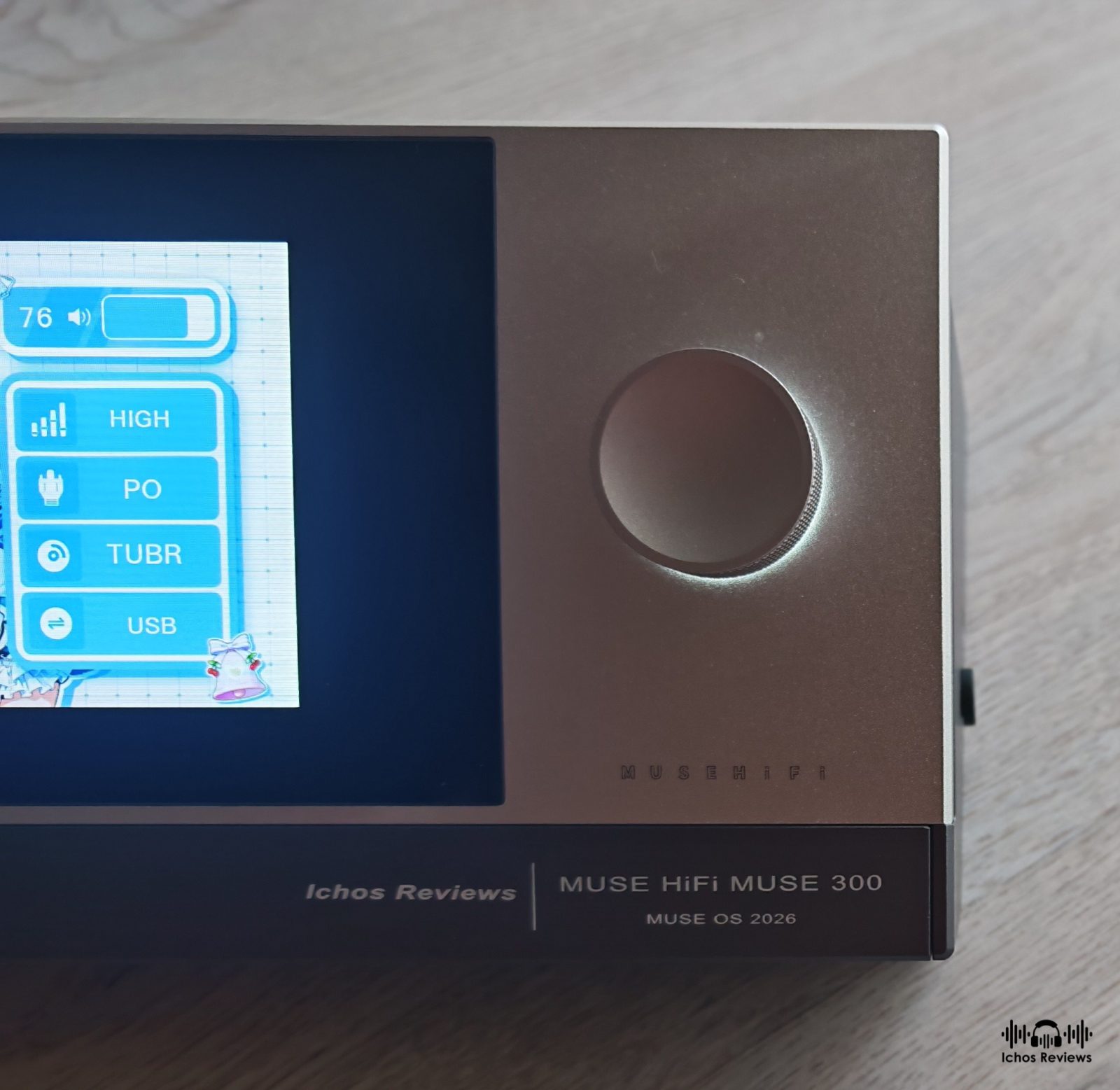

Today’s review is about the Muse HiFi Muse 300, the world’s first desktop DAC and headphone amplifier with a dedicated operating system.
The review sample was kindly provided free of charge in exchange for an honest review. I didn’t receive monetary or any other kind of compensation and I don’t use affiliate links.
The Muse HiFi Muse 300 is currently available through its Kickstarter campaign at various special offers. The regular price after the campaign ends is going to be around $439.
Muse HiFi
Muse HiFi is a relatively new Chinese audio brand best known for its battery-powered, tube-hybrid DAC/amps. From the flagship M6 Double to the mid-tier M5 Ultra and the entry-level M3 Ultra, every model has received very positive reviews from both professional reviewers and audio enthusiasts alike.
I have already reviewed the M6 Double and the M5 Ultra models, while the review of the M3 Ultra is currently in the works.
Muse HiFi Muse 300
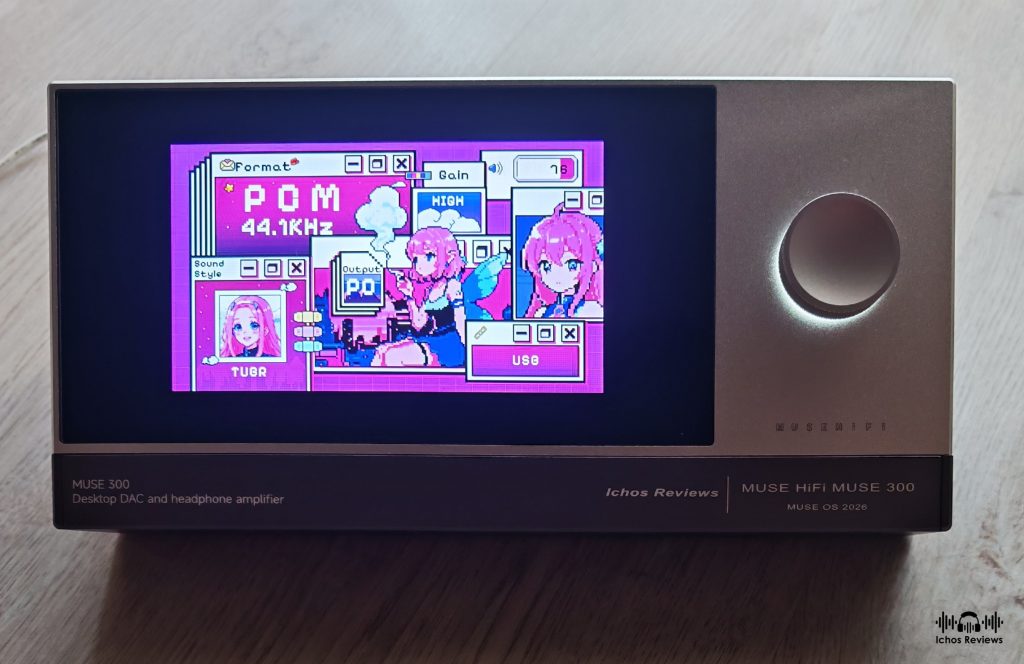
The Muse HiFi Muse 300 is a desktop DAC and headphone amplifier with a large 5″ color display and a dedicated OS.
So, what is all this fuss about a DAC/amp with a dedicated OS and why is it needed?
Most DAC/amps usually don’t need a special OS and even if they do, it is a bare bones software for volume control, I/O management and other basic functions.
Instead of designing a regular DAC/amp with switches and LEDs, the brand decided to equip the M300 with a large 5” color display and an advanced GUI, so using a dedicated OS was absolutely necessary.
Unlike Android players, DAC/amps run on MCU hardware, so the M300’s operating system had to be developed specifically for it and built from scratch. The Muse HiFi OS runs on a 32-bit MCU and the system manages more than 150 state variables, coordinated by complex algorithms to avoid any operation failures and sound quality degradation.
Technical Overview
Muse HiFi uses top-tier components throughout both for the digital and analog sections of the Muse 300. The digital stage is assigned to ESS’s flagship ES9039 DAC chip in a special edition that is co-developed with Muse HiFi and codenamed Ultra. It is followed by the I/V conversion stage using dual ES9603Q op-amps and low-pass filtering with dual OPA1612 op-amps.
USB input is handled by the SA9137L controller, the coaxial interface uses the AK4118 receiver and sample rate conversion is managed by the NE5532A. Headphone amplification is done with two TPA6120A2 ICs, while the entire circuit architecture remains fully differential from the DAC to the analog outputs.
The Muse 300 supports sampling rates up to 384kHz/32bit PCM and DSD256, while it is compatible with the ASIO low latency Windows driver, macOS, Android, and iOS.
Three Hardware Tuning Modes
Unlike other DAC/amps that use digital EQ or DSP that introduce phase shifts, unnatural tones, digital artifacts, quantization noise and distortion, the M300 allows the user to shape the sound through three specially designed hardware tuning circuits.
Digital EQ cannot fully replicate the complex harmonic structure and overall tonal character achieved by analog circuits. That is why the Muse 300 resorts to the traditional method of fine-tuning the sound by using different capacitors, op-amps and other electronic components in the signal path.
There are three tuning modes to choose from:
First is the Balanced Mode that is neutral and uncolored, offering the most balanced frequency response that faithfully reproduces the original recording.
Second is the Tube Amplifier Mode that imitates the warmth and full-bodied sound of vacuum tubes without their disadvantages, such as increased distortion and background noise.
And third there is a mode called ACG (Anime, Comics, Gaming) that is tailored for listening to anime songs or soundtracks and playing games
Inputs and Outputs
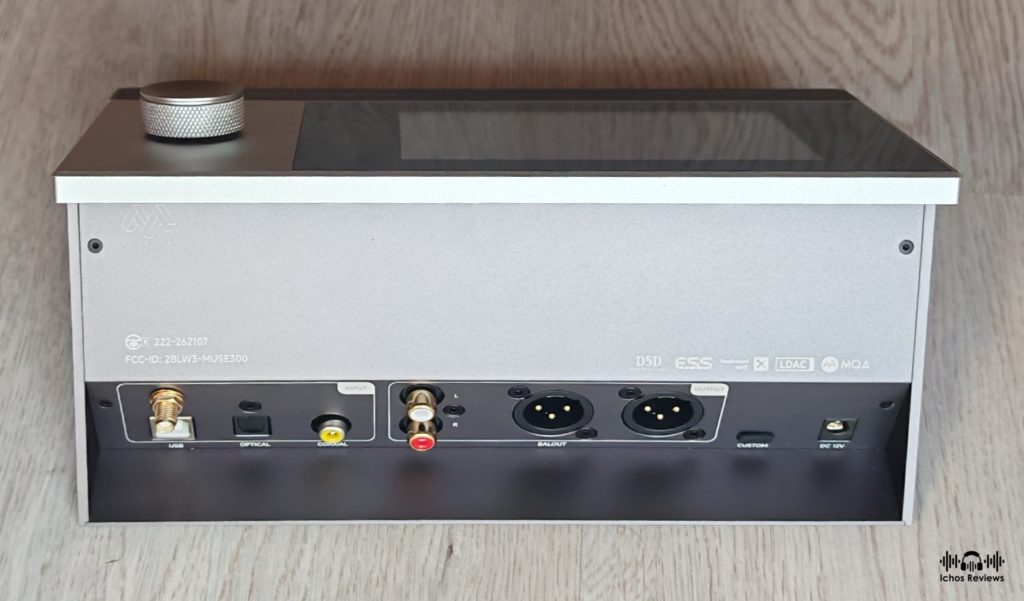
The device is equipped with USB type-B, coaxial and optical digital inputs, as well as balanced XLR and RCA analog outputs, all located at the rear side of the device. The two dedicated headphone outputs (4.4mm and 6.35mm) are to be found at the right.
All inputs and outputs are protected by rubber dust covers that should be removed before use. Plenty of connectivity options that will cover most use cases, however HDMI I2S is missing and USB type-C would be more handy than type-B.
Power is handled by a 12V switching power adapter.
Design and Build Quality
The device has a special looking, minimalistic industrial design that sets it apart from the majority of desktop DAC/amps that usually have a simple rectangular shape. Its CNC-machined aluminum chassis is finished in silver/grey sandblasted coating and is exceptionally well made and assembled.
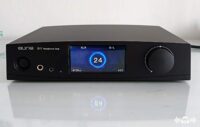
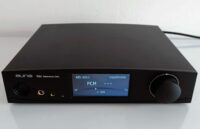
The large 5” display dominates the front panel that has a clean and plain appearance with only a single multifunction button positioned at the right side of the display. The various inputs and outputs are located on the rear and right parts of the chassis, leaving the front panel free from any unnecessary clutter. The angled design improves screen visibility and makes it easier to read from a distance.
The Muse 300 successfully blends modern appearance with practicality and ease of use. It has a really unique device that looks much more premium than its price would suggest. The only thing missing is a remote control that would make it easier to use a few meters away from the device.
Accessories
The package includes a power adapter with the appropriate AC cable, a USB data cable, a Bluetooth antenna, a manual, a 6.35mm headphone adapter and two extra adhesive stripes to be placed underneath the device.
User Interface and Operation
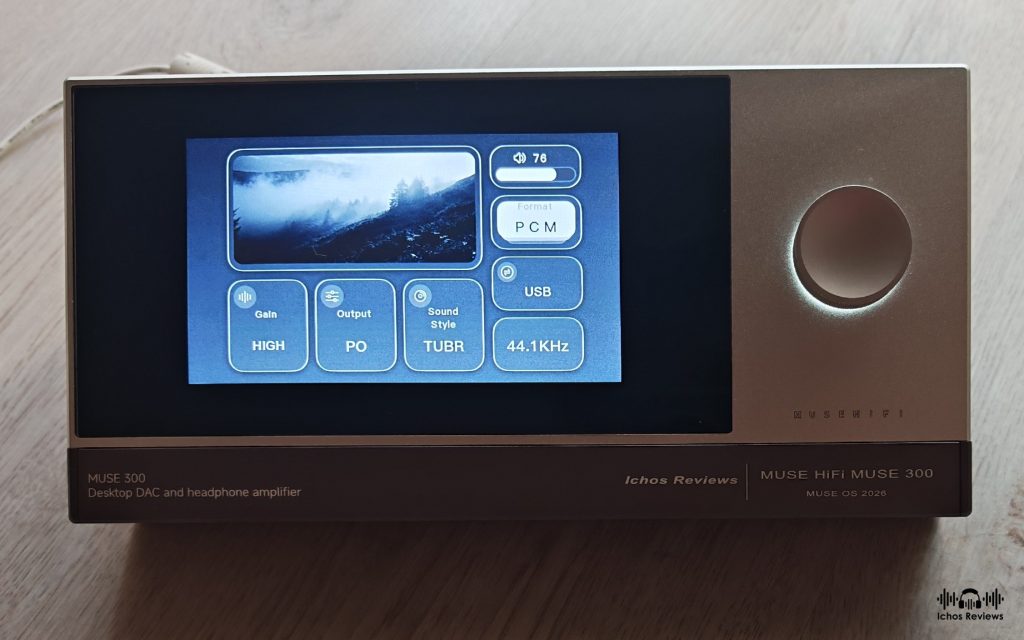
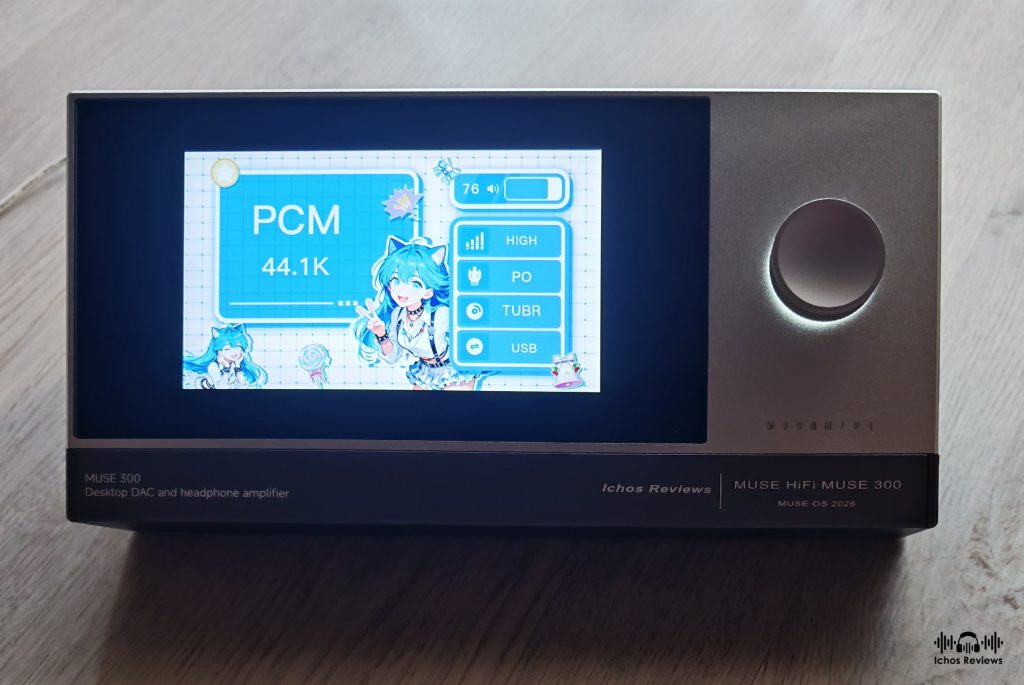
The Muse 300 has three different GUIs to choose from: The Cyberpunk with its neon-lights style and high-tech feel, the Minimalist which is clean and simple, and the AGG style which is bright and lively, with a playful anime vibe. The display is clean, vibrant and easy to read, even from a distance.
Just like all other Muse HiFi audio devices, the user interface is simple and easy to use, without multi-layered menus that are difficult to navigate or memorize. It is equipped with a only a single multifunction button that is used for both volume adjustment and navigating the menus.
Long-pressing the button powers the device on or off, while a single press enters the main menu and a quick double press returns to the previous page. After entering the main menu, rotate the button until you highlight the submenu you want to configure. A single press enters the selected submenu, after which you can use the same method to highlight and select the desired option. Double-press the button to return to the previous page.
It is a simple control method, but it also has one drawback: there are no buttons for selecting the input source, output mode or amplifier gain. Instead, you have to enter the menu every time you want to change any of these settings.
The Home Screen and the Configuration Menu
The home screen displays the input sampling rate, volume level, gain setting, output mode, sound mode, and input source at a glance. It enters screen-saving mode after 5 minutes and switches off completely after one hour if no buttons are pressed.
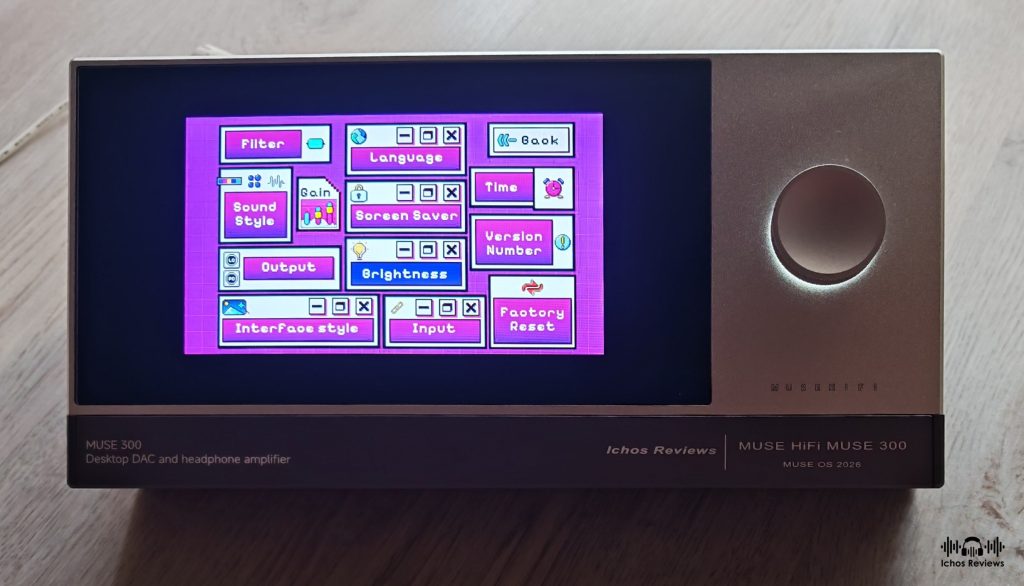
The main configuration menu includes the following options: digital filter, sound signature mode, gain adjustment, output mode, interface style, language, screen saver style, screen brightness, input source, time setting, display version number and factory reset.
Known Software Bugs
There are a few software bugs that I have discovered and need to be addressed in a future firmware update. However, they are relatively minor and have no impact on the sound quality.
The word “TUBE” is misspelled as “TUBR” throughout the menus.
The “Back” button cannot be highlighted within the menu, so you must always use the double-click action to return to the previous page.
The clock screen saver cannot keep the correct time and constantly loses time.
The VU-meter and spectrogram screensavers do not work well and don’t respond to the signal level.
The display does not automatically switch off after one hour of inactivity, as it is supposed to do, and you can’t manually switch it off.
Bluetooth Connectivity
Pairing the Muse 300 with a smartphone, is simple and straightforward, while the Bluetooth connection remains stable at distances of up to 5-10m away from the device. Don’t forget to set your phone to the highest Bluetooth codec it supports so you can enjoy the best possible sound quality. The chipset supports the aptX Lossless, aptX Adaptive, aptX HD, LDAC, AAC, and SBC codecs.
The sound quality is on par with the current industry standards and is not that inferior to a wired connection when using either the aptX Lossless or LDAC codecs. That said, for critical listening of HD music, the USB connection remains the best performing option.
Output Power and Noise
The headphone amplifier of the Muse 300 uses two TPA6120A ICs configured to operate at their full potential, delivering a maximum output power of 2×2200mW into 32Ω or 8.4Vrms from the balanced headphone output. These numbers drop to 2×1100mW into 32Ω or 4.2Vrms from the single-ended output.
Plenty of power to drive both planar magnetic and high-impedance headphones, such as the Hifiman HE1000 Stealth and the SIVGA Peng. The three gain settings (Low, Mid, and High), combined with 100 steps of precise volume adjustment, help a lot to pair it with a wide variety of headphones and IEMs, while the noise floor is practically inaudible, even with sensitive earphones.
Listening Impressions
Readers who are familiar with, or have read the reviews of the Muse HiFi M6 Double and M5 Ultra will know that they offer excellent audio quality that punches well above their price. In both these models, users have the option to choose between the more transparent and technical sounding solid-state mode or the more musical and relaxed tube-hybrid mode.
The same approach also applies to the Muse 300, where users can choose between the neutral presentation of the balanced mode, the vacuum tube emulation of the tube mode or the distinctive sonic character of the ACG mode.
The Balanced Mode
In the default balanced tuning mode, the overall sound signature of the Muse 300 is strictly flat and neutral, with strong technical precision, great transparency and stellar clarity. Some would dare to call it a typical ESS presentation, but I should also add that the sound doesn’t become clinical or sterile. The Muse 300 doesn’t add any kind of sonic coloration or character of its own but at the same time, it manages to avoid behaving as a studio monitoring tool.
Typical of such an implementation, the bass is fast, tight, controlled and well defined with punchy dynamics. It never loses pace or timing and stays composed no matter what happens in the bass line. The bass is less dry and considerably more weighty than I was expecting from past experience with the same kind of hardware.
The midrange is crystal clean, articulate, and tonally neutral, yet it never comes across as sounding lifeless or lacking in expression. The timbre is realistic with a convincing tonal palette for both instruments and voices. While textures aren’t the most organic or analog-like, they don’t sound too lean or harmonically flat, striking a good balance between accuracy and musicality.
The treble is airy, extended, and energetic, with a touch of brightness that adds extra sparkle without making the presentation too sharp. It isn’t exactly smooth or relaxed, but it never becomes too raw or fatiguing. The notes decay in a rather natural manner so high pitched instruments don’t sound especially thin or flat.
Technical Performance
What is really impressive is that the treble remains largely free from digital glare and metallic artificiality. It is evident that the engineers at Muse HiFi have carefully tuned the hardware to address these issues and make the Muse 300 sound as natural as possible.
The overall resolution is class-leading throughout the whole frequency range, allowing the listener to explore the finest details of a recording, but only when the music calls for it and not in an analytical manner. It is the kind of technical performance that serves the music rather than drawing attention to itself. The soundstage is expansive and spacious, with convincing depth and precise imaging. It never sounds flat or compressed, always preserving the true scale and proportions of the recording.
The Tube Mode
It is really admirable how well the engineers have managed to emulate the sound of vacuum tubes without actually using them. That said, it is not exactly like listening to real tubes, but the end result is surprisingly close without the usual tube drawbacks, such as increased distortion and background noise.
In tube mode, the sound becomes a touch more organic and harmoniously rich. The midrange gains in melodic expression, while the treble eases off a little bit and sounds smoother and more relaxed. The bass loses a small amount of its punchiness, tightness, and control but It gains elasticity, weight and more natural ambient reverb.
The soundstage is slightly less focused but expands favorably, sounding more holographic and diffuse. The tube mode is not that less capable than the balanced mode when it comes to the overall resolution, while clarity and transparency stay well preserved.
What happens in the tube mode is that the presentation shifts from strictly neutral and reference-oriented to something that sounds slightly less critical and more relaxed. Technicalities are pushed into the background in favor of some extra musicality and warmth.
The ACG Mode
This is a special tuning mode that cleans up the bass line, greatly enhancing clarity and definition, but it also makes the low-end sound hollow and lean compared to the other two modes. It also boosts the upper midrange and treble, making them sound more prominent and brighter.
It is a rather unconventional tuning that focuses on improving clarity, transparency, and definition, but it also makes the sound a little artificial, tonally unbalanced, and lifeless. It might be suitable for competitive gaming or for listening to certain types of music.
The Balanced Line Output
As much as the Muse HiFi Muse 300 is an excellent all-in-one solution for listening to music with your favorite headphones, it should also be noted that its balanced line output scales very well with external headphone amplifiers or when connected to a speaker amplifier.
The Muse 300 is, first of all, a high quality DAC that also includes a handy headphone amplifier. However, anyone who wishes to experience its full sonic potential should pair it with a high quality external amplifier or active monitors.
In The End
I have to admit that I am really impressed with Muse HiFi, a brand that was virtually unknown to me until I had the chance to review the M5 Ultra and M6 Double, both of which left me with nothing but positive impressions.
And if I was initially a little sceptical about their first foray into desktop units and the whole “tube without tubes” concept, all my hesitations completely vanished after finishing this review.
The Muse 300 is an impressive sounding desktop DAC/amp with three distinctive tuning modes that add even greater sonic versatility. The tube mode is especially well implemented, as it successfully manages to capture a great deal of the “tube magic” without using vacuum tubes.
I wouldn’t have any hesitation recommending it based on its sonic performance alone, let alone its desktop-friendly design and unique operating system. I wish it had a touch screen, but I guess we can’t have everything for roughly $439, especially considering that the price drops to $349 for anyone who backs the Kickstarter campaign.
Copyright – 2026.
Authored by Petros Laskis for Ichos Reviews. All content is original and copyrighted. Republishing full reviews or portions without written permission is prohibited. Excerpts up to 100 words are allowed with a direct link.
+ Stellar audio quality
+ Three hardware-based tuning modes
+ Can sound from reference-neutral to more musical and relaxed
+ Excellent transparency and fidelity
+ Impressive clarity and resolution
+ Well implemented vacuum tube emulation mode
+ Natural and realistic timbre in tube mode
+ Big and spacious soundstage
+ Class-leading DAC performance
+ Very limited digital artificiality
+ Unique operating system with three GUIs
+ Desktop-friendly design and excellent build quality
+ Large and vibrant display
+ Competitively priced

- Outdated USB type-B input instead of type-C
- No HDMI I2S digital input
- Various software bugs that must be fixed
- No touchscreen or remote control
- The headphone amplifier is a side feature rather than the main attraction






Leave a comment