



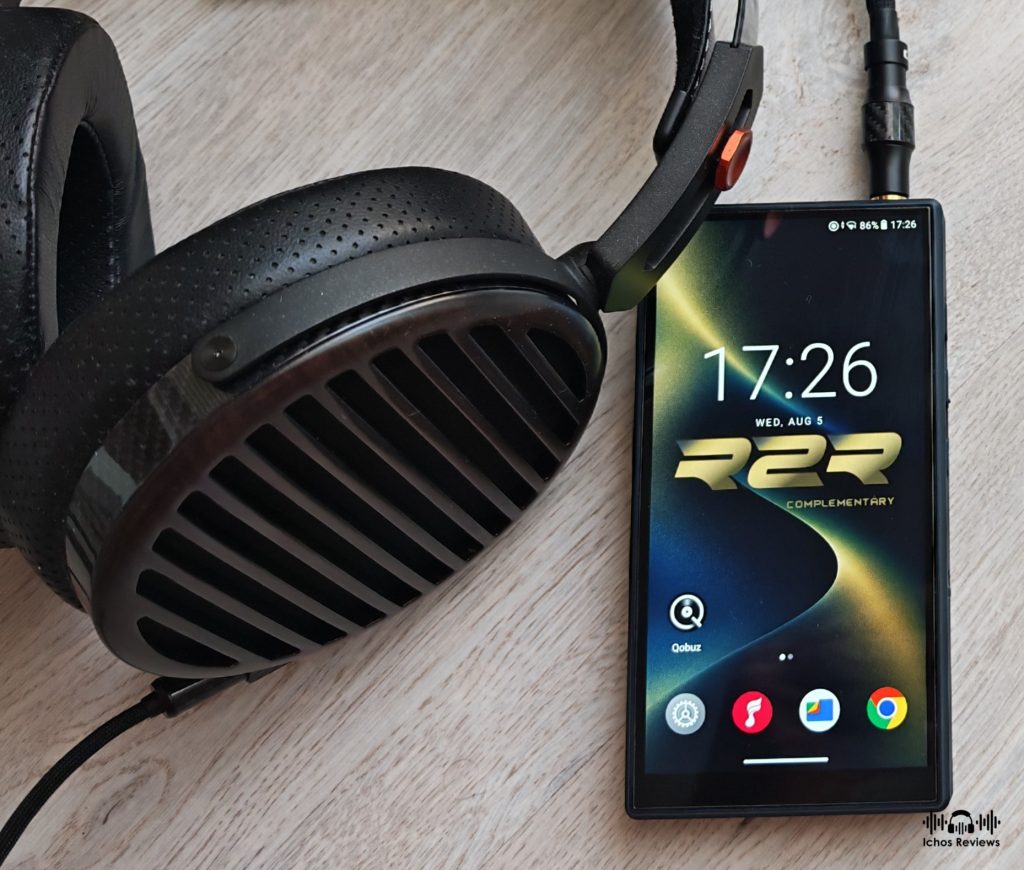
Today’s review is about the FiiO M33 R2R, the brand’s first Digital Audio Player with an R2R instead of a D/S DAC.
The review sample was kindly provided free of charge in exchange for an honest review. I didn’t receive monetary or any other kind of compensation and I don’t use affiliate links.
The price of the FiiO M33 is €699 and you can buy it from here.
About FiiO
As usual, I am skipping the FiiO brand introduction, because I don’t think there is a single hobbyist on the planet who isn’t already familiar with them. Instead, you can click here to explore FiiO and its products through our past reviews.
FiiO M33 R2R DAP
Among many other products, FiiO is best known for its Digital Audio Players (DAPs from now on), which span all price ranges, from the entry-level FiiO JM21 to the flagship FiiO M27.
Currently, FiiO offers about eight DAPs, including the more affordable models from its sub-brands, SNOWSKY and Jade Audio. All of them use D/S DAC chips, with the sole exception of the M33 R2R, which is FiiO’s first DAP to employ the R2R decoding technology.

Technical Overview
FiiO has taken its proprietary R2R resistor array DAC, originally designed for desktop equipment and first introduced in the FiiO K11 R2R, and brought it to a DAP for the first time.
It is a fully differential 24-bit resistor array DAC with four independent channels, utilizing a total of 192 precision thin-film resistors with 0.1% tolerance and low temperature drift.
The FiiO M33 R2R integrates an independent XMOS XU316 USB interface chip, supporting USB DAC functionality up to 768kHz/32-bit PCM and native DSD512, while local playback is limited to 384kHz/32-bit PCM and native DSD256. The DAP is also equipped with a coaxial output (shared with the 3.5mm headphone output) that supports up to 384kHz/24-bit PCM and DSD128.
The analog stage features dual OPA1637 fully differential I/V op-amps, OPA1662 op-amps for the LPF stage, four INA1620 headphone amplifier chips, and a precision NJW1195A volume control chip.
Eight high quality Rubycon film capacitors are used to fine-tune the sound, while independent power supplies for the digital and analog stages, together with multi-layer partitioned shielding, significantly reduce crosstalk and noise.
You can read all the technical details here.
FiiO’s Patented Desktop and Super High Gain Modes
FiiO’s patented Desktop Mode is used to completely bypass the M33’s internal battery whenever you are near a power source, thus reducing charge/discharge cycles and significantly extending its lifespan.
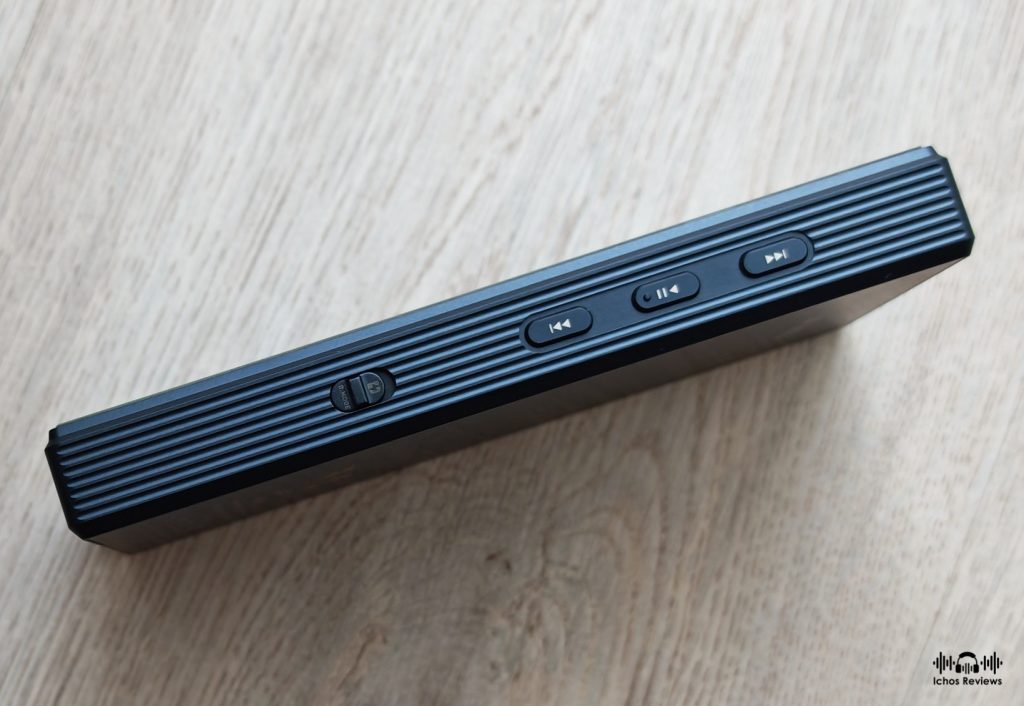
To activate this mode, a 5V fast charger must be connected to the orange USB Type-C port, and the corresponding switch must be set to Desktop Mode.
Plugging a 5V fast charger into either USB Type-C port also unlocks Super High Gain Mode, raising the amplifier’s output power from 900mW*2/32Ω in battery mode to 1100mW*2/32Ω, making it capable of driving more demanding loads.
The Super High Gain Mode is independent of Desktop Mode. You can activate it while still using the battery as the main power source, with the battery continuing to charge at the same time.
Design and Build Quality
For the M33 R2R, FiiO adopted a clean and minimalistic design, following the 18:9 golden ratio, which essentially means that the device is twice as long as it is wide, making it easy to hold and operate with just one hand.
The DAP measures 138.2×71.5x15mm and weighs about 258g, making it relatively compact and lightweight, which is ideal for everyday portable use. There are other DAPs that are even more compact and lightweight, but they don’t offer the same feature set as the FiiO M33 R2R that strikes the perfect balance between size and functionality.
The chassis is machined from a single block of aluminum alloy, while the back is fitted with an AG glass panel. As is usually the case with FiiO, the build quality and finish are absolutely flawless. The FiiO M33 R2R is available in gold, black and blue finishes.
Accessories
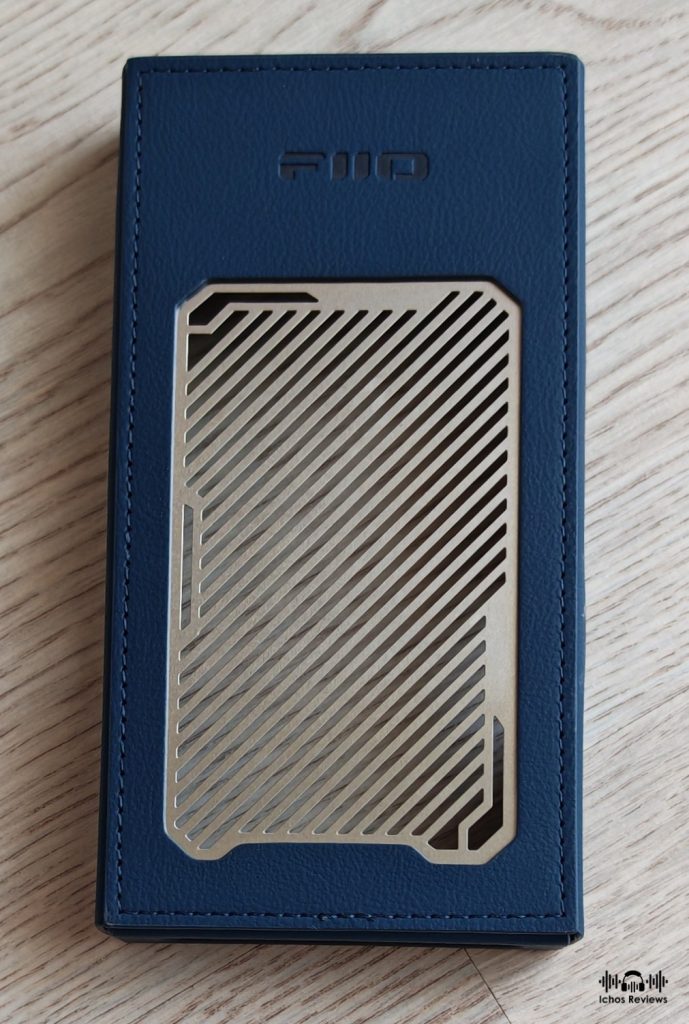
The package includes a high quality protective case that fits the DAP like a glove, a USB data cable and various documents. A screen protector film is pre-applied from the factory.
I/O and Interface
The player is equipped with both 3.5mm and 4.4mm headphone outputs that can also be configured as pure line outputs with either a fixed or variable output level. Both interfaces are located on the top of the unit, together with the power on/off button.
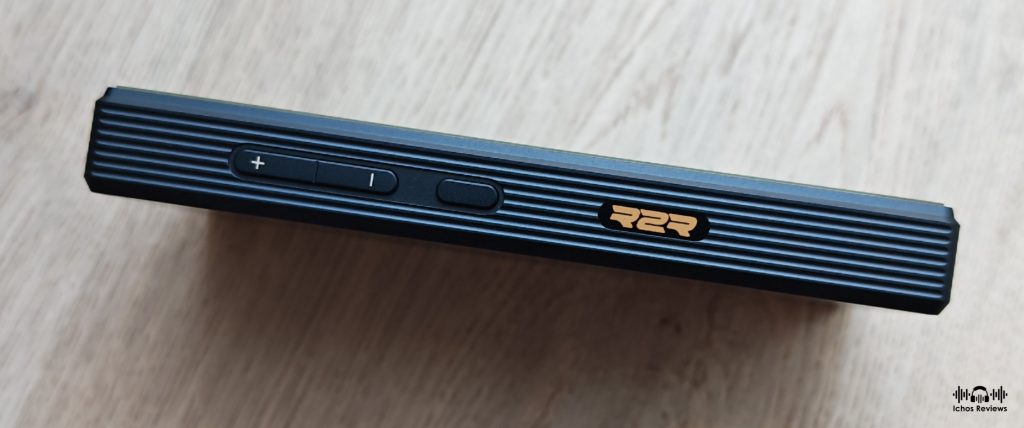
At the right side of the DAP there are three playback control buttons, followed by the Desktop Mode switch. The left side houses independent volume up and down buttons, as well as a multifunction button that its action can be configured through the settings menu.
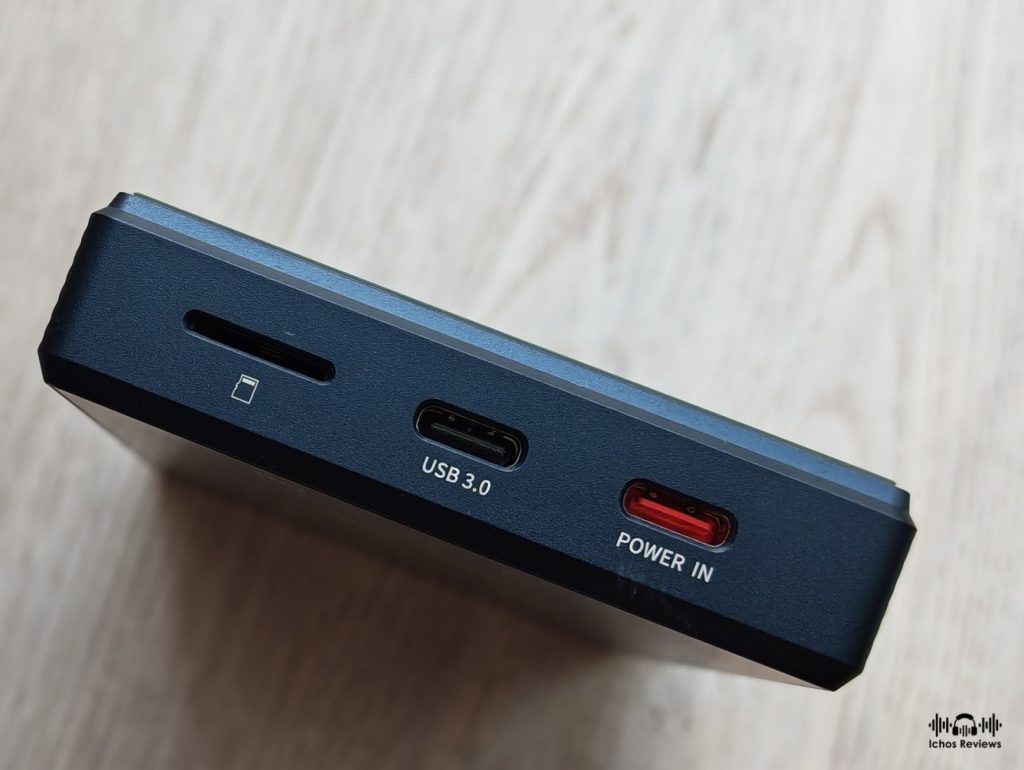
The bottom of the DAP accommodates the two USB Type-C ports and the microSD card slot. One USB port is used for data input, while the orange-colored one serves as the power input required to activate the Desktop Mode.
User Experience
The M33 is powered by a Qualcomm Snapdragon 680 SoC running the Android 13 OS, with support for bit-perfect playback. It is equipped with 8GB of RAM and 128GB of internal storage, expandable up to 2TB via a microSD card.
The side-to-side mounted large 5.5” 1080×2160 resolution display occupies the entire front panel. It offers vivid, albeit slightly dark, colors, and excellent visibility while supporting the double-tap-to-wake function. The user can choose between various UI themes, including a cassette tape player, iPod emulator, various VU meters, and spectrograms.
The player is fast and responsive, with all music and streaming applications running smoothly without any noticeable lag. Although I use my DAPs exclusively for music listening, I also tested web browsing and YouTube watching and didn’t encounter any performance issues. The Google Play Store is officially supported, allowing you to download and install all your favorite applications.
Except for the Android mode, the FiiO M33 also supports FiiO’s Pure Music mode, AirPlay, DLNA, FiiO Link, USB DAC functionality, and two-way Bluetooth connectivity. In addition to functioning as a USB DAC, the M33 can also be used as a digital transport through its USB or coaxial outputs.
Bluetooth Connectivity
Bluetooth transmission supports the SBC, aptX, aptX HD, LHDC, and LDAC codecs, while reception is limited to SBC and LDAC.
I tested both transmission and reception modes, and they worked flawlessly at distances of approximately 7 to 10 meters. The sound quality is very good and meets the current industry standards when using the LDAC codec.
Battery Duration
The FiiO M33 R2R is equipped with a 4400mAh battery that supports 30W fast charging, allowing it to be fully charged in just 1.5 hours.
Power management has been improved over the FiiO M23, and I was able to squeeze about 11 to 12 hours of music playback from the balanced output in high gain mode while streaming from Qobuz. Playing local files with Wi-Fi switched off extends battery life even further.
The 10-band Lossless Equaliser
A major advantage of the FiiO M33 R2R over the competition is that it supports a 10-band lossless parametric equalizer with a system-wide effect.
In addition to manually adjusting the various parameters and saving your own EQ curves, you can also use the Auto EQ function, which automatically retrieves the corrected frequency response curve for your headphones or earphones from an online database.
Output Power and Noise
With 900mW*2/32Ω in battery mode and 1100mW*2/32Ω in Desktop Mode from the balanced output, the M33 R2R has enough power to drive a wide variety of earphones and headphones, such as the FiiO FT7.
The amplifier’s noise floor is practically inaudible, making the M33 R2R an excellent match for highly sensitive earphones like the FiiO FA19. Three gain settings (low, medium, high) and the super high gain mode allow the M33 R2R to pair well with all kinds of loads.
Desktop Mode is not only useful for driving more demanding loads, but it also benefits all headphones by enhancing low-end dynamics and delivering tighter, more controlled and punchier bass. Battery mode still performs very well in this regard, but I prefer using Desktop Mode whenever I am at home and near a power source.
Listening Evaluation
Readers familiar with FiiO’s R2R desktop DACs will already have a good idea of what to expect from the M33’s sound signature. The M33 inherits much of the sonic character that has made FiiO’s R2R desktop DACs so famous and infuses it to a DAP for the first time.
The FiiO M33 R2R offers the much valued analog and organic timbre usually associated with R2R DACs, while remaining tonally balanced, transparent, and technically proficient.
The overall sonic temperature is slightly warm but the sound is not dark or veiled. The M33’s greatest strength is that it is entirely free from the digital artificiality that most D/S DAPs exhibit, to a greater or lesser extent, and the presentation is not clinical or sterile.
Actually, the M33 is the most musical and expressive sounding DAP ever made by FiiO and the one with the most harmoniously rich and colorful overtones throughout the whole frequency range. Comparing it side by side with other FiiO DAPs, like the M23 or M15S, you can easily notice how much fuller and weightier its textures are. They are less dry and lean, not only in the bass but also in the mids and highs. Note decay is more relaxed, especially in the treble, something that benefits all higher-pitched instruments, making them sound natural and realistic, without any metallic sheen.
The FiiO M33 has a mildly relaxed and smooth attitude when playing music, but it can’t be said that it lacks in transient speed or isn’t energetic enough. It resolves very well, but it doesn’t throw every detail right at your face. Instead, it uses them to support the music, helping it become more lifelike. It may not be the best option for those who prefer analytical and sharper tuning profiles, but it is ideal for anyone seeking a more easy-going and natural sounding player.
More Listening Impressions
The bass is fast, tight, and controlled with excellent definition while remaining especially weighty and visceral. The M33 can easily follow fast-paced tracks, and it doesn’t lose composure when the music becomes busy. Some other DAPs might surpass it in textural clarity and speed, but they fail to sound as elastic or convey the natural physicality of the low frequencies as convincingly.
One area that could use some further improvement is dynamics. While the bass is always punchy and impactful, it can’t quite match the full swing and powerful slam of some competing DAPs.
The FiiO M33 R2R is like a good, trusty analog source, it might not offer class-leading technicalities and resolution but it magically connects you with the music and lets you immerse yourself in your favorite tunes. It is so engaging that you can listen for hours without feeling the need to take a break.
Where R2R DACs usually outperform their D/S rivals is in how much more holographic and immersive they can sound, adding an extra layer of realism to the music. The M33 might not compete with other FiiO DAPs when it comes to surgically precise imaging or the sheer openness and expansiveness of the soundstage, but it definitely outperforms them in how convincingly it communicates the real ambience and atmosphere of the recording.
The M33 is a tonally balanced sounding DAP that pairs well with all kinds of headphones, whether neutral, bright, or warm, it doesn’t really matter as long as they are your favorites. It also offers some fine-tuning options as we are going to discuss later on.
Side note:
The FiiO M33 R2R sounds at its best after about half an hour of music playback, when the resistors have reached their optimal operating temperature.
NOS vs OS
Those familiar with R2R DACs will know that they lack the usual D/S digital reconstruction filters and instead have two options to choose from: NOS (non-oversampling) and OS (oversampling). These two filters will not make the M33 sound radically different, but they offer two distinctive sonic profiles to choose from.
The major sonic difference between these two filters is that the OS option more closely resembles the presentation of a D/S DAC by enhancing the overall clarity, technical performance, and transparency of the M33. It also makes the bass a little tighter, sounds more focused, and feels a touch more energetic, but not as organic and expressive as the NOS filter.
Flat vs Enhanced Sound Quality
Besides the two filters, FiiO has also added another option to fine-tune the sound. The user can select between two sound modes called Flat and Enhanced.
The first one does exactly what its name suggests: it offers a completely neutral and flat frequency response that stays true to the original recording without altering anything.
The Enhanced option applies a very gentle bass boost, adds a touch of extra prominence to the mid-range, and slightly smooths the treble, making the M33 sound more pleasant and fuller. This is not just a simple EQ profile, as it also slightly adjusts second and third order harmonics in order to achieve the desired sonic profile.
There is also FiiO’s All-to-DSD function, so there are plenty of options to fine-tune the sound, even without taking the system-wide PEQ into account.

FiiO M33 R2R vs iBasso DX270
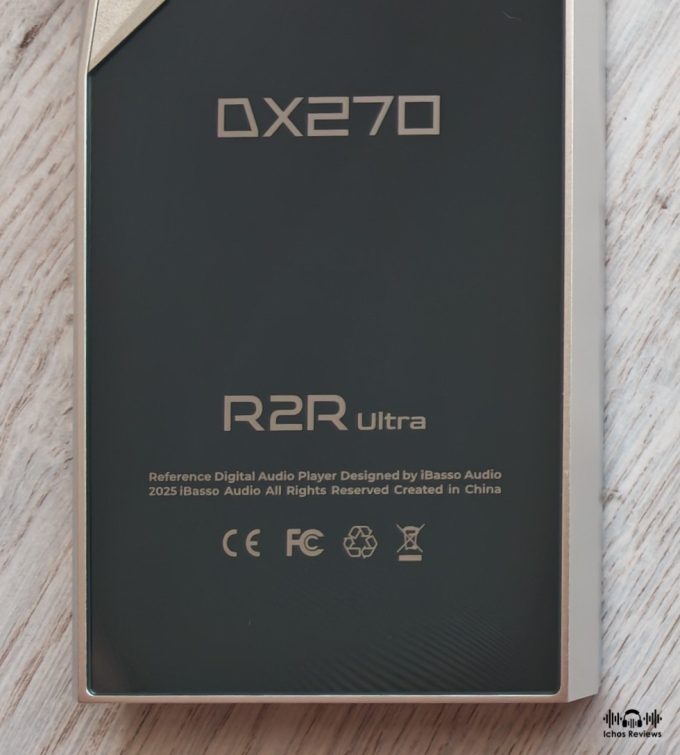
The DX270 is iBasso’s first ever DAP to use R2R decoding technology, borrowed from their flagship portable DAC/amp, the D17. At $1.149, it is roughly two times more expensive than the FiiO M33 R2R, but not entirely without a reason.
Technical and Physical Comparison
In contrast to the FiiO M33, which uses a simple 24-bit resistor-array DAC with four independent channels, utilizing a total of 192 precision thin-film resistors with 0.1% tolerance, the DX270 goes with a much more advanced decoding technology.
The DX270 employs a hybrid DAC architecture that combines a 20-bit R2R MSB DAC with a 4-bit string DAC, together with a hardware resistor compensation network. The whole system counts a total of 344 high-precision thin-film resistors with 0.01% accuracy instead of 0.1%.
The DX270 also supports a 12V DC external power input that boosts the amplifier’s power supply from ±8V to ±12V, raising its output power to 1575mW*2/32Ω, thus making it slightly more powerful than the M33.
However, the FiiO M33 R2R is equipped with the more powerful Snapdragon 680 SoC than the slightly outdated 665 and 8GB of RAM instead of 4GB. This translates to a slightly faster and smoother user experience, especially if you multitask while listening to music.
Both DAPs have a battery bypass desktop mode, but only the DX270 has a user-replaceable battery. They are very well made, the DX270 looks a little more premium and expensive, but the M33 is friendlier to handle and use.
Sonic Comparison
Before going into the actual sonic differences between these two DAPs, let’s note that the FiiO M33’s EQ application has a system-wide effect, whereas the DX270’s is only effective in Mango OS.
While both DAPs share the same organic R2R character, they present music quite differently.
The iBasso DX270 sacrifices some R2R warmth and timbral density for a more neutral and technical presentation. It is like you have combined the excellent technical precision and transparency of a high-end D/S DAC with R2R’s organic and analog timbre.
The DX270 is not a brighter or more clinical version of the M33. It still has plenty of the characteristic R2R tone, but it is like someone removed part of the warmth and richness in exchange for more clarity, faster transients, tighter and punchier bass, sharper imaging, extra sense of spaciousness and more resolution.
The DX270 is a more technically capable player with stronger fidelity and transparency, but on the other hand, it doesn’t sound as lush and analog as the M33, nor as musical and forgiving.
The M33 is a more romantic player, like vinyl, with richer harmonies and fuller textures. It sounds smoother and more relaxed, presenting the music in a more “dirty” and “tasty” fashion, but it can’t touch the class-leading physicality and timbral realism of the DX270.
Comparison Verdict
Two great players that share a lot of common traits but also present music in a radically different manner. The vast price gap between them is also something that should be seriously taken into consideration before reaching your final decision.
In the End
Until now, FiiO’s DAPs have been valued for their class-leading neutrality, and while some of them, like the M15S, threw a touch of extra warmth into the mix, they were still considered more technical than musical-sounding sources.
With the M33 R2R, FiiO steers the tuning in the exact opposite direction and presents us with its most organic and analog-sounding DAP, where musicality finally takes the lead without sacrificing too much in terms of technical performance.
The M33 R2R is FiiO’s most musical-sounding DAP to date and maybe the most affordable R2R DAP among the competition. It is a player for all those who prefer the tonal timbre and density of R2R DACs over the more clinical and sterile presentation of D/S DACs.
I have owned or reviewed every single DAP FiiO has made to date, and the M33 R2R is by far my favorite one. I really don’t mind that it is not the last word in technicalities and resolution, nor the most transparent and neutral source out there.
What I do know is that every listening session with the FiiO M33 R2R tends to last much longer than I originally intended, something that doesn’t happen with any other FiiO DAP.
Copyright – 2026.
Authored by Petros Laskis for Ichos Reviews. All content is original and copyrighted. Republishing full reviews or portions without written permission is prohibited. Excerpts up to 100 words are allowed with a direct link.
Pros
Natural, organic R2R sound
Rich timbre and excellent musicality
Tonally balanced and smooth
Very good transparency and fidelity
Immersive and holographic soundstage
Powerful but silent amplifier
Battery bypass Desktop Mode
Long battery life
Fast Android 13 OS with 8GB RAM and 128GB ROM
System-wide lossless PEQ
Vibrant display
Excellent build quality and ergonomics
High quality protective case
Excellent value for an R2R DAP
Cons
Not class-leading in technicalities and resolution
Dynamics could be stronger
No user-replaceable battery













Leave a comment