

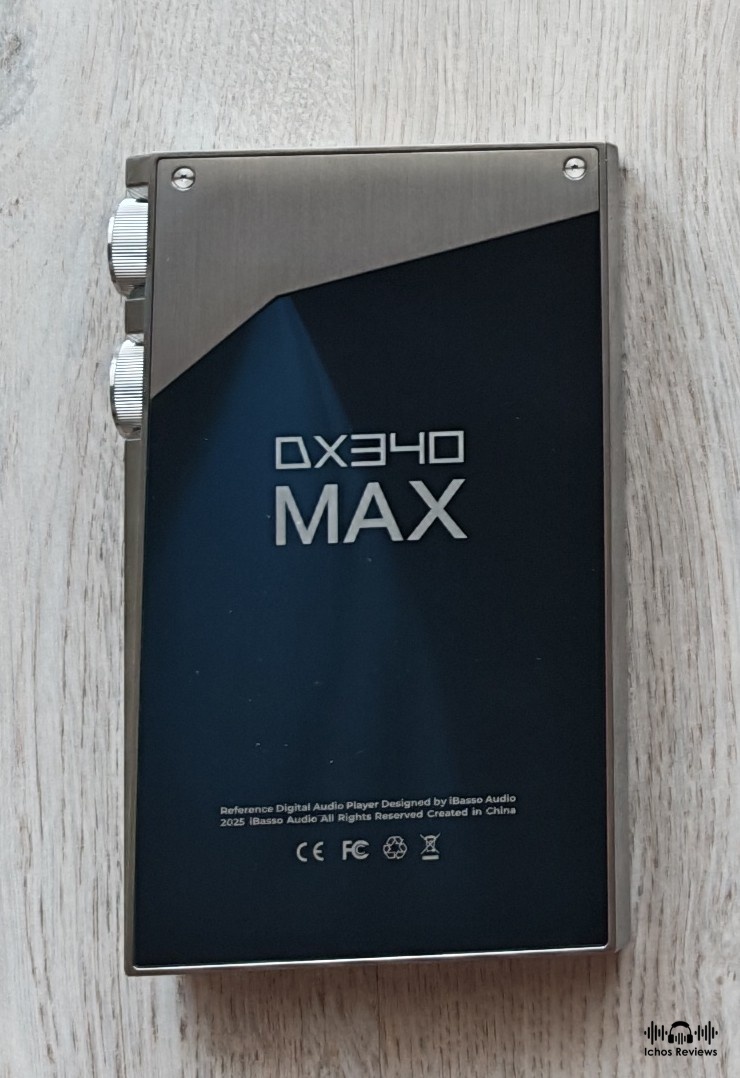

Today’s review is about the iBasso DX340MAX, the brand’s magnum opus and current flagship digital audio player, with production limited to just 688 units worldwide.
The review sample was kindly provided free of charge in exchange for an honest review. I didn’t receive monetary or any other kind of compensation and I don’t use affiliate links.
The price of the iBasso DX340MAX is €3499.99 and you can buy it from here.
iBasso Audio
iBasso Audio is a boutique audio brand from China that specializes in manufacturing high-performing and competitively priced digital audio players (DAPs). Their extensive product lineup also includes earphones, headphones, portable USB DAC dongles, battery-powered headphone amplifiers and DACs, as well as their newly launched desktop line.
iBasso Audio has been extensively covered by Ichos Reviews. Click here to read our previous reviews and discover many of their interesting audio products.
iBasso’s MAX Legacy
Readers familiar with iBasso Audio will know that the brand has a practice of producing MAX versions of its flagship DAPs. These cost-no-object DAPs build upon the basic circuitry of the regular version and use much more advanced electronic components and more sophisticated circuitry to further improve their sonic performance, without considering factors such as production cost or the size of the device.
They are usually very expensive and beyond the reach of most hobbyists, but they are still priced according to iBasso’s philosophy of keeping profit margins as low as possible while offering an unsurpassed price-to-performance ratio.
iBasso DX340MAX
The iBasso DX340MAX is not a completely new player but rather an advanced version of the regular DX340. It is a much bigger device, with significantly more internal space, allowing the engineers to unleash their creativity without limitations, while also using audiophile-grade electronic components.
Both models share the same software platform, processor and core DAC philosophy, but the MAX takes advantage of its much larger chassis to implement far more sophisticated digital and analog circuitry, plus a redesigned power supply.
The Digital Stage
Starting with the digital stage, the DX340MAX uses iBasso’s discrete 1-bit decoding architecture, but the number of discrete PWM-DAC elements has been increased from the DX340’s 128 to 160.
The design goes much further than a mere increase in the number of decoding elements, as the circuit has been extensively optimized with reworked signal routing, improved clock precision and more advanced algorithm scheduling.
This translates into a measured THD+N of as low as -122dB, a level of performance comparable only to desktop 1-bit DACs that cost three or four times more than the DX340MAX.
The DX340MAX uses iBasso’s in-house developed FPGA-Master 3.0 technology as its main audio controller, directly requesting data from the SoC. It is paired with two Accusilicon femtosecond oscillators, achieving fully synchronized single-clock operation.
The player is also equipped with a dedicated professional-grade audio DSP chip, measuring an exceptional 192dB dynamic range and -174dB THD+N, that can achieve perfect audio conversion, while significantly reducing the load on the main SoC.
The DAC supports sampling rates up to 768kHz/32bit PCM, native DSD512 and playback of all types of music files. You can also use the DX340MAC as a USB DAC or as digital transport through its USB and SDIF interfaces.
The Headphone Amplifier
The headphone amplifier of the iBasso DX340MAX builds upon the DX340’s AMP18 module with a key upgrade: the addition of a dedicated differential buffer amplification stage, thus achieving a fully differential transmission.
The amplifier adopts a 4-channel fully differential architecture with a cascaded current feedback design, improving latency issues associated with deep negative feedback circuits. A total of 80 transistors are used in a two-stage amplification structure to ensure linearity during signal amplification. Coupled with a complementary output circuit, it effectively reduces signal clipping distortion.
Thanks to the extra board space, the headphone amplifier of the DX340MAX goes far beyond the design of the AMP18, using 48 nickel-chromium metal-film resistors at key points in the circuitry. They are paired with numerous electrolytic and film capacitors for fine-tuning, including some legendary, discontinued audiophile capacitors from RIFA and SPRAGUE.
Analog & Digital Volume Controls
Following the example of iBasso’s flagship portable DAC/amp the D17, the DX340MAX features independent analog and digital volume controls, allowing for more precise volume adjustment.
The analog volume control uses iBasso’s in-house developed stepped potentiometer which is crafted with 96 high-precision resistors and a special mechanical design. It supports 24 steps of volume control, but it is only one-tenth the size of traditional stepped potentiometers, while maintaining an astonishing channel difference below ±0.1dB.
The benefit of using dual volume controllers is that high digital volume does not affect bit depth, while low analog volume can be synchronized to attenuate background noise. For the best listening experience, iBasso suggests to keep digital volume between 90 and 100 and then adjust the analog volume accordingly.
Four Batteries – Dual Power Supplies
Readers familiar with the iBasso DX340 will know that it is the only DAP to use a dual-battery power supply with independent digital and analog sections. The DX340MAX goes one step further, doubling the batteries from two to four. The digital and analog sections are independently powered by two separate battery packs, ensuring stable power supply for the headphone amplifier and effectively isolating electromagnetic interference from the digital section.
The analog section is powered by two batteries connected in series, forming an 8.4V high-voltage battery pack. Compared to traditional single 4.35V batteries, this configuration provides a more stable continuous output voltage, stronger transient output capability, lower internal resistance, and less loss.
This patented iBasso design includes two battery indicators and two battery management units. The iBasso DX340MAX uses four custom low-impedance lithium polymer batteries that support fast charging and discharging, with a lifespan and stability superior to ordinary batteries. They are easily accessible and user replaceable, available as spare parts from iBasso Audio.
Battery Duration and Charging
Each battery pack is charged independently and has its own status indicator, with the letter A indicating the analog section and D the digital section. Both packs support QC3.0 and PD3.0 quick charge protocols and a full charge needs about 3 hours for the digital battery and 2 hours for the analog.
Unlike the DX340, where both batteries are charged through the same USB type-C input using a single charger, the analog battery pack of the DX340MAX must be charged through a secondary 12V power input, the same that is also used to enable the amplifier’s super gain mode. It is not that practical, but it is necessary because of the two separate battery packs and you get used to the whole charging procedure after a couple of days.
Both batteries can be completely bypassed once fully charged, allowing the DX340MAX to operate in full desktop mode using separate 12V and 5V external power adapters.
Battery duration depends on the usage scenario and can vary from 13 to 16 hours, or even more if you are into local file playback and avoid using WiFi and streaming services. The analog battery pack doesn’t get discharged when you use the DX340MAX as a DAC through the line output.
The External Power Supply Technology
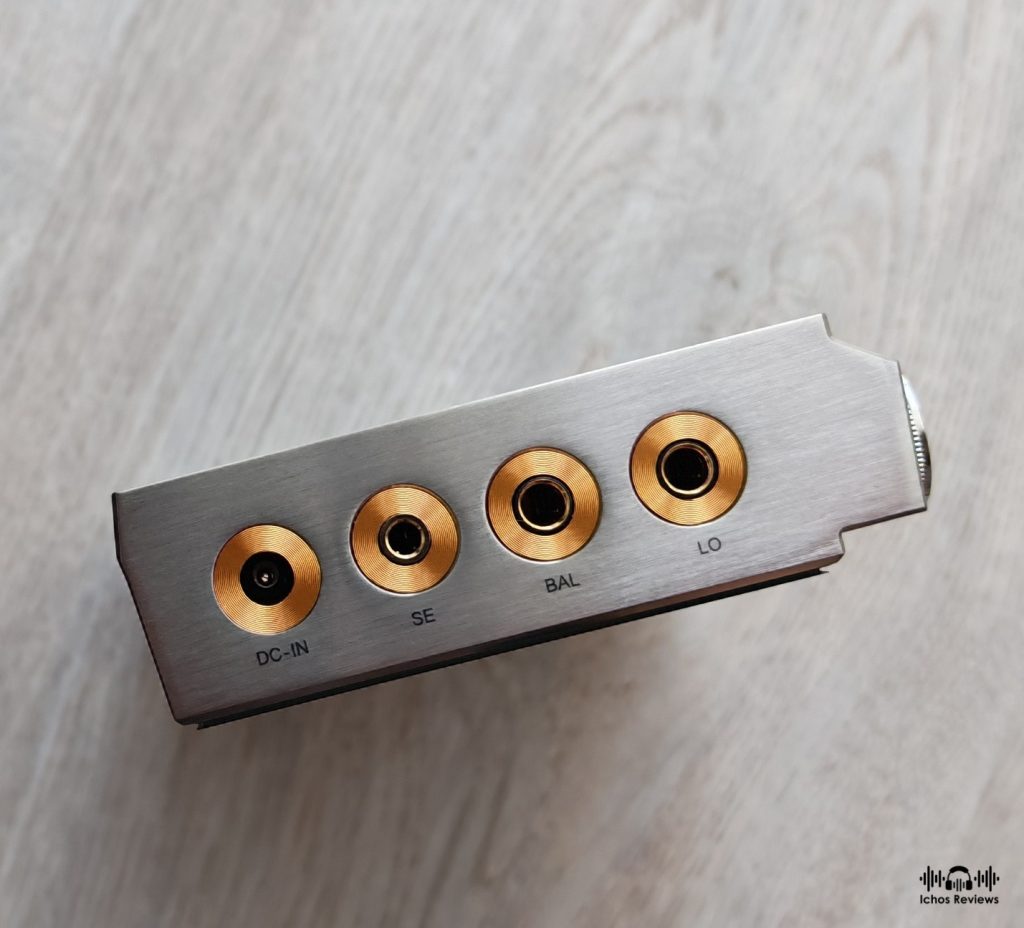
Just like the DX340, the amp section of the iBasso DX340MAX supports iBasso’s patented 12V DC external power supply technology. When connected to a 12V DC power source through the dedicated input, it automatically bypasses the battery power and the headphone amplifier is powered directly by the 12V supply.
In DC mode, the operating voltage of the amplifier instantly rises from ±8.4V to ±12V and the DC super gain mode can be enabled, delivering a drive power of up to 2250mW + 2250mW/32Ω. Unlike the DX340 AMP cards that used a narrow DC barrel, the DX340MAX is equipped with a regular sized one, making it easier to use aftermarket power supplies and cables.
The Harmonic Filters
Being a 1-bit discrete DAC, the DX340MAX doesn’t have the usual digital filters found in D/S DACs. Instead, it incorporates numerous advanced algorithms for adjusting the even and odd harmonics, allowing the user to choose between five distinct sound characteristics.
The available filters are Original (no filtering applied), Natural, Even Harmonics+, Odd Harmonics+, and both Even/Odd Harmonics+. Increasing the even harmonics emulates the sound of a tube amplifier, while increasing the odd harmonics adds more precision and transparency.
The Harmonic Filters are considerably more effective than conventional digital filters and provide easily audible and meaningful ways to fine-tune the sound.
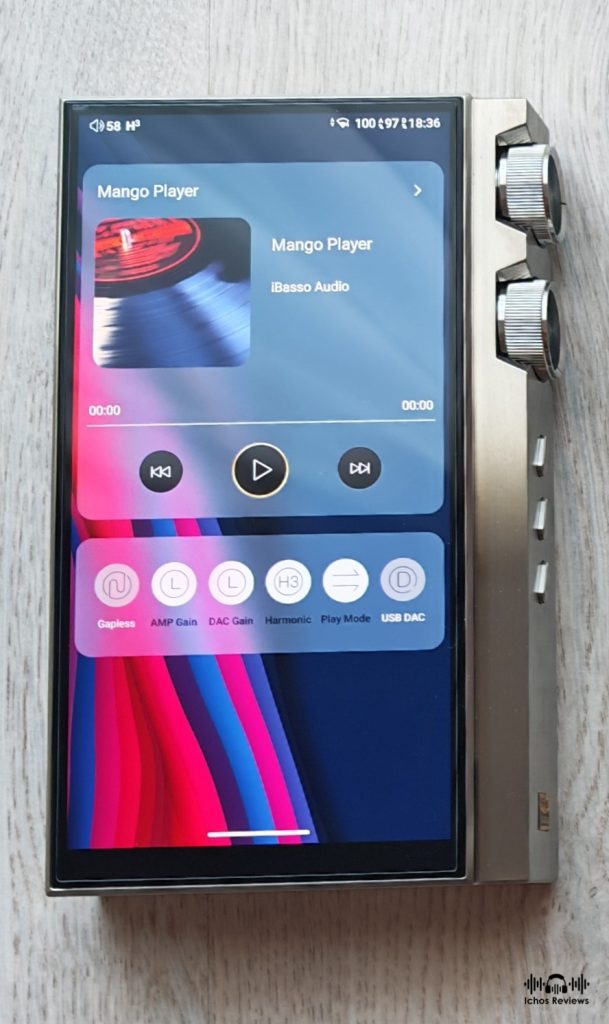
Besides the harmonic filters, there is also a 6-band EQ that is only available when the device operates under the Mango OS. There is no EQ with a system-wide effect so the user must rely on a third party application to do the job.
Accessories
The package includes a high-quality protective case made from genuine leather, a 12V DC switching power adapter, a high-quality USB data cable, a short 3.5mm-to-RCA digital cable, the famous iBasso burn-in cable, and a metallic faceplate with the unit’s unique serial number etched onto its surface.
Also included are spare screws for the removable back panel, a quick start guide, a warranty card, a cleaning cloth, and additional tempered glass and film protectors for the front and rear panels.
The green leather case is truly luxurious. It is exceptionally well made and carefully stitched. It matches the iBasso DX340MAX very well, fits it perfectly, and is designed with a metallic perforated grid at the back to help dissipate heat.

Design and Build Quality
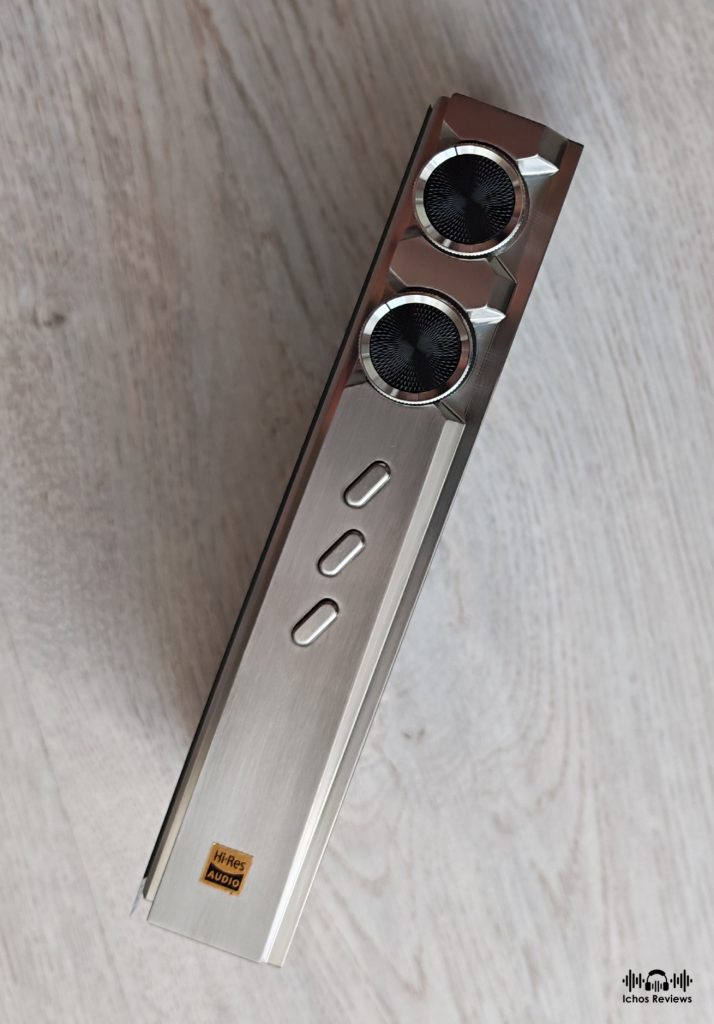
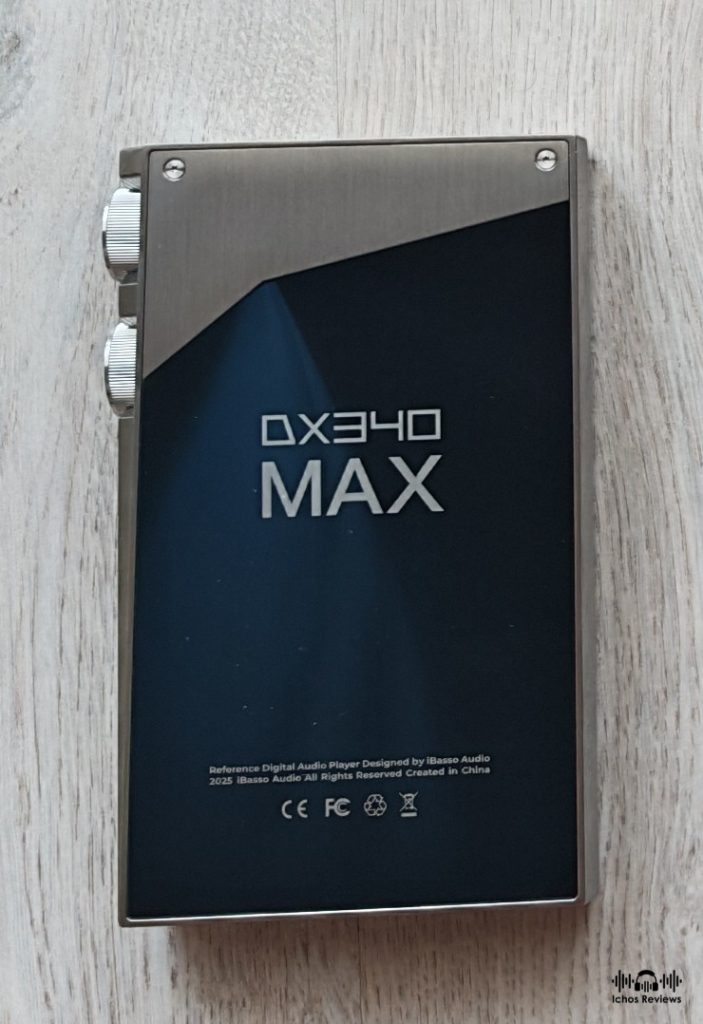
The DX340MAX follows iBasso’s newly introduced modern-minimalist design, with a more aggressive appearance and sharper lines than their previous generation of DAPs. Its outer appearance closely resembles that of the DX340 Ti, with the most notable difference being the two oversized volume control knobs that dominate the right side of the device.
The chassis is crafted from aerospace-grade titanium alloy that is perfectly finished and polished through a time-consuming and expensive machining process. The volume control knobs are among the most luxurious to be found on a portable device. Subjectively speaking, I think that the iBasso DX340MAX easily blows away any other competing flagship DAP when it comes to build quality and design.
According to iBasso Audio, the DX340MAX is considerably more expensive to produce than the DX320MAX, but instead of raising its price, the company decided to absorb the difference and keep the same retail price.
The DX340MAX has a grown size and weight, measuring 150×89.5×27.2mm and weighing a whole 610g, making it one of the largest and heaviest DAPs on the market. So buyers should be aware that it is a desktop-grade device, rather than a usual player that you can carry with you for portable use.
Daily Usage
The DX340MAX is big and heavy to be used one-handed. It doesn’t take too long until you start feeling the extra weight at the palm of your hand, while it is impossible to adjust the volume controllers without using the other hand. Thus, it is best used in a stable surface near your listening position or inside a backpack if someone wishes to take it out for a walk.
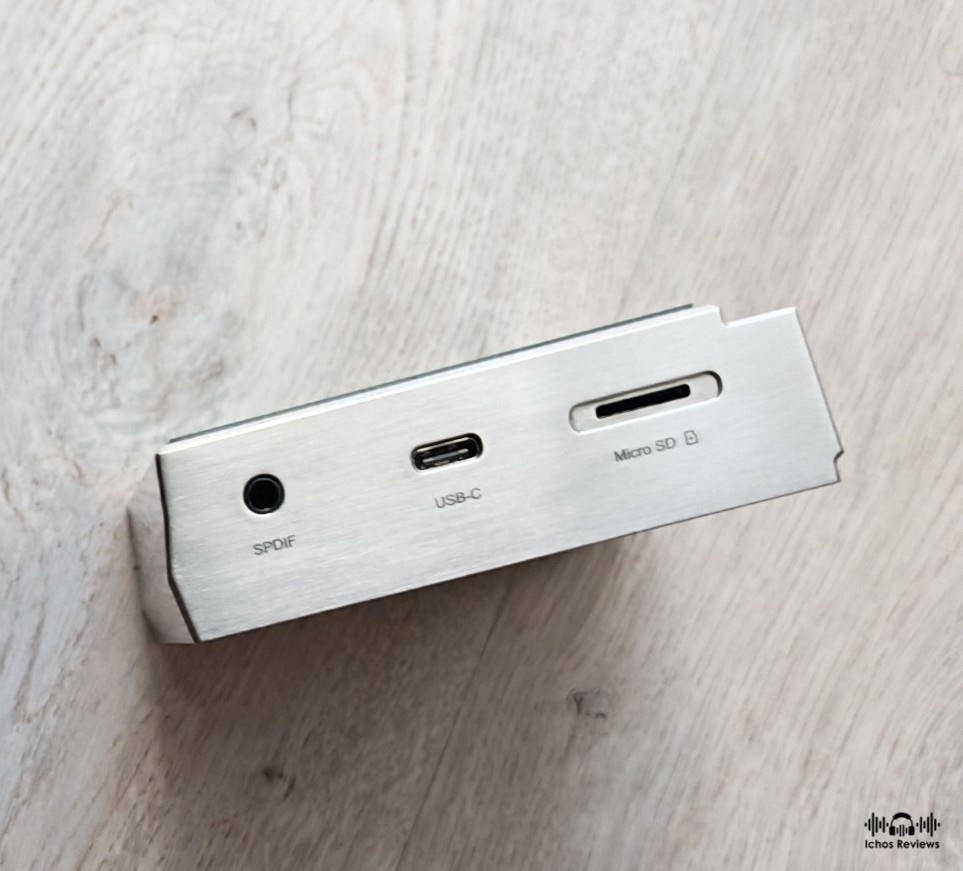
All the analog inputs are located at the upper top of the device, while the USB input, the SD card slot and the 3.5mm coaxial output are to be found at the bottom. The three playback buttons are set beneath the volume control knobs at the middle of the right side of the DAP.
This is not a very convenient place though and you will often find yourself accidentally pressing the buttons. You can disable them through the menu, but then you can’t control music playback. I think that the upper left corner would be a more convenient location and would allow for a better user experience.
Software Performance and UI
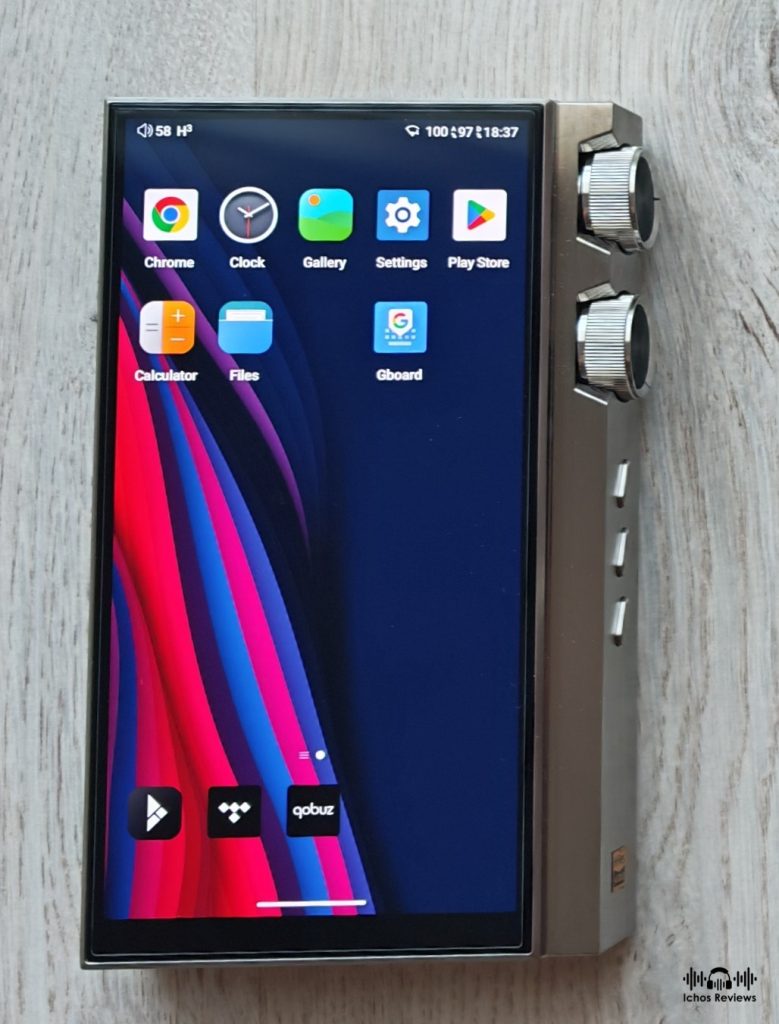
iBasso decided to use the same Qualcomm Snapdragon 665 SoC and 8GB/256GB RAM and ROM configuration as they do in the DX340. The device runs the Android 13 OS with global SRC bypass for bit-perfect playback.
The Linux-based, in-house developed Mango OS is another way to operate the iBasso DX340MAX when the best possible audio quality is required. Mango OS features extensive optimizations in music decoding and the underlying algorithms, reducing CPU load and focusing solely on audio playback. It is a pure audio system without WiFi or Bluetooth interference, offering low EMI and providing a purer listening experience. It is suitable only for local only playback or USB DAC operation.
The edge-to-edge fitted 6” AMOLED display is vibrant with crisp colors and easy to read, while it also supports the double-tap to wake function. The official Google Play Store comes preinstalled, so you can download all your favorite streaming services and other applications.
The system needs about 45 seconds to boot up. It is fast and responsive when using streaming and playback applications, and it also handles web browsing while listening to music, allowing for a seamless user experience.
Some nerdy readers might find the SoC and the overall configuration a little outdated, but what matters most is that the system is optimized for audio playback, and it gets the job done more than well enough. I don’t know about you, but I don’t use my DAPs for anything other than listening to music, so what I can say is that I am very satisfied with the software performance of the DX340MAX.
Output Power and Noise
The headphone amplifier has a rated output power of 1300mW*2/32Ω (6.45Vrms) from the balanced output and 330mW*2/32Ω from the single-ended, in battery mode. These numbers rise to 2250mW*2/32Ω (8.48Vrms) and 570mW*2/32Ω respectively in 12V DC mode.
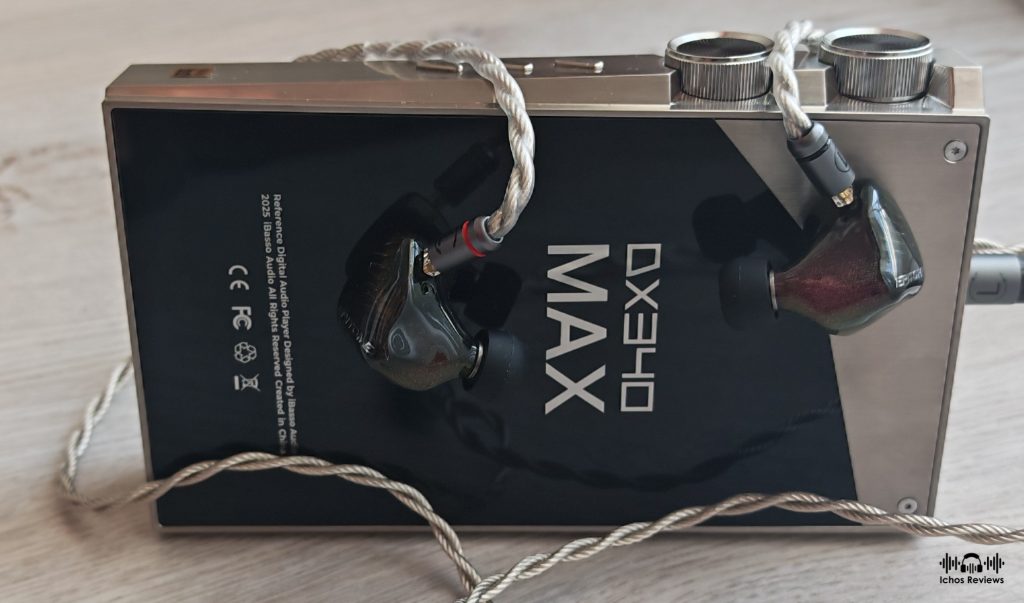
Plenty of power in both cases, and especially in DC mode where the DX340MAX is powerful enough to drive even inefficient headphones such as the Hifiman Susvara. Background noise is practically inaudible even with very sensitive earphones like the iBasso Epitome, that I have used during the listening evaluation.
Mixing and matching with various loads is very easy thanks to the dual volume control system, the three amplifier gain levels (low, mid, high) and the two additional DAC gain levels (low, high). The amplifier needs about half an hour to warm-up and perform at its best.
About the Burning Process
The circuit of the iBasso DX340MAX is equipped with a lot of full-size capacitors and other audiophile components, so this is why the manufacturer recommends letting it burn in for at least 200 hours, using the supplied cable, before engaging in critical listening sessions.
Listening Evaluation
When buying a high-end DAP, most people usually plan to use it with headphones or earphones and tend to overlook how well it might perform as a standalone DAC through its balanced line output.
There are a few instances where the line output might not be too special, but in the case of the DX340MAX, we are talking about a level of sonic performance that easily matches, or even outperforms, some of the best desktop DACs in the same price range. This is why I decided to split the listening evaluation into two sections: pure DAC output and the headphone amplifier.
The Balanced Line Output
Headphone systems are very good for assessing the sonic performance of a DAC, but competent two-channel speaker systems are even better because they provide a superior sense of parameters such as space, dimensionality, behavior in the time domain and integration within the listening room.
The line output of the iBasso DX340MAX is clean and derived directly from the 1-bit PWM DAC, without any further amplification. It was tested with the Lab12 integre4 MK2 (Toroid version) vacuum tube amplifier and the Kinki EX-M1 integrated amplifier, driving the Audio Physic Spark speakers in a dedicated, acoustically treated room.
The iBasso DX340MAX offers an impressive level of audio performance with class-leading transparency and fidelity, reference neutrality and outstanding tonal precision. At the same time, the sonic character is exceptionally natural and realistic with a thoroughly engaging and enveloping musical character.
It takes the already excellent sounding direct line output of the DX340 (as tested through the AMP17 or AMP18) as its starting point and elevates it to the next level. There is more clarity, a blacker background, superior technical performance and resolution, as well as better definition and transparency. It also delivers more realistic timbre, zero digital artificiality and far more refined textures.
iBasso’s 1-bit discrete DAC ideally combines reference fidelity with a rich enough harmonic structure and deep musical expression. The DX340MAX might not have the warmer timbre of R2R DACs or offer the same harmonic saturation as vacuum tubes (like the resident Lab12 dac1 reference does), but it is not that lacking in these parameters while also offering class-leading neutrality and precision.
More impressions…
Note weight and textural gravity are increased in comparison to the DX340, while the bass is weightier and more visceral, with stronger physical impact. The midrange sounds slightly more articulate and melodic, while the treble is more refined and less edgy by comparison.
The DX340MAX’s 1-bit DAC ideally merges the technical superiority of the best D/S DAC chips with the more musical and natural sonic characteristics of R2R or multibit DACs. It manages to sound engaging without adding to or subtracting from the input signal or imposing a sonic character of its own.
At this point, however, it should be noted that the DX340MAX is not exactly a smooth or easy-sounding DAC. It doesn’t have the lushest or most elastic textures, the presentation might not be aggressive, but it is not relaxed either, and it is totally unforgiving of lower-quality recordings.
This reference kind of sonic character, on the other hand, allows it to match a wide range of audio systems and lets the amplifier or the speakers do the sound shaping. As an example, I got two different but equally enjoyable sonic presentations with the vacuum tube and solid-state amplifiers, while the DX340MAX remained the common sonic denominator.
The DX340MAX can easily do justice to a high-end 2-channel speaker system by helping it sound big and holographic while also helping the speakers vanish from the room. The presentation is lifelike, the performers are arranged with tight precision in both depth and width, while the system easily adapts and follows the size of the ensemble. The DAC is a skilful communicator of both time and space, and there is a constant sense of ultimate realism, especially when listening to live recordings.
The Headphone Amplifier
The DX340MAX is essentially like having two high-quality audio devices under the same hood. First, there is the reference DAC as described above and then there is the discrete and specially designed headphone amplifier. It might not be on the exact same level as a high-end standalone amplifier, but it gets remarkably close without adding the extra bulk.
While it might be difficult for the amp stage of the DX340MAX to compete with some of my favorite headphone amplifiers, such as the Flux Lab Mentor or the Violectric V222, it is so unbelievably good that most of the time I didn’t feel like going through the whole procedure of listening with either of them.
I also compared it with the Cayin C9 portable headphone amplifier and didn’t find the latter to be superior. They simply sound different, especially if you prefer tubes, but I could happily live with the DX340MAX alone, particularly considering the simplicity of using a single device.
The amplifier takes the reference-grade sound of the DAC and complements it with a touch of extra warmth and a deeper sense of expression without affecting its class-leading transparency and fidelity.
Enjoying your headphones…
Plug in your favorite headphones to enjoy powerful, weighty and extended, yet technical and precise bass that grabs your attention without overpowering the higher frequencies. The amp eases up the aggressive character of the treble a little, helping it relax without losing its speed. It adds more weight to the textures and helps the notes decay more smoothly. The midrange remains tonally balanced and neutral, but it sounds slightly more engaging and harmoniously rich through the amp.
The amplifier of the DX340MAX is a big evolution over the AMP18 and is carefully tuned to match the sonic character of the DAC, offering a holistic and extremely realistic listening experience through headphones or earphones. People who already love and enjoy the DX340/AMP18 combo will be enthralled when they listen to the DX340MAX. It is really admirable what the engineers have managed to do by taking advantage of the extra board space inside the DX340MAX.
If your headphones or earphones can handle the slightly increased noise floor of the external DC mode, it is suggested to always use it because it sounds more dynamic and controlled than the battery mode. It offers deeper and more impactful bass and helps the soundstage expand both in width and depth. The DC mode is not only about extra power but it considerably elevates the sonic performance of the headphone amplifier.
Comparison with the FiiO M27
The FiiO M27 costs $1800, so it is considerably less expensive than the iBasso DX340MAX and the comparison might be rather unfair but this is the only other flagship DAP that I have handy for comparison.
Physical Differences
The M27 uses two ES9039SPRO DAC chips for the digital audio decoding and then follows a headphone amplifier that can deliver up to 2250mW*2/32Ω (8.5Vrms) in battery mode and 5000mW*2/32Ω (12.7Vrms) in DC desktop mode, so it is more powerful than the DX340MAX.
Measuring 157.4×85.1x28mm and weighing 630g in the titanium alloy version, it is also a brick just like the DX340MAX. It has more inputs and outputs and supports a 31-band EQ with global effect but it lacks the discrete analog volume control of the DX340MAX.
Aside from the difference in output power, the M27 has the advantage of charging with a single charger, while the desktop mode is activated with a simple 5V fast charger. However, in order to be fair, it should be noted that its power supply is considerably simpler with just a single battery for both the analog and digital sections, when the DX340MAX has the patented dual power supply with four batteries split into two battery packs.
Sonic Differences
The sonic character of the M27 is the epitome of neutrality and precision, while FiiO’s engineers have succeeded this time to avoid the overly clinical and sterile presentation of the M17, and have kept digital artificiality under control.
The line output of the DX340MAX matches or even outperforms the M27 in transparency and fidelity, while It also manages to sound considerably more natural and realistic. The overall presentation comes across as more sophisticated and mature, the music sounds more realistic and lifelike through the DX340MAX.
Then there is the headphone amplifier of the DX340MAX, which is on a whole different level than that of the M27. The M27’s amp stage is generally speaking, achromatic and completely neutral, some could even call it clinical and sterile. The amplifier of DX340MAX on the other hand has a stronger personality, it highlights the harmonic structure of the music and makes it sound convincingly realistic and lifelike without compromises in technical fidelity and transparency.
The FiiO M27 is an excellent sounding and the most affordable flagship DAP on the market, but in order to be fair, it would be more appropriate to compare it with the iBasso DX340 with its stock AMP card, rather than the DX340MAX, which easily outperforms in sound quality and timbre realism.
In the End
After a review that long, I thought that it would be better to keep the conclusion as short as possible:
The DX340MAX stands out as the culmination of iBasso’s engineering and tuning expertise. It is a reference-grade DAP with class-leading sonic performance that can confidently serve as the master digital source in any high-end audio system while its headphone amplifier will make flagship headphones and earphones sing like never before.
Those who can afford it should seriously consider adding it to their collection, and they should hurry too, because 688 units is not that many and won’t last forever.
Copyright – 2026.
Authored by Petros Laskis for Ichos Reviews. All content is original and copyrighted. Republishing full reviews or portions without written permission is prohibited. Excerpts up to 100 words are allowed with a direct link.
+ Reference sonic performance
+ Statement tuning
+ Class-leading transparency and realism
+ Powerful headphone amplifier with ultra-low noise
+ Can serve equally well as a high-end DAC and DAP
+ Harmonic filters provide meaningful fine-tuning
+ Independent analog and digital volume controls
+ Discrete stepped attenuator with excellent channel matching
+ Innovative four-battery dual power supply
+ Desktop battery bypass mode
+ User-replaceable batteries
+ Long battery life
+ Stable and responsive dual Android 13 and Mango OS
+ Excellent build quality and impressive appearance
+ Luxurious accessories

- Large and heavy - not truly portable
- The analog battery requires a separate 12V charger
- No system-wide EQ (Mango OS EQ only)
- Very revealing and unforgiving
- Limited production














Leave a comment